




States Agree to Remove 'Friction' From I-10 Corridor
Transportation leaders from California, Texas, Arizona and New Mexico have created a coalition supporting innovation along the Interstate 10 corridor to improve the safety and efficiency of the vital transportation route.

Photo: Arizona DOT
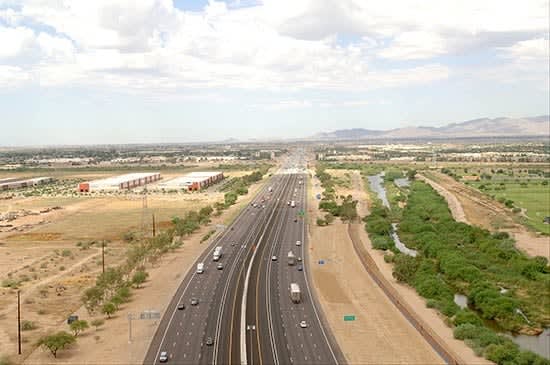
Photo: Arizona DOT
Transportation leaders from California, Texas, Arizona and New Mexico have created a coalition supporting innovation along the Interstate 10 corridor to improve the safety and efficiency of the vital transportation route.
An agreement establishing the voluntary I-10 Corridor Coalition, proposed by Arizona Department of Transportation director John Halikowski, was signed June 2. The initiative is modeled after a coalition involving 15 states that govern Interstate 95 that runs the length of the East Coast.
“The efficient flow of commerce in Arizona drives our state’s economic vitality,” said Halikowski. “This agreement with our transportation partners in California, New Mexico and Texas will work to build a reliable, friction-free I-10 corridor to support Arizona’s businesses and export industries.”
The partnership is designed to remove what transportation officials refer to as “friction” from the corridor, such as the variety of commercial vehicle permitting and inspection practices in each state along I-10. These different policies and regulations restrict the movement of goods, creating transportation inefficiencies.
The coalition will employ the transportation knowledge of each state collectively to enable resource sharing, joint testing and economies of scale. It will apply best practices to improve safety and efficiency along the corridor, improve freight movement, expand and coordinate the use of technology along the corridor and promote cooperative planning.
Interstate 10 is a major trucking route from the Ports of Long Beach and Los Angeles in Southern California to the rest of the U.S., transporting goods coming to the country from Asian markets all the way through Central Texas.
“We want to see the day when a truck or a non-commercial vehicle can travel the 1,700 miles between Los Angeles ports and Houston ports– safely, efficiently and without delay,” said Halikowski. “Someday we want the I-10 Corridor to be filled with truck platoons and connected vehicles, weigh-in-motion sensors and automated truck parking lots.”
More Fleet Management

Why Private Fleets Are Taking More Freight
Private fleets are putting their own trucks on demanding customers and high-cost lanes as companies seek greater control over service, costs, and capacity.
Read More →
Color Match Smarter: Tools That Restore & Perform
For fleet managers and collision repair professionals keeping heavy-duty trucks on the road, getting the color right the first time isn't just about appearance — it's about efficiency, turnaround time, and bottom-line results. Discover how today's digital color tools are transforming the repair process from guesswork to precision.
Read More →
FMCSA Pauses Biennial-Update Enforcement Amid Motus Transition
Carriers whose updates were due on or after June 1 have more time, while FMCSA works to stabilize its new registration system and warns of phishing sites impersonating its new carrier registration system, Motus.
Read More →


2026 Blueprint for Countering Smarter Supply Chain Theft
Cargo theft is no longer just the cost of doing business. It's a multi-billion-dollar criminal enterprise exploiting vulnerabilities across your fleet, drivers, and supply chain.
Read More →
How Telematics Improves Visibility, Control, and Performance in Refrigerated Fleets
Explore how telematics help refrigerated fleets improve visibility, uptime, efficiency, compliance, and cargo protection across connected cold chain operations.
Read More →
What the U.S.-Canada Trade War Means for Trucking
Escalating U.S.-Canada tariffs could disrupt cross-border freight, reduce truck volumes, raise costs, and create new uncertainty for carriers on both sides of the border.
Read More →
What Are Trucking’s Top Concerns for 2026?
The American Transportation Research Institute wants to know what's worrying trucking fleet managers, drivers, and other stakeholders in its annual Industry Issues survey.
Read More →
American Trucking Associations Looks for a New Leader
ATA President and CEO Chris Spear abruptly left his job at the association on August 21, at a pivotal time for the trucking industry.
Read More →
Public Wi-Fi Cybersecurity Risks: How Truck Drivers and Fleets Can Protect Their Data
Public Wi-Fi can expose truck drivers and fleets to credential theft, malware, and other cyber threats. Here’s how to reduce the risk on the road.
Read More →
For Nicky Cupp, Fleet Innovation Starts With Frustration
HDT Truck Fleet Innovator Nicky Cupp turns everyday pain points at Fraley & Schilling into opportunities for better technology and smarter processes.
Read More →