




Related: Daimler Unveils Highway Pilot Connect Truck Platooning
European Platooning Challenge Delivers 'Promising' Results
Volvo, Daimler Trucks, DAF Trucks, Iveco, MAN Truck & Bus and Scania all participated in the challenge, driving platooned convoys thousands of miles across multiple borders in countries that included Sweden, Germany and Belgium.
by Staff
April 7, 2016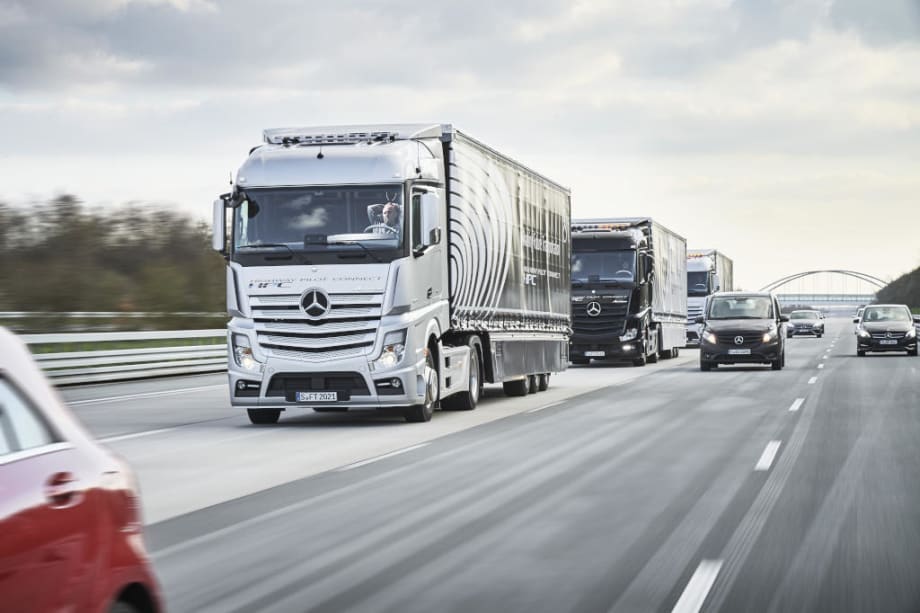
Mercedes-Benz Actros trucks driving in a connected convoy (truck platoon) using the Highway Pilot Connect system. Photo: Daimler
2 min to read

Mercedes-Benz Actros trucks driving in a connected convoy (truck platoon) using the Highway Pilot Connect system.Photo: Daimler
The European Truck Platooning Challenge came to a close on April 6, with the last of six participating truck manufacturers reaching the final destination of Rotterdam, Netherlands.
Six European truck makers participated in the project, which was initiated by the Dutch government to promote platooning by running truck convoys using the technology on public roads.
Volvo, Daimler Trucks, DAF Trucks, Iveco, MAN Truck & Bus and Scania all participated in the challenge, driving platooned convoys thousands of miles across multiple borders in countries that included Sweden, Germany and Belgium.
“The results of this first ever major tryout in Europe are promising,” said Melanie Schultz van Haegen, The Netherlands' Minister of Infrastructure and the Environment. “It will certainly help my colleagues and I discuss the adjustments needed to make self-driving transport a reality.”
In addition to showcasing a working version of platooning technology, the project also highlighted the need for synchronized rules between European countries so that manufacturers can create a technology that meets regulations across the European Union.
“Platooning also reinforces the leadership position of our automotive industry in terms of new technology; this also boosts Europe’s competitive position in the global marketplace,” said Erik Jonnaert, Secretary-General of ACEA, the organization representing the six manufacturers involved. “Cooperation within the EU is crucial in preventing the development of a patchwork of local rules and procedures, strangling progress.”
During the event, platoons were monitored and filmed from the air to study how other traffic reacted to the three-truck long columns on the road. A joint study is underway with the Royal Dutch Touring Club (ANWB) to see how road users can be actively involved in the introduction of truck platooning.
Truck platooning involves a group of three trucks connected wirelessly driving in a column to reduce the total amount of fuel consumed by the vehicles.
The technology has also shown promise in reducing carbon emissions and improving safety by reducing human error. By allowing the vehicles to communicate and operate semi-autonomously, the trucks can drive with smaller gaps thanks to the synchronization of braking.
“As the test shows, the technology has come a long way already,” said Schultz van Haegen. “What it also makes clear is that we Europeans need to better harmonize rules of the road and rules for drivers. This will open the door for upscaled, cross-border truck platooning.”
More Fleet Management

Sponsored•September 16, 2026
Color Match Smarter: Tools That Restore & Perform
For fleet managers and collision repair professionals keeping heavy-duty trucks on the road, getting the color right the first time isn't just about appearance — it's about efficiency, turnaround time, and bottom-line results. Discover how today's digital color tools are transforming the repair process from guesswork to precision.
Read More →
FMCSA Pauses Biennial-Update Enforcement Amid Motus Transition
Carriers whose updates were due on or after June 1 have more time, while FMCSA works to stabilize its new registration system and warns of phishing sites impersonating its new carrier registration system, Motus.
Read More →
Sponsored•September 14, 2026
2026 Blueprint for Countering Smarter Supply Chain Theft
Cargo theft is no longer just the cost of doing business. It's a multi-billion-dollar criminal enterprise exploiting vulnerabilities across your fleet, drivers, and supply chain.
Read More →


Sponsored•September 1, 2026
How Telematics Improves Visibility, Control, and Performance in Refrigerated Fleets
Explore how telematics help refrigerated fleets improve visibility, uptime, efficiency, compliance, and cargo protection across connected cold chain operations.
Read More →
What the U.S.-Canada Trade War Means for Trucking
Escalating U.S.-Canada tariffs could disrupt cross-border freight, reduce truck volumes, raise costs, and create new uncertainty for carriers on both sides of the border.
Read More →
What Are Trucking’s Top Concerns for 2026?
The American Transportation Research Institute wants to know what's worrying trucking fleet managers, drivers, and other stakeholders in its annual Industry Issues survey.
Read More →
American Trucking Associations Looks for a New Leader
ATA President and CEO Chris Spear abruptly left his job at the association on August 21, at a pivotal time for the trucking industry.
Read More →
Public Wi-Fi Cybersecurity Risks: How Truck Drivers and Fleets Can Protect Their Data
Public Wi-Fi can expose truck drivers and fleets to credential theft, malware, and other cyber threats. Here’s how to reduce the risk on the road.
Read More →
For Nicky Cupp, Fleet Innovation Starts With Frustration
HDT Truck Fleet Innovator Nicky Cupp turns everyday pain points at Fraley & Schilling into opportunities for better technology and smarter processes.
Read More →
Adam Buttgenbach’s Approach to Electric Trucks: Start With Where They Fit
HDT Truck Fleet Innovator Adam Buttgenbach helped PepsiCo build one of North America’s largest EV fleets by focusing on where electric trucks make operational sense.
Read More →