




ATA Warns Rhode Island on Policing Truck-Toll Dodging
The American Trucking Associations has weighed in on the battle over truck-only tolling in Rhode Island by cautioning the governor against banking on revenues from the proposed tolls that are “premised on truck restrictions that are currently disallowed by federal and/or state law.”

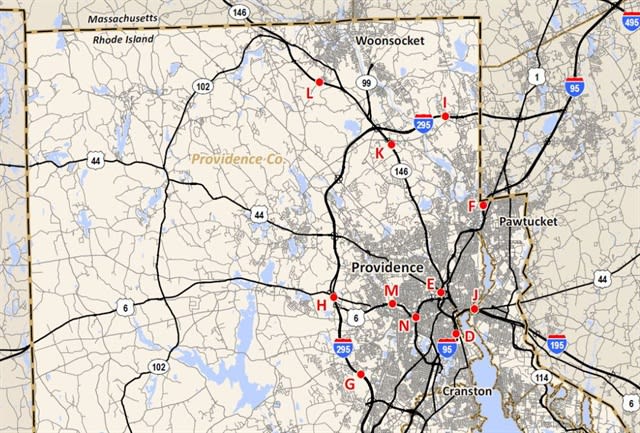
Map shows 11 of 14 proposed locations for truck-only tolls in Rhode Island. Image: RI DOT
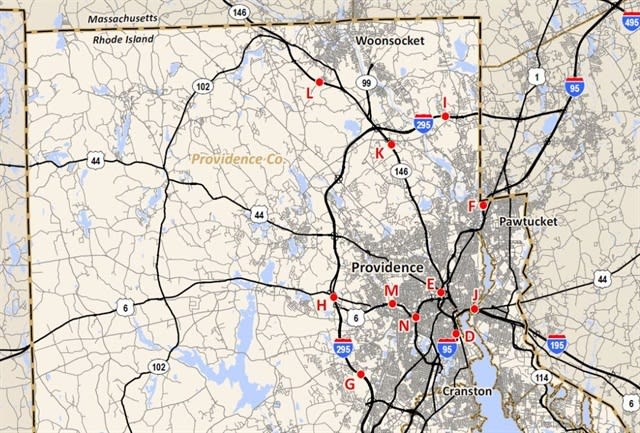
Map shows 11 of 14 proposed locations for truck-only tolls in Rhode Island.Image: RI DOT
The American Trucking Associations has weighed in on the months-long legislative battle over implementing truck-only tolls in Rhode Island by cautioning the governor against banking on revenues from the proposed tolls that are “premised on truck restrictions that are currently disallowed by federal and/or state law.”
In a Jan. 18 letter to Rhode Island Gov. Gina Raimando (D), ATA Vice President and Acting Counsel Richard Pianka said that in a Jan. 5 letter on the preliminary location of proposed toll gantries, “Rhode Island Department of Transportation Director Peter Alviti, Jr. suggested that he has received a commitment from State Police Superintendent O’Donnell to prevent trucks from exiting highways to avoid paying tolls.”
In that letter, Alviti stated that he’d been “assured” that the State Police “will take action once the [toll] gantries are erected to prevent large commercial trucks from exiting the highways to avoid the user fees.”
Pianka went on to caution that “Putting aside the lack of current state legal authority afforded to law enforcement agencies to conduct such action, even if state law is amended, federal law imposes superseding limitations on states’ authority to restrict large trucks.
"These limitations may prevent, in part or in whole, Rhode Island’s ability to prevent trucks from exiting highways to avoid paying a toll," he added.
Pianka closed by recommending that Rhode Island “consult with the Federal Highway Administration’s regional office prior to proposing legislation aimed at restricting large trucks, in order to ensure that any contemplated action is consistent with federal law. We also recommend that you inform legislators and members of the public that both state and federal law impose limitations on the state’s authority to prevent trucks from using alternate routes to avoid tolls.”
Copied on Pianka’s letter were Rhode Island’s top legislators, Speaker of the House Nicholas A. Mattiello (D) and Senate President M. Theresa Paiva-Weed (D).
The Rhode Island Trucking Association, an affiliate of ATA, is battling against the truck-toll legislation. Dubbed RhodeWorks, the proposal calls for fixing more than 150 structurally deficient bridges and making repairs to another 500 bridges “to prevent them from becoming deficient.” It would invest an additional $1 billion above current plans in transportation infrastructure.
Part of the funding would be derived from truck tolls, to be used to finance $500 million in repairs and replacements of aging bridges. The tolls are expected to raise between $60 million and $100 million a year.
The toll scheme was proposed in 2015 by Gov. Gina Raimondo (D). On Jun. 23, just before adjourning for the year, the Democratic-controlled Senate passed the bill by a 33-4 vote along party lines.
While the Democrats (63-11-1) also hold the majority (63-11-1) in the House, it appears the tolling measure won’t pass that chamber quickly or easily during the current legislative session.
“It is fair to ask how a Rhode Island trooper is expected to know when a truck is purposely diverting a toll and when they are getting off the highway to make a delivery– or quite frankly just going home,” said RITA president Chris Maxwell on the legal issue raised by ATA, per a Providence Journal report. “We intend to fight any legislative initiative that will create a police state for the trucking industry.”
Related: For Whom the Bridge Is Tolled
More Fleet Management

Color Match Smarter: Tools That Restore & Perform
For fleet managers and collision repair professionals keeping heavy-duty trucks on the road, getting the color right the first time isn't just about appearance — it's about efficiency, turnaround time, and bottom-line results. Discover how today's digital color tools are transforming the repair process from guesswork to precision.
Read More →
FMCSA Pauses Biennial-Update Enforcement Amid Motus Transition
Carriers whose updates were due on or after June 1 have more time, while FMCSA works to stabilize its new registration system and warns of phishing sites impersonating its new carrier registration system, Motus.
Read More →
2026 Blueprint for Countering Smarter Supply Chain Theft
Cargo theft is no longer just the cost of doing business. It's a multi-billion-dollar criminal enterprise exploiting vulnerabilities across your fleet, drivers, and supply chain.
Read More →


How Telematics Improves Visibility, Control, and Performance in Refrigerated Fleets
Explore how telematics help refrigerated fleets improve visibility, uptime, efficiency, compliance, and cargo protection across connected cold chain operations.
Read More →
What the U.S.-Canada Trade War Means for Trucking
Escalating U.S.-Canada tariffs could disrupt cross-border freight, reduce truck volumes, raise costs, and create new uncertainty for carriers on both sides of the border.
Read More →
What Are Trucking’s Top Concerns for 2026?
The American Transportation Research Institute wants to know what's worrying trucking fleet managers, drivers, and other stakeholders in its annual Industry Issues survey.
Read More →
American Trucking Associations Looks for a New Leader
ATA President and CEO Chris Spear abruptly left his job at the association on August 21, at a pivotal time for the trucking industry.
Read More →
Public Wi-Fi Cybersecurity Risks: How Truck Drivers and Fleets Can Protect Their Data
Public Wi-Fi can expose truck drivers and fleets to credential theft, malware, and other cyber threats. Here’s how to reduce the risk on the road.
Read More →
For Nicky Cupp, Fleet Innovation Starts With Frustration
HDT Truck Fleet Innovator Nicky Cupp turns everyday pain points at Fraley & Schilling into opportunities for better technology and smarter processes.
Read More →
Adam Buttgenbach’s Approach to Electric Trucks: Start With Where They Fit
HDT Truck Fleet Innovator Adam Buttgenbach helped PepsiCo build one of North America’s largest EV fleets by focusing on where electric trucks make operational sense.
Read More →