




Economic Watch: 3 Reports Show Uneven Freight Movements
Taken separately, new reports on freight movements in the U.S. on freight volume, shipper spending and even the spot market seem to run almost counter to one another. A deeper dive into the analysis shows why activity has slowed but is not widespread.

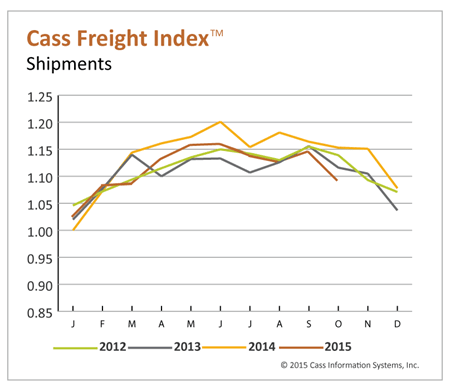
Cass Freight Index of shipments. Credit: Cass
Taken separately, new reports on freight movements in the U.S. on freight volume, shipper spending and even the spot market seem to run almost counter to one another. A deeper dive into the analysis shows why activity has slowed but is not widespread.
Cass Freight Index of shipments.
Cass
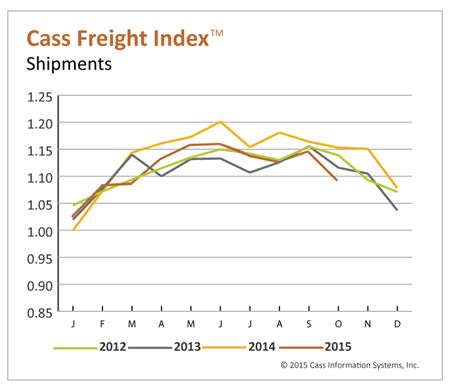
Total spending on shipments and the number of shipments for North American freight fell in October, according to the Cass Freight Index. Its measure of shipments fell 5.3% from a year earlier and posted 4.7% drop from September. This put the index at a level of 1.092, the worst October performance since 2011, and the lowest reading since March.
Also, the Cass measure of freight expenditures fell 8.7% last month from the same time in 2014, while showing a 2.2% drop in October of this year from September. That puts this measure at 2.435, also the lowest October reading since 2011.
The October decline in shipments is much sharper than in recent years and can be directly correlated to falling imports and exports as well as decreased domestic manufacturing levels, according to Rosalyn Wilson, supply chain expert, and senior business analyst with the management services firm Parsons, who provides analysis for the report.
“Burdened by bloated inventories, and under the shadow of a possible interest rate increase by the Federal Reserve, businesses cut back on new orders placed in the last three or four months. This is resulting in lower import volumes, less freight to move and faltering industrial production,” she said.
The drop in freight payments was the third in the last four months.
“While some of this month’s decrease comes with the drop in shipments, spot rates have also impacted October’s results,” Wilson said. “At this point in time there is abundant capacity in the trucking sector, which has depressed spot rates. Trucking companies are reporting that new contracts are yielding only 2% to 3% rate increases going into 2016. Dedicated carriage contracts are faring slightly better for the carriers, with an average of a 3% to 4% percent rise in rates. Carriers are still reporting that they are unwilling to lose a good customer over a few percentage points.”
The drop in spot market freight rates Wilson was referring to can be clearly seen in new figures released by the freight matching service provider DAT Solutions.
The DAT North America Freight Index also showed spot market freight volume declined 9.7% in October.
Line haul rates fell 5.7% for vans, 5.6% for reefers and 5.4% for flatbeds, compared to October 2014. Total rates paid to the carrier declined by 15% year-over-year, partly due to a 48% decline in the fuel surcharge, which comprises a portion of the rate.
When October is compared to the month before, line haul rates on the spot market followed volume trends by equipment type, falling 2.6% for vans, 4.5% for reefers and 1.7% for flatbeds.
The latest figures are a common seasonal pattern, according to DAT. However, the company notes while freight volume fell below same-month levels of the past five years, total volume for the year to-date has exceeded the same period for every year prior to an atypical 2014.
By equipment type, compared to the previous month, van freight availability declined 13%, refrigerated trailers lost 16%, and flatbed volume slipped 4.5% lower.
Compared to the record spot market volume of 2014, freight was down 44% in October. By equipment type, year over year, van demand was down 42%, reefer volume fell 34%, and flatbeds dropped 50%, compared to October 2014.
Finally, a third report that looks a little further back into the overall freight hauling picture in the U.S. shows the recent slowdown in activity isn’t limited to last month.
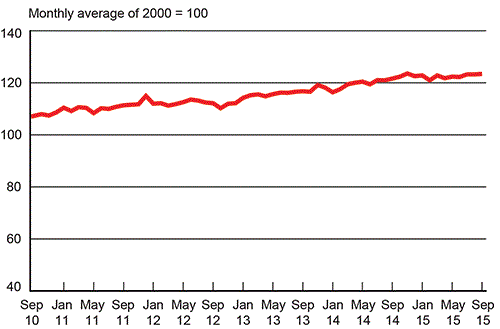
Freight Transportation Services Index, September 2010 - September 2015.
U.S. DOT
The federal government’s Freight Transportation Services Index (TSI), which is based on the amount of freight carried by the for-hire transportation industry, rose 0.2% in September from the revised and now unchanged August level.
Despite the small to zero increases in the index’s most recent two months, the level of freight shipments in September measured by the Freight TSI, 123.4, was 0.1% below the all-time high level of 123.5 in November 2014. And September was 1.5% higher than September 2014.
At first blush, this almost runs counter to what Wilson detailed in her report, but there is more to the overall picture.
As manufacturing levels have declined, along with shipments from this sector of the economy, another area has been increasing – retail spending, a bigger driver of the American economy and truck freight.
According to Wilson, consumer sector goods are, by far, the strongest in the market now.
“In many ways this is the silver lining in the storm clouds, because it means that consumers are still in the game,” she said. “Consumer spending, which accounts for more than two‐thirds of U.S. economic activity, grew 3.2% in the third quarter after expanding at a 3.6% pace in the second quarter.”
More Fleet Management
Why This Trucking Recovery Is Different
Freight demand remains sluggish, but rising costs and tougher enforcement have taken enough capacity out of the market to change the outlook for motor carriers.
Read More →
Platform Science Adds Dispatch and Safety Tools
Four additions to PS Fleet help fleets monitor loads, manage driver coaching, share truck locations and adjust video system settings.
Read More →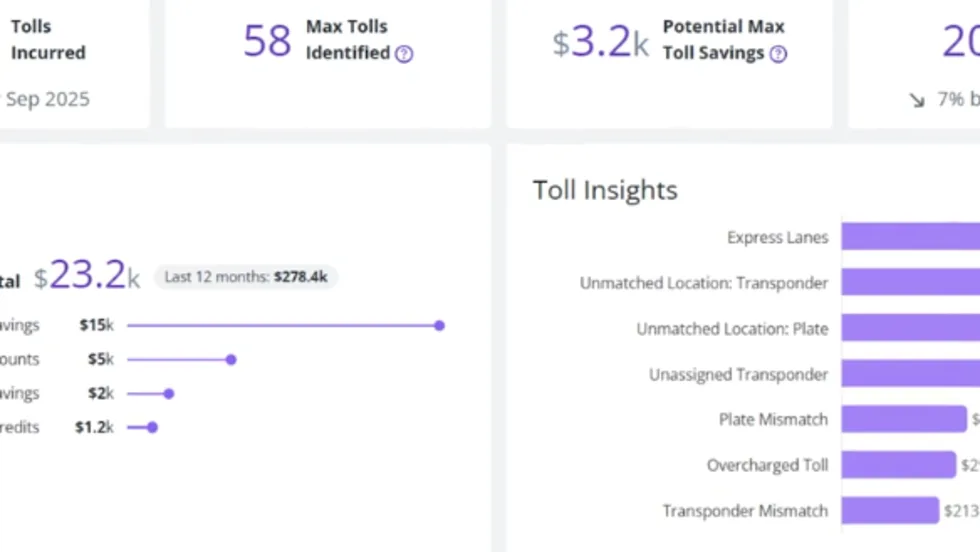
PrePass Intelligence Mines Fleet Bypass, Toll and Safety Data
PrePass Intelligence helps fleets measure bypass savings, flag potential toll overcharges, and spot suspicious transactions by combining data from separate systems.
Read More →
Motive Adds AI Agents for Fleet Operations
New tools automate follow-up on fleet data, from maintenance work orders to driver alerts, with two-way voice conversations planned for later this year.
Read More →
Can You Beat Our Trucking Trivia Challenge?
Test your truck knowledge with 19 trivia questions from Heavy Duty Trucking Exchange. Can you keep up with the fleet pros?
Read More →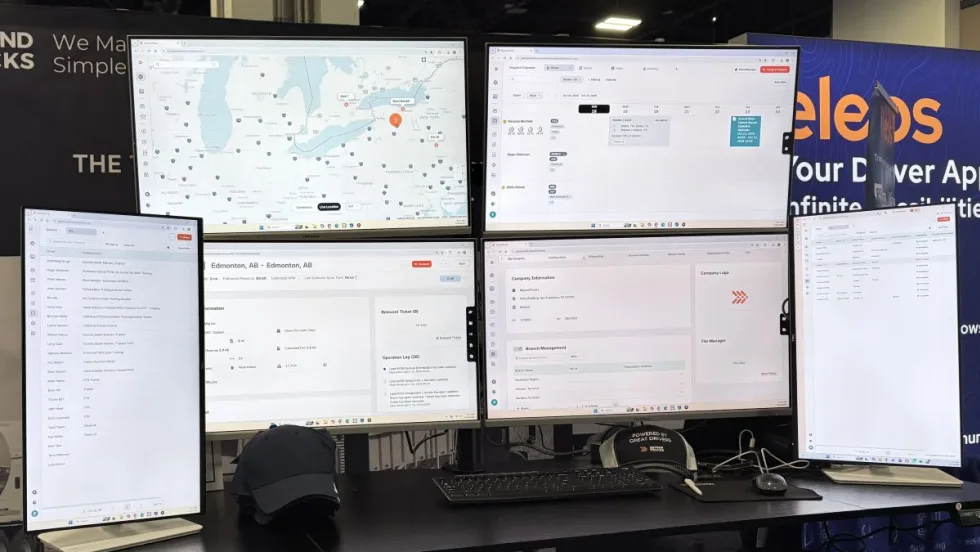
BeyondTrucks Adds Rules Checks to Dispatch
New Compatibility Engine checks driver qualifications, equipment requirements and fleet policies before loads are dispatched.
Read More →
Diesel Prices Hijack Trucking’s Worry List
ATRI’s annual survey finds cautious optimism about freight, but diesel costs, litigation, and insurance continue to squeeze fleets. Drivers have different priorities on several issues.
Read More →
Nomination Deadline Extended for HDT Emerging Leaders
Just a few more days to nominate accomplished trucking fleet professionals under 40 who are making an impact and helping lead the industry forward for the HDT Emerging Leaders award. Deadline extended to October 20!
Read More →
What Will ATA’s New Leader Bring to Trucking's Table?
Incoming President and CEO Mark Colson’s record in Alabama offers clues about his priorities and approach following Chris Spear’s abrupt departure as the head of the American Trucking Associations.
Read More →
Volvo, Waabi Start Commercial Autonomous Operations in Texas
Volvo VNL Autonomous trucks, powered by the Waabi Driver, are hauling freight directly to third-party facilities for a customer in Texas.
Read More →