




Blunt: Regs Could Keep U.S. From Taking Advantage of Opportunity
SAN DIEGO -- The United States has exciting opportunities it can take advantage of, if the government shows a little common sense and doesn't allow over-regulation to stand in the way. That was the message of Sen. Roy Blunt, R-Mo., speaking Sunday at the American Trucking Associations' Management Conference and Exhibition.

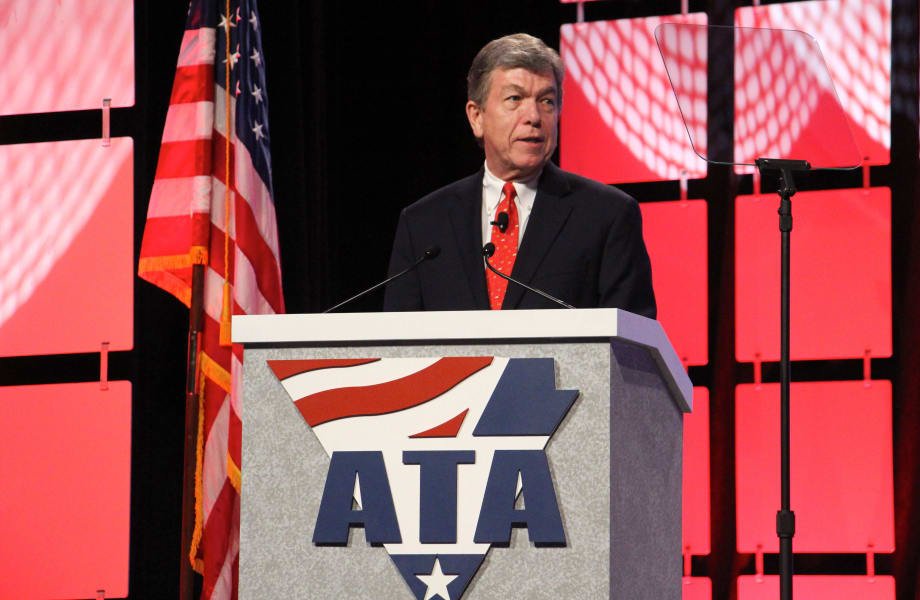
Roy Blunt, R-Mo., talks regulations at ATA MC&E. Photo by Evan Lockridge.
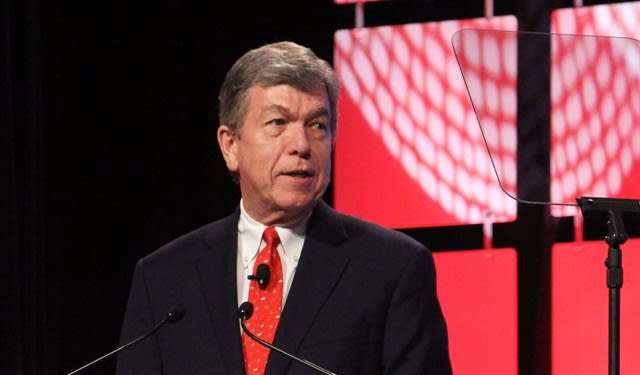
Roy Blunt, R-Mo., talks regulations at ATA MC&E.Photo by Evan Lockridge.
SAN DIEGO -- The United States has exciting opportunities it can take advantage of, if the government shows a little common sense and doesn't allow over-regulation to stand in the way. That was the message of Sen. Roy Blunt, R-Mo., speaking Sunday at the American Trucking Associations' Management Conference and Exhibition.
"Some of the things we should be excited about are the dynamics coming together that can impact our economy in an incredible way," he said, comparing the current time in history to the advancements in technology seen with the railroad and telegraph in the decades before Abraham Lincoln became president.
Today, American energy presents a tremendous opportunity, he said. "If there is a more pure formula than more American energy means more American jobs, I don't know what formula that would be." Twenty years ago, he said, people doubted energy independence was a possibility. Today it's happening.
Another big opportunity, he said, will come from increasing global demand for food. "Somehow in the next 55 years we've got to figure out how to double what we've learned to do in the last 10,000 years. And the U.S. will be a source of growing that food and also the technology and distribution of how that happens."
The Panama Canal expansion means the Mississippi River will become more important than it has been in 100 years for food distribution, he predicted.
Regulations
But threatening all that, Blunt said, are regulations that don't make sense. "The regulators are not only out of control -- they're unaccountable," Blunt said, noting that regulations cost the country $2 trillion a year.
On the energy side, for instance, those opportunities are threatened by regulations limiting the use of American coal and the lack of movement on the Keystone XL pipeline project.
"Fossil fuels for the next 75 years are going to be dominant fuel source in a smart economy," he said, Yes, we need to find ways to make them more efficient and environmentally friendly, but "the idea we're not going to use them makes no sense at all."
In his role on the Senate Appropriations Committee, sometimes they can slow down legislation by refusing to appropriate the funds to enforce new rules. "You can't not fund them forever," he said, "but you can not fund them long enough" to find another solution.
He pointed to the committee's accomplishment in winning a vote for trucking on the new hours of service rules.
In June, the committee voted by 21-9 to suspend the current 34-hour restart provision of the hours of service rule while the Federal Motor Carrier Safety Administration studies the impact of the rule. The amendment, offered by Sen. Susan Collins, R-Maine, was attached to a Senate bill appropriating transportation funds for fiscal year 2015. It would have stripped funding out of the FMCSA appropriations to enforce the restart rule that took effect in 2013 as part of the new hours of service rules.
The provision did not make it into the House version as had been expected, probably because of the public attention to the issue following a fatal crash that seriously injured comedian Tracy Morgan.
Nevertheless, Blunt said, it was an example of how government can work in the industry's favor.
"If common sense prevails there is no reason a country as smart as we are, as well positioned as we are, as flexible as we can be, can't dominate this century in economic ways and thought ways the way it did the last. That's something we shouldn't let regulators get in the way of."
More Fleet Management

How Telematics Improves Visibility, Control, and Performance in Refrigerated Fleets
Explore how telematics help refrigerated fleets improve visibility, uptime, efficiency, compliance, and cargo protection across connected cold chain operations.
Read More →
What the U.S.-Canada Trade War Means for Trucking
Escalating U.S.-Canada tariffs could disrupt cross-border freight, reduce truck volumes, raise costs, and create new uncertainty for carriers on both sides of the border.
Read More →
What Are Trucking’s Top Concerns for 2026?
The American Transportation Research Institute wants to know what's worrying trucking fleet managers, drivers, and other stakeholders in its annual Industry Issues survey.
Read More →

American Trucking Associations Looks for a New Leader
ATA President and CEO Chris Spear abruptly left his job at the association on August 21, at a pivotal time for the trucking industry.
Read More →
Public Wi-Fi Cybersecurity Risks: How Truck Drivers and Fleets Can Protect Their Data
Public Wi-Fi can expose truck drivers and fleets to credential theft, malware, and other cyber threats. Here’s how to reduce the risk on the road.
Read More →
For Nicky Cupp, Fleet Innovation Starts With Frustration
HDT Truck Fleet Innovator Nicky Cupp turns everyday pain points at Fraley & Schilling into opportunities for better technology and smarter processes.
Read More →
Adam Buttgenbach’s Approach to Electric Trucks: Start With Where They Fit
HDT Truck Fleet Innovator Adam Buttgenbach helped PepsiCo build one of North America’s largest EV fleets by focusing on where electric trucks make operational sense.
Read More →
Deen Albert: Let Automation Do the Math, People Make the Decisions
HDT Truck Fleet Innovator Deen Albert makes sure people are still at the heart of operations at Grand Island Express, even while adopting artificial intelligence tools. AI-assisted dispatch helped boost revenue 25% with the same number of trucks.
Read More →
Trimble’s New AI Agent Takes Aim at Fleet Back-Office Busywork
Arc Agent works across Trimble TMS products to automate repetitive tasks such as freight orders, maintenance, invoices, fuel costs and more.
Read More →
How HDT’s 2026 Truck Fleet Innovators Are Rethinking Fleet Operations
Meet five trucking leaders who are challenging assumptions, solving operational problems, and putting innovative ideas to work.
Read More →