




Maine Speed Limits Moving Higher, Minnesota Studying Higher Limits
Speed limits along some Interstate routes in Maine as well as one non-Interstate route are increasing, some immediately. The move by the state transportation department follows a study of crash numbers and speeds it claims most people are already driving.
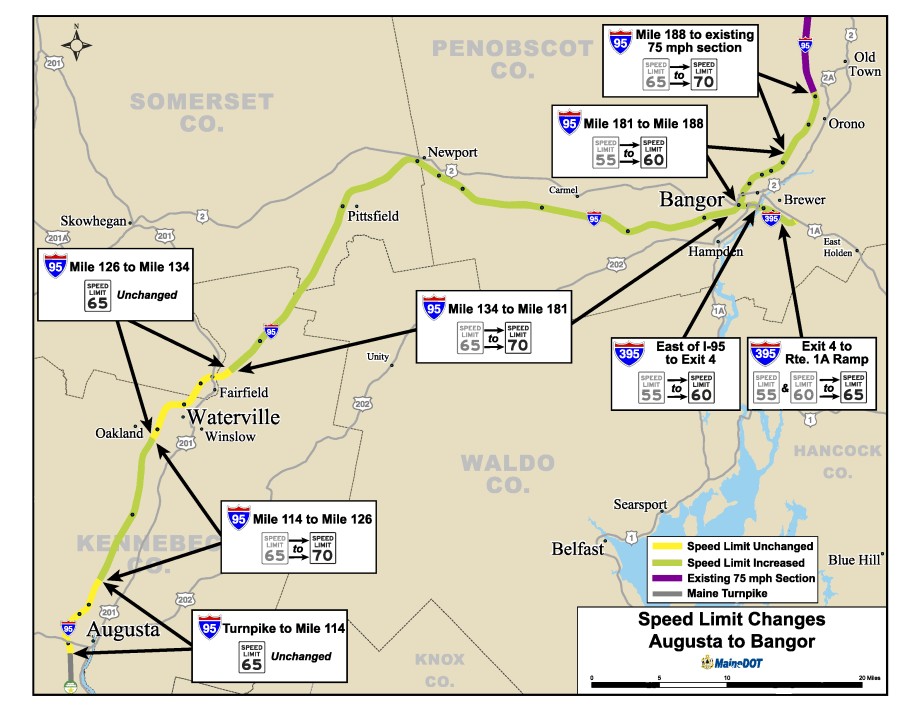
Click to enlarge. Credit: Maine DOT.
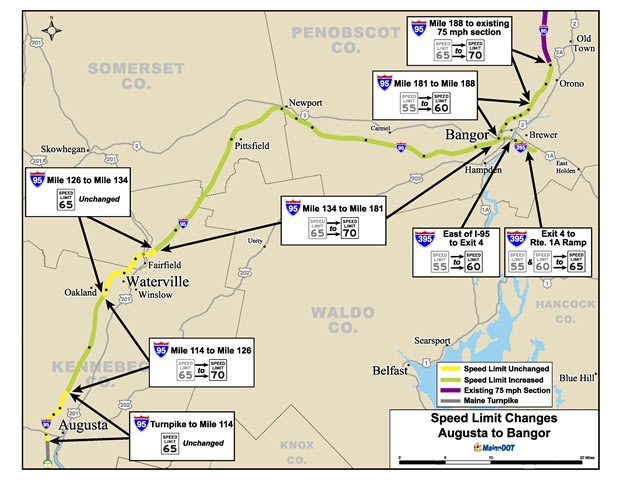
Click to enlarge.
Maine DOT.
Speed limits along some Interstate routes in Maine as well as one non-Interstate route are increasing, some immediately. The move by the state transportation department follows a study of crash numbers and speeds it claims most people are already driving.
Among the routes getting the higher limits are parts of Interstates 95, 295 and 395, along with Route 1, with hikes of five mph. The highest speed limit of 70 mph will be along parts of I-95 and I-295.
Legislation signed into law last year made the increases possible.
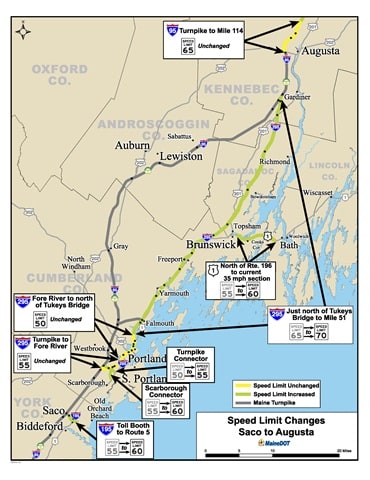
Click to enlarge.
Maine DOT.
In announcing the increases, Maine’s DOT said it used radar data from the 64 variable speed limit signs on the interstates to determine average and 85th percentile speeds. it showed that most vehicular traffic was traveling in excess of 70 mph for a majority of the day, with average speeds three to four mph lower at night.
According to the Maine DOT, "studies show that the 85th percentile speed is the safest to operate a motor vehicle, an unrealistically low speed limit creates safety and enforcement problems, and speed does not necessarily cause crashes; speed differential does."
The moves comes as the Maine Turnpike Authority is reportedly set to increase the speed limit from 65 mph to 70 mph for much of the route sometime this summer.
More details are available from the Bangor Daily News or the Portland Press Herald.
Meantime, new legislation signed into law in Minnesota, could pave the way for higher speed limits along the state’s two-lane highways that currently have a 55 mph speed limit.
State traffic engineers have been tasked with reviewing more than 6,700 miles of such roads to see if speeds along them can be “safety and reasonably” increased.
Nearly 10 years ago officials bumped the speed limit from 55 mph to 60 mph along nearly 800 miles of two lane roads in Minnesota, with another 750 miles moving higher last year.
Read more about if from the Star Tribune.
More Fleet Management

How Telematics Improves Visibility, Control, and Performance in Refrigerated Fleets
Explore how telematics help refrigerated fleets improve visibility, uptime, efficiency, compliance, and cargo protection across connected cold chain operations.
Read More →
What the U.S.-Canada Trade War Means for Trucking
Escalating U.S.-Canada tariffs could disrupt cross-border freight, reduce truck volumes, raise costs, and create new uncertainty for carriers on both sides of the border.
Read More →
What Are Trucking’s Top Concerns for 2026?
The American Transportation Research Institute wants to know what's worrying trucking fleet managers, drivers, and other stakeholders in its annual Industry Issues survey.
Read More →

American Trucking Associations Looks for a New Leader
ATA President and CEO Chris Spear abruptly left his job at the association on August 21, at a pivotal time for the trucking industry.
Read More →
Public Wi-Fi Cybersecurity Risks: How Truck Drivers and Fleets Can Protect Their Data
Public Wi-Fi can expose truck drivers and fleets to credential theft, malware, and other cyber threats. Here’s how to reduce the risk on the road.
Read More →
For Nicky Cupp, Fleet Innovation Starts With Frustration
HDT Truck Fleet Innovator Nicky Cupp turns everyday pain points at Fraley & Schilling into opportunities for better technology and smarter processes.
Read More →
Adam Buttgenbach’s Approach to Electric Trucks: Start With Where They Fit
HDT Truck Fleet Innovator Adam Buttgenbach helped PepsiCo build one of North America’s largest EV fleets by focusing on where electric trucks make operational sense.
Read More →
Deen Albert: Let Automation Do the Math, People Make the Decisions
HDT Truck Fleet Innovator Deen Albert makes sure people are still at the heart of operations at Grand Island Express, even while adopting artificial intelligence tools. AI-assisted dispatch helped boost revenue 25% with the same number of trucks.
Read More →
Trimble’s New AI Agent Takes Aim at Fleet Back-Office Busywork
Arc Agent works across Trimble TMS products to automate repetitive tasks such as freight orders, maintenance, invoices, fuel costs and more.
Read More →
How HDT’s 2026 Truck Fleet Innovators Are Rethinking Fleet Operations
Meet five trucking leaders who are challenging assumptions, solving operational problems, and putting innovative ideas to work.
Read More →