




Stoughton Trailers File Unfair Trade Petition Against China
Stoughton Trailers announced that it has filed an unfair trade petition regarding imports of 53-foot domestic dry containers (“domestic containers”) from China.
Stoughton Trailers announced that it has filed an unfair trade petition regarding imports of 53-foot domestic dry containers (“domestic containers”) from China. The petition, filed with the U.S. Department of Commerce and the International Trade Commission, asserts that imports of the product are sold in the United States at dumped and subsidized prices, and that Chinese manufacturers have gained an unfair competitive advantage through these unfair trade practices.
The petition also asserts that Stoughton Trailers, which currently accounts for all of the known installed manufacturing capacity in the U.S. to produce domestic containers, has suffered material competitive injury as a result of these unfair trade practices. According to the petition, the domestic container manufacturing industry in the U.S. has been “materially retarded,” that is, abnormally prevented from growing and developing as it otherwise would have in a truly free market, as a result of the Chinese imports.
The petition requests that the U.S. government investigate these unfair trade practices and their harmful impact on the domestic container manufacturing industry in the U.S., and to apply anti-dumping and countervailing duties on imports of these containers from China in order to restore competitive parity in the U.S. market and to allow the domestic container manufacturing industry to naturally develop in the U.S. The petition documents anti-dumping and countervailing duty margins in excess of 50%.
Over the last several years, the market share of domestic containers captured by manufacturers in China has grown to over 95% of the market.
According to Robert P. Wahlin, president of Stoughton Trailers, the market share growth by these Chinese companies has not been earned on a “level playing field” as China does not abide by the same rules as U.S. manufacturers.
“China has ‘dumped’ domestic container products into the U.S. market at prices that are well below fair value,” said Wahlin. “Furthermore, Chinese manufacturers receive an array of government subsidies, not to mention that country’s manipulation of currency exchange rates. All of these factors equate to an enormous unfair advantage for Chinese manufacturers of these products. This unfair advantage has injured Stoughton Trailers specifically, and has precluded the competitive establishment of a 53-foot cargo container manufacturing industry in the U.S. generally.”
“The goal in filing this petition is to ensure that all of the participants in this important market - Stoughton Trailers as well as our Chinese competitors - have the opportunity to compete on a level playing field,” added Wahlin.
In line with regulatory timelines, a preliminary ruling and escrow deposit requirement could be implemented by mid to late summer 2014 and a final ruling and duty could be implemented by early 2015.
More Fleet Management

FMCSA Pauses Biennial-Update Enforcement Amid Motus Transition
Carriers whose updates were due on or after June 1 have more time, while FMCSA works to stabilize its new registration system and warns of phishing sites impersonating its new carrier registration system, Motus.
Read More →
2026 Blueprint for Countering Smarter Supply Chain Theft
Cargo theft is no longer just the cost of doing business. It's a multi-billion-dollar criminal enterprise exploiting vulnerabilities across your fleet, drivers, and supply chain.
Read More →
How Telematics Improves Visibility, Control, and Performance in Refrigerated Fleets
Explore how telematics help refrigerated fleets improve visibility, uptime, efficiency, compliance, and cargo protection across connected cold chain operations.
Read More →

What the U.S.-Canada Trade War Means for Trucking
Escalating U.S.-Canada tariffs could disrupt cross-border freight, reduce truck volumes, raise costs, and create new uncertainty for carriers on both sides of the border.
Read More →
What Are Trucking’s Top Concerns for 2026?
The American Transportation Research Institute wants to know what's worrying trucking fleet managers, drivers, and other stakeholders in its annual Industry Issues survey.
Read More →
American Trucking Associations Looks for a New Leader
ATA President and CEO Chris Spear abruptly left his job at the association on August 21, at a pivotal time for the trucking industry.
Read More →
Public Wi-Fi Cybersecurity Risks: How Truck Drivers and Fleets Can Protect Their Data
Public Wi-Fi can expose truck drivers and fleets to credential theft, malware, and other cyber threats. Here’s how to reduce the risk on the road.
Read More →
For Nicky Cupp, Fleet Innovation Starts With Frustration
HDT Truck Fleet Innovator Nicky Cupp turns everyday pain points at Fraley & Schilling into opportunities for better technology and smarter processes.
Read More →
Adam Buttgenbach’s Approach to Electric Trucks: Start With Where They Fit
HDT Truck Fleet Innovator Adam Buttgenbach helped PepsiCo build one of North America’s largest EV fleets by focusing on where electric trucks make operational sense.
Read More →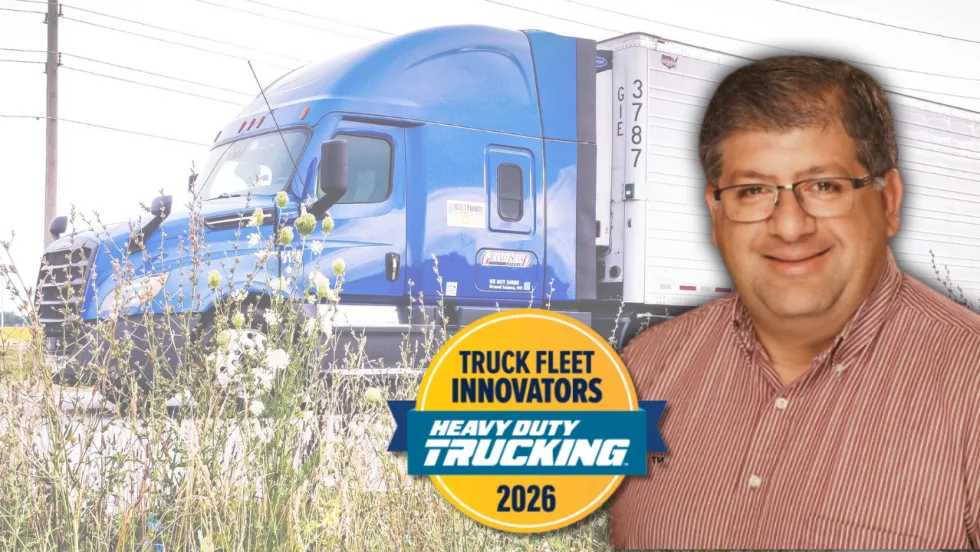
Deen Albert: Let Automation Do the Math, People Make the Decisions
HDT Truck Fleet Innovator Deen Albert makes sure people are still at the heart of operations at Grand Island Express, even while adopting artificial intelligence tools. AI-assisted dispatch helped boost revenue 25% with the same number of trucks.
Read More →