




Carriers Reluctant to Add Capacity as Shippers Seek Longer Term Options
Carriers are still reluctant to add capacity, according to results from Transport Capital Partners' Second Quarter 2012 Business Expectations Survey. Seventy-one percent of carriers expect to add little or no capacity, a slight increase from last quarter's 65%
Carriers are still reluctant to add capacity, according to results from Transport Capital Partners' Second Quarter 2012 Business Expectations Survey. Seventy-one percent of carriers expect to add little or no capacity, a slight increase from last quarter's 65%.

"Carriers' confidence in the economy to generate volumes and compensatory rates is dropping as the industry is certainly bearing the burdens of more federal regulation, scarce drivers, an anticipated jump in 2013 taxes, and hearing more pundits ponder recession," says Richard Mikes, a TCP partner specializing in finance and economics.
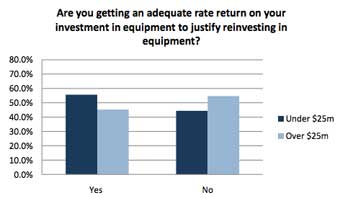
More carriers believe that they are not getting an adequate return on investment for their equipment compared to this time a year ago: 51% versus 47% in May of 2011. The high percentage of carriers that find the ROIs to be lacking might explain why carriers are unwilling to add capacity.

"This, coupled with adverse driver dynamics - i.e. shifting demographics, CSA putting pressure on drivers, raising turnover and pay rising, - is similar to causing carriers to die by a thousand cuts," stresses Lana Batts, TCP partner with long-term industry experience in driver issues.
With uncertainty about capacity, carriers are unsure as to how shippers will respond. Thirty-five percent of smaller carriers think that shippers will do nothing, compared to only 14% of the larger carriers. Larger carriers think that it is more likely that shippers will use long-term dedicated services (29.3%) or favor larger fleets (26.7%).
"Dedicated is clearly a win-win option for shippers and carriers over the long run, and dedicated is rising in popularity with our carrier contacts, as well as looking for acquisitions," Mikes says. "It allows the current low interests rates to be locked-in, gives shippers a custom and controlled base line capacity not subject to the spot market over five to seven years and removes the uncertainty of steady volumes to justify an investment."
More Fleet Management

AUCTION OF EQUITY INTEREST IN HEAVY HAUL TRUCKING COMPANY!!
Mark your calendar: June 30, 2026 (10:00 a.m. PDT). MagnaTrans, LLC, a California limited liability company doing business as Magna Transportation Group is going to auction! Bid on a 37.5% ownership interest in this Rancho Cucamonga-based heavy haul and over-dimensional trucking company operating across California, Oregon, and Arizona. The equity interest will be sold to the highest bidder or bidders under Article 9 of the Uniform Commercial Code at 10:00 a.m. PDT.
Read More →
Volvo Trucks Adds Unattended Over-the-Air Software Update Capabilities
The latest evolution of Volvo’s over-the-air update technology allows software updates to run while trucks are parked, helping fleets keep vehicles current without disrupting operations.
Read More →
How Waste Connections is Using Data, Telematics, and AI
How do you manage and maintain more than 18,000 connected trucks? Data. Lots of it.
Read More →

Why Fleet Data Matters More Than Ever at Waste Connections [Watch]
Waste Connections' Chuck Palmer explains how telematics, predictive maintenance, safety analytics, and AI help keep vehicles on the road and drivers safe in this episode of HDT Talks Trucking.
Read More →
NMFTA Launches Free, Anonymous Cybersecurity Threat Report Portal
Organizations are encouraged to anonymously report freight fraud, cargo crime, and cyber threats while gaining visibility into incidents reported across the transportation sector.
Read More →
AI Can Optimize a Fleet. Can It Replace Human Judgment?
Fleets fear falling behind if they don’t adopt AI quickly enough. They also fear what happens if the technology makes the wrong decision.
Read More →
Jamie Hagen Gets Real About Running a Small Fleet in an Uncertain Economy
Small fleet owner Jamie Hagen says new legal risks, volatile fuel prices, and a changing freight market are forcing small carriers to rethink how they operate — and what they can afford.
Read More →
Jamie Hagen Gets Real About Freight, Fuel Prices, Safety, and Small-Fleet Survival
Running a small trucking fleet right now isn’t easy, especially right now. And Jamie Hagen doesn’t sugarcoat it.
Read More →
Jamie Hagen Gets Real About Freight, Fuel Prices, Safety, and Small-Fleet Survival
Running a small trucking fleet right now isn’t easy, especially right now. And Jamie Hagen doesn’t sugarcoat it.
Read More →
Data Lock‑In or Integration Lock‑Out?
Data fragmentation is costing dealerships, OEMs, fleets, and upfitters millions. Here’s why interoperability may be the fix the trucking industry needs.
Read More →