





Related: What Do Final Mile Trends Mean for Equipment and Maintenance Managers?
How Home Delivery and Fresh Foods are Changing Refrigerated Transport
The way Americans get their groceries is changing – and that's affecting refrigerated transporters and the equipment they buy.
April 17, 2018
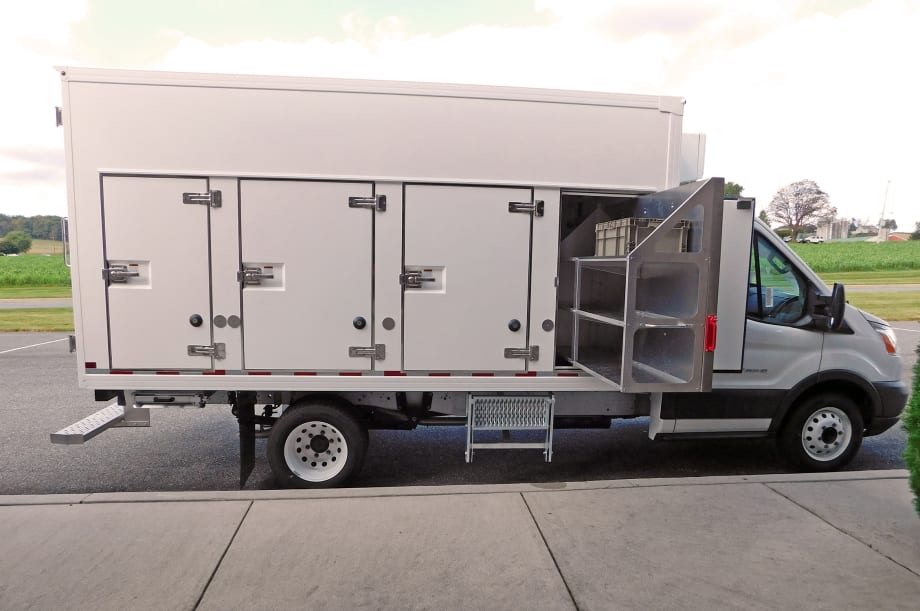
Morgan's home grocery delivery body is designed for smaller delivery vehicles. Photo: Morgan Corp.
5 min to read
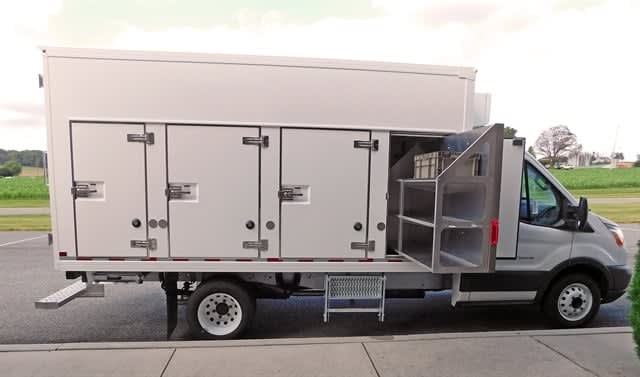
Morgan's home grocery delivery body is designed for smaller delivery vehicles.Photo: Morgan Corp.
The way Americans get their groceries is changing. According to Statistica, U.S. online grocery sales amounted to about $14.2 in 2017 and are expected to rise to nearly $30 billion by 2021.
Meal kits are currently a $2.2 billion business and will grow 25-30% annually over the next 5 years, according to Parcelpending.com, as startups like BlueApron and Hello Fresh provide boxed meal kit services as alternatives to eating take-out meals or cooking totally from scratch. After Amazon’s acquisition of Whole Foods last year, the e-commerce giant recently began to offer same-day delivery of groceries from Whole Foods in six cities and says it will expand the program to the rest of the country later this year. And Walmart just announced it’s expanding its online grocery delivery service to 100 metropolitan areas by the end of the year.
However, FoodDive.com notes that despite rapid advancements and expansion of grocery click-and-collect and home delivery models, the ongoing struggle to solve the last mile continues.
“Execution and operational hurdles abound in the quest to adequately pick and satisfactorily deliver high-margin perishable products like produce and meat, as well as frozen and refrigerated foods that require controlled temperatures,” reports the website.
“The logistics industry changes as U.S. food consumption patterns change,” notes Mark Ehrlich, director, van product line at Wabash National. “Equipment is changing as modes of transportation shift in response to the consumption trend.”
The Ever-Changing Cold Chain
Final mile and product-specific refrigerated vehicles, including more multi-temp truck bodies, are becoming more useful to meet the ever-changing cold chain.
Paul Jarossy, director of marketing and new business development for Morgan Corp., says the company is engaged with some of the key retailers in the country, “and they don’t really know what’s going to happen, it’s changing so fast. Many of the retailers in the past 10 to 15 years have failed at doing it, and they’re finally staring to figure it out.”
Jarossy says these trends started with what he calls “the two G’s: generational and geographic. It was really driven by Millennials in urban areas who value their free time and don’t necessarily have cars, and it makes sense to delivery in a dense population like that. But it’s grown beyond Millennials and the urban areas.”
There are multiple players in this arena, from the retailers themselves, to third-party delivery companies, to logistics upstarts like Peapod or Fresh Direct, Jarossy says.
Some services simply use personal shoppers and depend on insulated bags to keep goods cold. The new Amazon-Whole Foods program, for instance, is run through Amazon’s Prime Now service, which relies on contractors to make deliveries in their personal cars. Whether these services will be successful in delivering cold foods still at the proper temperature upon delivery is another question.
Jarossy explains that other services and retailers are looking for lower-weight delivery vehicles. These allow them to use drivers without a commercial driver’s license. “Smaller chassis makers like Ford Transit and Spinter vans are becoming more popular for that segment.”
And the changing logistics of refrigerated foods isn’t limited to home grocery delivery. Jarossy points to the example of Sheetz, a convenience store chain that also offers burgers, pizzas, sandwiches, salads and other quick-service foods – you can even order online or via app.
“They’re booming,” Jarossy says. “They move product from depot to stores, and there are a lot of stores in the delivery area, so they need to get in and out quickly. Even some of the medium-duty larger reefers are too big, so they’re looking for the smaller trucks.”
Changing Reefer Truck Options
With these trends pushing more demand for smaller refrigerated truck bodies, it also means that the weight of the body for these operations is crucial. Earlier this year, Morgan launched a home grocery body for just this purpose, based on its NexGen platform that uses weight-saving composite walls. “That allows them to add more cargo capacity with a smaller chassis,” without pushing the vehicle over the limit into a weight class that requires a CDL.
Other manufacturers have also responded to these changing trends.
For example, Wabash National recently bought truck body maker Supreme. The driving factor behind the buy was cited as the impact that the rising tide of e-commerce shipping business is having on the need for more “final mile” deliveries. Wabash formally entered the final mile space in 2015 with the launch of both dry and refrigerated truck bodies, and Supreme produced both dry and refrigerated bodies as well.
Carrier Transicold’s model 35X direct-drive unit was introduced last year to provide refrigeration for perishable and frozen cargo in small- to medium-sized box trucks and large delivery vans. The 35X includes an exterior-mounted condenser unit, a compressor that mounts to the truck engine and a narrow-profile SlimLine evaporator that fits tightly to the ceiling of the cargo area, helping to maximize cargo space. As a split system, the 35X unit provides flexible mounting options for the condenser, either to the nose of a box truck or roof of a van.
Mickey Truck Bodies last year added a refrigerated van option, featuring thermal-efficient composite panels on the roof, walls, and floor, with smooth sidewalls with no fasteners that allow for easier decal application and a “billboard” appearance.
And in urban areas where air pollution and noise are a concern, some companies are experimenting with electric options, For instance, D&D Wholesale Distributors in City of Industry, California, is working with Canadian company, Volta Air, to test all-electric refrigeration units for vans and medium-duty delivery trucks to distribute produce, meats, poultry, grocery, frozen foods and dairy in the Southern California area.
Subscribe to Our Newsletter
More Fleet Management

Sponsored•September 16, 2026
Color Match Smarter: Tools That Restore & Perform
For fleet managers and collision repair professionals keeping heavy-duty trucks on the road, getting the color right the first time isn't just about appearance — it's about efficiency, turnaround time, and bottom-line results. Discover how today's digital color tools are transforming the repair process from guesswork to precision.
Read More →
FMCSA Pauses Biennial-Update Enforcement Amid Motus Transition
Carriers whose updates were due on or after June 1 have more time, while FMCSA works to stabilize its new registration system and warns of phishing sites impersonating its new carrier registration system, Motus.
Read More →
Sponsored•September 14, 2026
2026 Blueprint for Countering Smarter Supply Chain Theft
Cargo theft is no longer just the cost of doing business. It's a multi-billion-dollar criminal enterprise exploiting vulnerabilities across your fleet, drivers, and supply chain.
Read More →


Sponsored•September 1, 2026
How Telematics Improves Visibility, Control, and Performance in Refrigerated Fleets
Explore how telematics help refrigerated fleets improve visibility, uptime, efficiency, compliance, and cargo protection across connected cold chain operations.
Read More →
What the U.S.-Canada Trade War Means for Trucking
Escalating U.S.-Canada tariffs could disrupt cross-border freight, reduce truck volumes, raise costs, and create new uncertainty for carriers on both sides of the border.
Read More →
What Are Trucking’s Top Concerns for 2026?
The American Transportation Research Institute wants to know what's worrying trucking fleet managers, drivers, and other stakeholders in its annual Industry Issues survey.
Read More →
American Trucking Associations Looks for a New Leader
ATA President and CEO Chris Spear abruptly left his job at the association on August 21, at a pivotal time for the trucking industry.
Read More →
Public Wi-Fi Cybersecurity Risks: How Truck Drivers and Fleets Can Protect Their Data
Public Wi-Fi can expose truck drivers and fleets to credential theft, malware, and other cyber threats. Here’s how to reduce the risk on the road.
Read More →
For Nicky Cupp, Fleet Innovation Starts With Frustration
HDT Truck Fleet Innovator Nicky Cupp turns everyday pain points at Fraley & Schilling into opportunities for better technology and smarter processes.
Read More →
Adam Buttgenbach’s Approach to Electric Trucks: Start With Where They Fit
HDT Truck Fleet Innovator Adam Buttgenbach helped PepsiCo build one of North America’s largest EV fleets by focusing on where electric trucks make operational sense.
Read More →