




Analysis: Freight Payment Index Offers Helpful Regional Benchmark
If you want to know how your trucking operation is stacking up against other freight shipping businesses, there is a new barometer available, U.S. Bank's Freight Payment Index, and it offers some features that have not been seen before, says business contributing editor Evan Lockridge in his December Hotline column.

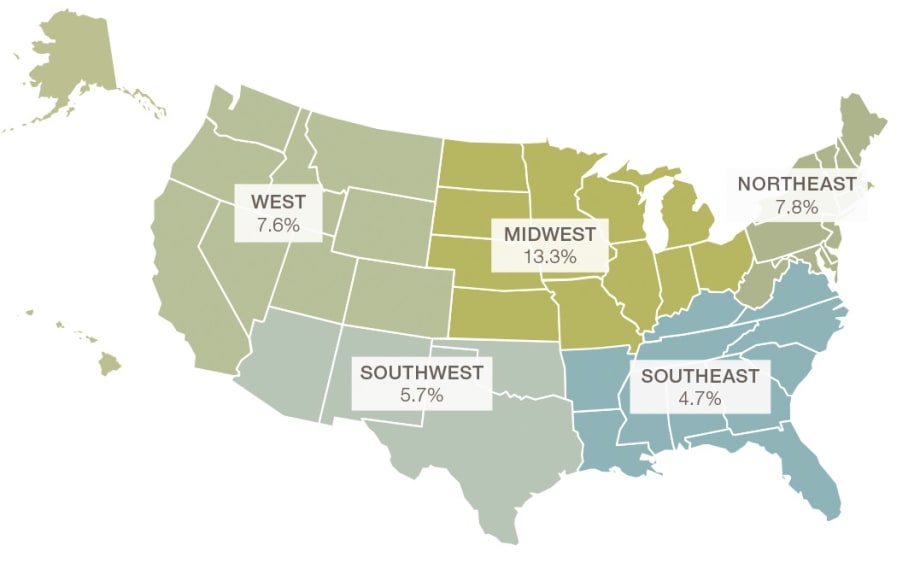
Regional quarter-over-quarter % change in spending. Source: U.S. Bank Freight Payment Index
Regional quarter-over-quarter % change in spending.Source: U.S. Bank Freight Payment Index
If you want to know how your trucking operation is stacking up against other freight shipping businesses in the country, there is a new barometer available, and it offers some features that have not been seen before.
That was the message from U.S. Bank during the American Trucking Associations’ annual Management Conference & Exhibition in Orlando in October as it announced its new quarterly Freight Payment Index – which actually is two indices.
One measures changes in shipment activity. The other is a gauge of changes in freight spending activity. Both are based on data processed through U.S. Bank Freight Payment, which processes around $23 billion annually in freight payments for some of the world’s largest corporations and government agencies. (You can see the latest report online at www.freight.usbank.com.)
What makes this new gauge unique are two things: One, it breaks the data down into five U.S. regions, based on the state of origin for a shipment. And two, the analysis features commentary from Bob Costello, chief economist from the ATA and one of the most respected people in the field of analyzing both trucking and economics.
This first snapshot revealed just how much things can vary regionally.
For instance, the Northeast region saw the biggest gain in shipments, up 10% in the third quarter from the second quarter. It was helped by better manufacturing activity and slightly higher housing starts.
In sharp contrast, shipments in the Southeast, where activity is usually strong, saw just a 0.1% increase as Hurricane Irma disrupted the supply chain, following a 3.9% second quarter gain. However, at the same time freight spending jumped nearly 4.7% as truck capacity tightened as a result of the storm.
The Midwest led all other regions in overall freight spending, jumping 13.3% from the second quarter to a record high, due in large part to a rebound in general manufacturing activity.
Making the West impressive wasn’t just a 6.8% increase in freight shipments or the 7.6% gain in spending over the second quarter, but rather the 12.8% year-over-year jump in shipments, likely helped by better West Coast Port volumes.
Lastly, the Southwest, which includes Texas, saw shipments increase 3%, slower than the 5.3% gain in the second quarter, but considering it was during Hurricane Harvey it was remarkable. This region will likely get a significant boost when the rebuilding gets into full swing, according to the report.
Why are these regional differences so important? “Freight shipments are generally not uniform across the country,” Costello said, noting the index “gives a good snapshot into the differences in economic climate from one end of the country to the other.”
Let’s also not forget the big national picture, which showed freight spending increased 8.3% in the third quarter, the largest quarterly gain since the final quarter of 2014, while the shipment index improved 3.3%. That’s slower than the 5.8% surge in the second quarter, but still solid.
Looking at all of these changes can be helpful for benchmarking your company’s performance against others. And with the historical data going back to 2010, it can give you and your business a real sense of trends over time.
And the good news, judging from this report, is that conditions for trucking and the economy were good in the third quarter. Barring any sudden jolts, it will likely be at least as just as good as this current quarter wraps up and as we say goodbye to 2017 and greet a New Year.
More Fleet Management

Why Private Fleets Are Taking More Freight
Private fleets are putting their own trucks on demanding customers and high-cost lanes as companies seek greater control over service, costs, and capacity.
Read More →
Color Match Smarter: Tools That Restore & Perform
For fleet managers and collision repair professionals keeping heavy-duty trucks on the road, getting the color right the first time isn't just about appearance — it's about efficiency, turnaround time, and bottom-line results. Discover how today's digital color tools are transforming the repair process from guesswork to precision.
Read More →
FMCSA Pauses Biennial-Update Enforcement Amid Motus Transition
Carriers whose updates were due on or after June 1 have more time, while FMCSA works to stabilize its new registration system and warns of phishing sites impersonating its new carrier registration system, Motus.
Read More →


2026 Blueprint for Countering Smarter Supply Chain Theft
Cargo theft is no longer just the cost of doing business. It's a multi-billion-dollar criminal enterprise exploiting vulnerabilities across your fleet, drivers, and supply chain.
Read More →
How Telematics Improves Visibility, Control, and Performance in Refrigerated Fleets
Explore how telematics help refrigerated fleets improve visibility, uptime, efficiency, compliance, and cargo protection across connected cold chain operations.
Read More →
What the U.S.-Canada Trade War Means for Trucking
Escalating U.S.-Canada tariffs could disrupt cross-border freight, reduce truck volumes, raise costs, and create new uncertainty for carriers on both sides of the border.
Read More →
What Are Trucking’s Top Concerns for 2026?
The American Transportation Research Institute wants to know what's worrying trucking fleet managers, drivers, and other stakeholders in its annual Industry Issues survey.
Read More →
American Trucking Associations Looks for a New Leader
ATA President and CEO Chris Spear abruptly left his job at the association on August 21, at a pivotal time for the trucking industry.
Read More →
Public Wi-Fi Cybersecurity Risks: How Truck Drivers and Fleets Can Protect Their Data
Public Wi-Fi can expose truck drivers and fleets to credential theft, malware, and other cyber threats. Here’s how to reduce the risk on the road.
Read More →
For Nicky Cupp, Fleet Innovation Starts With Frustration
HDT Truck Fleet Innovator Nicky Cupp turns everyday pain points at Fraley & Schilling into opportunities for better technology and smarter processes.
Read More →