




Related: FTR Conference - Expect 'Sauntering' Economy to Continue
Fleets Talk ELDs, Specs, Self-Driving Trucks on FTR Equipment Panel
How fleets think about equipment, electronic logging devices and even the future of autonomous vehicles were in the spotlight Wednesday afternoon at the annual FTR Transportation Conference in Indianapolis, as three trucking fleet people spoke on a panel about the challenges they face in today’s uncertain trucking environment.

Evan Lockridge・Former Business Contributing Editor
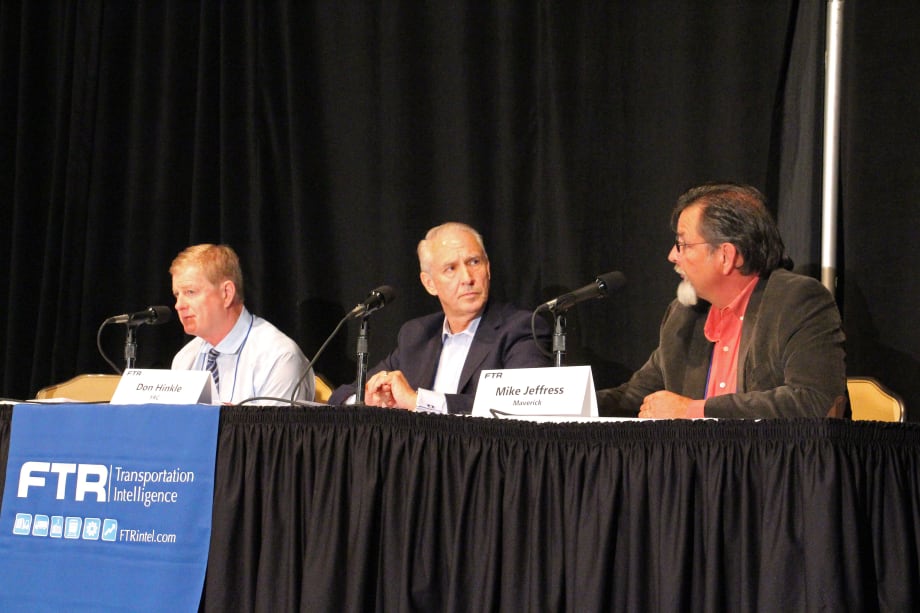
From left, Greg Eddy, president and CEO of Venture Logistics; Don Hinkle, vice president of equipment services at YRC Worldwide; and Maverick Vice President of Maintenance Mike Jeffress. Photo by Evan Lockridge
4 min to read
From left, Greg Eddy, president and CEO of Venture Logistics; Don Hinkle, vice president of equipment services at YRC Worldwide; and Maverick Vice President of Maintenance Mike Jeffress.Photo by Evan Lockridge
How fleets think about equipment, electronic logging devices and even the future of autonomous vehicles were in the spotlight Wednesday afternoon at the annual FTR Transportation Conference in Indianapolis, as three trucking fleet people spoke on a panel about the challenges they face in today’s uncertain trucking environment.
In a discussion about ELDs, Maverick Transportation Vice President of Maintenance Mike Jeffress said shortly after his fleet began using electronic logs around 2010, they were greeted with both a good and a bad surprise.
“We’ve never been really able to quantify this, but after we went to ELDs we saw an improvement in fuel efficiency,” he said. “I equated that to the fact the operator had to do better trip planning than what they had done historically.”
While he was glad to see what he described as a “soft improvement” in fuel efficiency – having no real numbers to quantify the savings – their productivity took a hit of around 15%.
“From a maintenance perspective on the ELD I don’t know if we’ve seen any other improvements. If anything, there might be a slight argument that you saw a little bit of reduction in brake wear,” he said.
Don Hinkle, vice president of equipment services at YRC Worldwide, noted his company has been surprised by the price of ELDs, calling them “expensive." Greg Eddy, president and CEO of Venture Logistics, praised the coming December federal mandate for their use.
“I think as we moved to ELDs several years ago we certainly saw a drop in capacity (about 4%)…but I think the key is the safety,” he said. “We need to get those drivers that are cheating…that’s when it gets really unsafe and that’s really what we need to stop.”
Despite the cost, Eddy called ELDs “a fantastic change in this industry." He and others on the panel said more than once that the cost of any equipment is always an important consideration, including when it comes to thinking about the equipment they use. But it's only one factor.
“From my seat, what drives everything is cost, and then at the end of the day profitability,” Eddy said. “But also important is driver satisfaction and uptime. We all have on the operations-side revenue goals we have to hit in order to cover our costs. That is the catalyst to what we look at.”
YRC’s Don Hinkle said properly spec’ing equipment is greatly important for his operation.
“With the numbers of equipment we have, we want to minimize the different OEMs as far as chassis and engines," he said, to help make things simpler for maintenance, technicians, and parts inventories.
For YRC, equipment spec'ing also means making sure trucks have the latest safety features as well as the best life cycle cost – and a long life as well.
From Advanced Safety to Fully Autonomous
Maverick’s Jeffress also talked about the importance of safety technologies – and, he said, this encompasses embracing the concept of autonomous trucks, including the advanced driver assist systems that are available on today’s trucks.
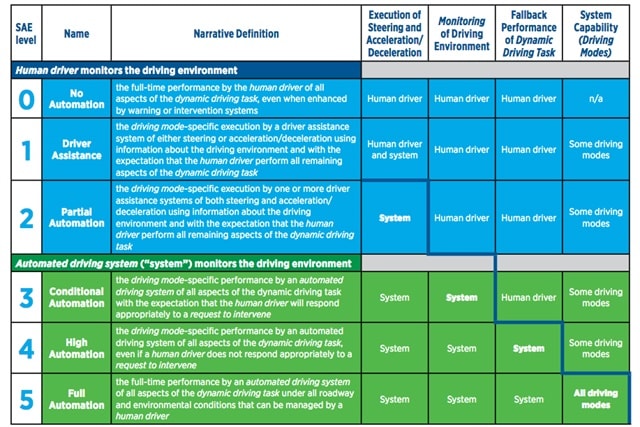
Part of the panel discussion touched on the Society of Automotive Engineers' defined levels of vehicle automation. They range from 0, no automation, to 6, fully autonomous. Systems such as advanced collision avoidance and cruise control already in use fall under the lower levels of partial automation on the chart.
Jeffress said that he believes full truck automation is definitely coming and is something that he supports – making it clear he was speaking for himself, not necessarily for Maverick as a company. As for when that may be, he said he is not sure – though it will be at least a few years before trucking advances further on that SAE autonomy ladder.
In the meantime, while it remains a mystery as to how fast the march toward completely autonomous vehicles will proceed, Venture Logistics’ Eddy noted that any step toward it becoming a reality is a plus for not just trucking but also the entire public.
“The cool thing about autonomous vehicles is that every step is another step forward to the ultimate goal, which is a truck or a car driving safely down the road without anybody driving it. Every one of those levels incorporates another level of safety, and when you have so many people racing to that finish line…we are going to have safer vehicles.”
Subscribe to Our Newsletter
More Fleet Management

Sponsored•September 16, 2026
Color Match Smarter: Tools That Restore & Perform
For fleet managers and collision repair professionals keeping heavy-duty trucks on the road, getting the color right the first time isn't just about appearance — it's about efficiency, turnaround time, and bottom-line results. Discover how today's digital color tools are transforming the repair process from guesswork to precision.
Read More →
FMCSA Pauses Biennial-Update Enforcement Amid Motus Transition
Carriers whose updates were due on or after June 1 have more time, while FMCSA works to stabilize its new registration system and warns of phishing sites impersonating its new carrier registration system, Motus.
Read More →
Sponsored•September 14, 2026
2026 Blueprint for Countering Smarter Supply Chain Theft
Cargo theft is no longer just the cost of doing business. It's a multi-billion-dollar criminal enterprise exploiting vulnerabilities across your fleet, drivers, and supply chain.
Read More →


Sponsored•September 1, 2026
How Telematics Improves Visibility, Control, and Performance in Refrigerated Fleets
Explore how telematics help refrigerated fleets improve visibility, uptime, efficiency, compliance, and cargo protection across connected cold chain operations.
Read More →
What the U.S.-Canada Trade War Means for Trucking
Escalating U.S.-Canada tariffs could disrupt cross-border freight, reduce truck volumes, raise costs, and create new uncertainty for carriers on both sides of the border.
Read More →
What Are Trucking’s Top Concerns for 2026?
The American Transportation Research Institute wants to know what's worrying trucking fleet managers, drivers, and other stakeholders in its annual Industry Issues survey.
Read More →
American Trucking Associations Looks for a New Leader
ATA President and CEO Chris Spear abruptly left his job at the association on August 21, at a pivotal time for the trucking industry.
Read More →
Public Wi-Fi Cybersecurity Risks: How Truck Drivers and Fleets Can Protect Their Data
Public Wi-Fi can expose truck drivers and fleets to credential theft, malware, and other cyber threats. Here’s how to reduce the risk on the road.
Read More →
For Nicky Cupp, Fleet Innovation Starts With Frustration
HDT Truck Fleet Innovator Nicky Cupp turns everyday pain points at Fraley & Schilling into opportunities for better technology and smarter processes.
Read More →
Adam Buttgenbach’s Approach to Electric Trucks: Start With Where They Fit
HDT Truck Fleet Innovator Adam Buttgenbach helped PepsiCo build one of North America’s largest EV fleets by focusing on where electric trucks make operational sense.
Read More →