




Q&A: Don Daseke on Going Public
On Feb, 28, the day the firm he founded began trading as a public company, Don Daseke, chairman and CEO of Daseke Inc., spoke with HDT Executive Editor David Cullen about the process the flatbed fleet operator followed to go public-- and why going public had been a long-held goal of his.

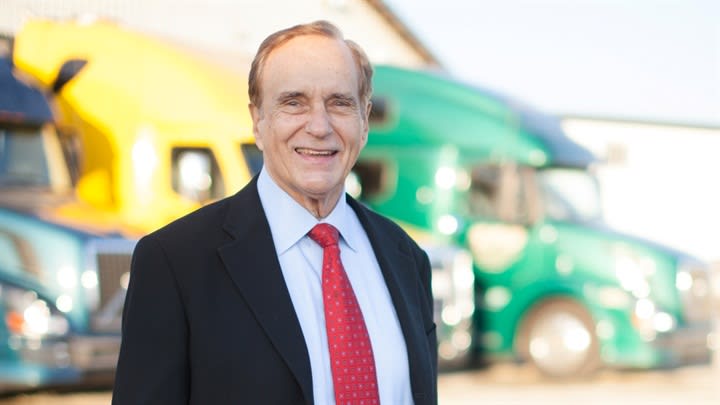
Don Daseke
Don Daseke
HDT: Congratulations on converting Daseke Inc. into a public company. Since you have not offered a typical initial public offering of stock, can you tell us about the process you followed to secure a Nasdaq listing?
Daseke: Thank you. What we did is somewhat unique; most people are not familiar with how we did it. Effectively, we merged with what used to be a special-purpose acquisition company [Hennessy Capital Acquisition Corp. II], which is a firm that just has cash to invest. Once we merged, the new company took the Daseke name and, as a public company, we received our stock symbols [on Feb 28]. It’s a very fast transition to going public compared to issuing an IPO and the company remains controlled by the board [which includes two directors who were the top executives of HCAC]. HCAC has gone away and now Daseke Inc. has the capital to go out and add more open-deck specialized carriers to our family of companies, which now numbers nine.
HDT: Daseke is the first trucking company to go public since 2010. I understand that taking the company public had been a goal of yours, perhaps even since launching Daseke in 2009. Why was that?
Daseke: [Along with raising capital] going public will allow for employee ownership of the company. We have always intended to offer that to all our employees, especially our drivers. We’ve found that people think differently and feel differently if they are the owner. [Employee ownership] is a way to show respect, especially to our drivers. Driving is a tough job and it’s even more so for our drivers, who must tarp all sorts of heavy, unusual things. It’s a highly skilled job and we want to show drivers respect for the difficult job they do and show we appreciate them for what they do as individuals. The specifics on this will be rolled out in the next 30 days.
HDT: Daseke has made its name as a highly successful operator of separate fleets that specialize in open-deck hauling. But will the influx of capital from going public affect your choice of acquisitions?
Daseke: We’ll stay in our niche. We’re already the biggest operator of open deck equipment. It’s a $133-billion freight market in North America, but at this point we have less than 1% of that niche. [Going public is] an exciting opportunity for us become the premier open deck operator. This is a segment characterized by companies that are family-owned, many for several generations. Usually, running these companies is a well-established team at all levels that understands the customers and their requirements. That’s why when we acquire a carrier, we keep the teams. We do not eliminate a single job. Really, Daseke operates as a team of teams.
HDT: It seems that Daseke has its own spin on mergers and acquisitions. Can you detail your approach a bit more?
Daseke: What we do is very different than the typical number-focused Wall Street approach [to M&A]. We focus on companies that are not for sale. Because those that are for sale, usually have an issue. We want truly successful companies with top safety ratings and with a great management team of people who care about their employees and customers. This kind of company usually says they are not for sale, so when we find them, we will keep talking to them for a period, even for years. In much the same way, HCAC approached us with opportunity to do a “fast IPO.” That made perfect sense to me and we were ready to act.
More Fleet Management

Why Private Fleets Are Taking More Freight
Private fleets are putting their own trucks on demanding customers and high-cost lanes as companies seek greater control over service, costs, and capacity.
Read More →
Color Match Smarter: Tools That Restore & Perform
For fleet managers and collision repair professionals keeping heavy-duty trucks on the road, getting the color right the first time isn't just about appearance — it's about efficiency, turnaround time, and bottom-line results. Discover how today's digital color tools are transforming the repair process from guesswork to precision.
Read More →
FMCSA Pauses Biennial-Update Enforcement Amid Motus Transition
Carriers whose updates were due on or after June 1 have more time, while FMCSA works to stabilize its new registration system and warns of phishing sites impersonating its new carrier registration system, Motus.
Read More →


2026 Blueprint for Countering Smarter Supply Chain Theft
Cargo theft is no longer just the cost of doing business. It's a multi-billion-dollar criminal enterprise exploiting vulnerabilities across your fleet, drivers, and supply chain.
Read More →
How Telematics Improves Visibility, Control, and Performance in Refrigerated Fleets
Explore how telematics help refrigerated fleets improve visibility, uptime, efficiency, compliance, and cargo protection across connected cold chain operations.
Read More →
What the U.S.-Canada Trade War Means for Trucking
Escalating U.S.-Canada tariffs could disrupt cross-border freight, reduce truck volumes, raise costs, and create new uncertainty for carriers on both sides of the border.
Read More →
What Are Trucking’s Top Concerns for 2026?
The American Transportation Research Institute wants to know what's worrying trucking fleet managers, drivers, and other stakeholders in its annual Industry Issues survey.
Read More →
American Trucking Associations Looks for a New Leader
ATA President and CEO Chris Spear abruptly left his job at the association on August 21, at a pivotal time for the trucking industry.
Read More →
Public Wi-Fi Cybersecurity Risks: How Truck Drivers and Fleets Can Protect Their Data
Public Wi-Fi can expose truck drivers and fleets to credential theft, malware, and other cyber threats. Here’s how to reduce the risk on the road.
Read More →
For Nicky Cupp, Fleet Innovation Starts With Frustration
HDT Truck Fleet Innovator Nicky Cupp turns everyday pain points at Fraley & Schilling into opportunities for better technology and smarter processes.
Read More →