




Related: 6 Trends to Track in 2016
Commentary: Four Lessons to Learn From 2015
We’ve all heard the saying, “Those who cannot remember the past are condemned to repeat it.” It’s one to take to heart looking back at 2015.

Evan Lockridge・Former Business Contributing Editor
3 min to read

Business Editor, Evan Lockridge.
We’ve all heard the saying, “Those who cannot remember the past are condemned to repeat it.” It’s one to take to heart looking back at 2015, described as a “pretty eventful year” by Larry Gross, senior consultant with the freight forecasting firm FTR in a webinar last month.
Lesson 1: Keep an eye on Washington
“Washington is playing an ever-increasing role in our transportation world,” Gross said. The new five-year surface transportation funding bill, the FAST Act, is a prime example.
Rather than looking at what’s in it (“a lot of accounting gimmicks and different sorts of magical items” to fund the bill, he said), let’s look at what didn’t make it into the law. Increased fuel taxes, bigger trucks, increased Interstate tolling, a broader pilot program allowing those under 21 to drive interstate are just some of the big items lobbyists tried to get Congress to put into the bill, but failed.
This doesn’t mean these ideas are gone forever. You can bet there will be future attempts to get such measures passed, all of which could affect your bottom line.
Lesson 2: Things can turn on a dime
“In 2015 the transportation world has again demonstrated it’s a very, very volatile place,” Gross said.
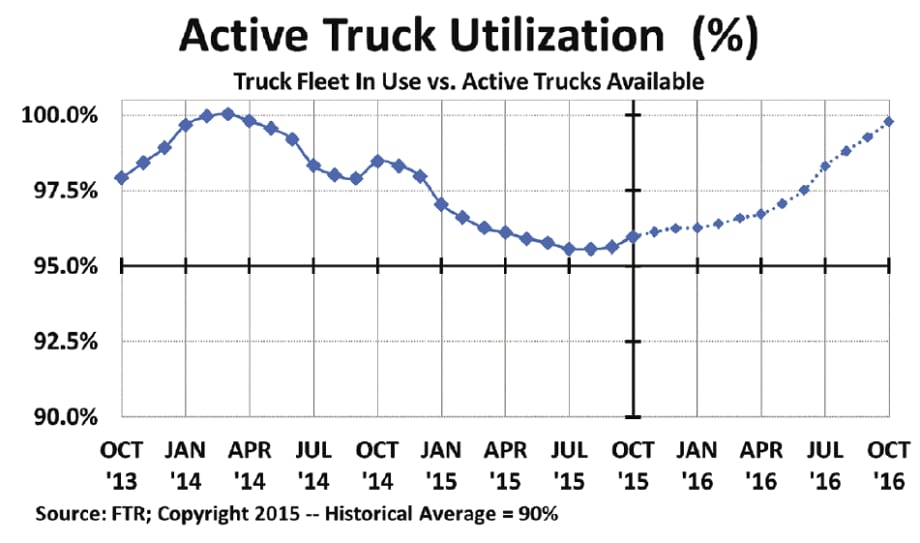
Truck capacity, for instance, was extremely tight in early 2014. By the end of 2015 it had loosened to numbers closer to historical averages. But don’t expect that to last – and this is where lesson number 1 comes in, thanks to expected new regulations.
“As these regulations…start to come into play, that utilization rate is going to start marching relentlessly northward again and start to get again into the extremely tight levels that we saw back in the winter of 2014 … as we get toward the latter part of next year.”
Add to this the big decline in the spot truckload freight market that happened in 2015 compared to the previous year – as Gross said, “a very good way of seeing the volatility of the sort of real time truck demand and supply equation” – and it’s easy to see how business conditions can change rapidly.
Lesson 3: The system is fragile
When you’re operating at high capacity levels, any glitches in the system can have farflung consequences.
The nation’s ports continue to be plagued by problems. Ocean shipping companies are dealing with what Gross called “chaos,” resulting from overcapacity, slow transit times, cancelled sailings and a major consolidation. Bigger ships on the East Coast will result in longer gate times.
If a fleet is operating at a level of utilization in the extreme high 90% area, “you have absolutely no ability to compensate for the unexpected…for any kind of disruption, and it’s going to to immediately and substantially affect pricing, rates and availability.”
Lesson 4: The only constant is change
One barometer the industry has traditionally used for future activity is the business inventory to sales ratio. Lower was better. But in recent years it has leveled out and now is rising. In the past, that was considered a sign that sales are slowing and the economy was weakening. That’s not the case this time around, with Gross noting the economy is growing, albeit at a “tepid 2%.”
So why are inventories growing? Distrust. A distrust “supply chain managers have with regard to the reliability of the network that they are using to bring their product in,” he said.
This distrust is probably the effect of West Coast port congestion that happened a year ago due to labor difficulties, which resulted in cargo containers stacking up at ports. Also, “shippers are starting to react to the fragility of the transportation network and the increased chances of disruption,” Gross said.
The takeaway from these four lessons? It’s important for businesses to maintain their agility and watchfulness. Remember things can and do change quickly. But possibly even more important was the final point he made. “Even our long-standing bedrock assumptions are potentially at risk.”
Subscribe to Our Newsletter
More Fleet Management

Sponsored•September 16, 2026
Color Match Smarter: Tools That Restore & Perform
For fleet managers and collision repair professionals keeping heavy-duty trucks on the road, getting the color right the first time isn't just about appearance — it's about efficiency, turnaround time, and bottom-line results. Discover how today's digital color tools are transforming the repair process from guesswork to precision.
Read More →
FMCSA Pauses Biennial-Update Enforcement Amid Motus Transition
Carriers whose updates were due on or after June 1 have more time, while FMCSA works to stabilize its new registration system and warns of phishing sites impersonating its new carrier registration system, Motus.
Read More →
Sponsored•September 14, 2026
2026 Blueprint for Countering Smarter Supply Chain Theft
Cargo theft is no longer just the cost of doing business. It's a multi-billion-dollar criminal enterprise exploiting vulnerabilities across your fleet, drivers, and supply chain.
Read More →


Sponsored•September 1, 2026
How Telematics Improves Visibility, Control, and Performance in Refrigerated Fleets
Explore how telematics help refrigerated fleets improve visibility, uptime, efficiency, compliance, and cargo protection across connected cold chain operations.
Read More →
What the U.S.-Canada Trade War Means for Trucking
Escalating U.S.-Canada tariffs could disrupt cross-border freight, reduce truck volumes, raise costs, and create new uncertainty for carriers on both sides of the border.
Read More →
What Are Trucking’s Top Concerns for 2026?
The American Transportation Research Institute wants to know what's worrying trucking fleet managers, drivers, and other stakeholders in its annual Industry Issues survey.
Read More →
American Trucking Associations Looks for a New Leader
ATA President and CEO Chris Spear abruptly left his job at the association on August 21, at a pivotal time for the trucking industry.
Read More →
Public Wi-Fi Cybersecurity Risks: How Truck Drivers and Fleets Can Protect Their Data
Public Wi-Fi can expose truck drivers and fleets to credential theft, malware, and other cyber threats. Here’s how to reduce the risk on the road.
Read More →
For Nicky Cupp, Fleet Innovation Starts With Frustration
HDT Truck Fleet Innovator Nicky Cupp turns everyday pain points at Fraley & Schilling into opportunities for better technology and smarter processes.
Read More →
Adam Buttgenbach’s Approach to Electric Trucks: Start With Where They Fit
HDT Truck Fleet Innovator Adam Buttgenbach helped PepsiCo build one of North America’s largest EV fleets by focusing on where electric trucks make operational sense.
Read More →