





Driver Dilemma: A Year-Long, In-Depth Series on the Driver Shortage
How CSA Compliance Can Benefit Fleets and Drivers
Thanks to a combination of government regulations and market pressures, operating trucks safely has never been more mutually beneficial to fleets and drivers.
October 14, 2015

Photos: Con-way
8 min to read

Photos: Con-way
Thanks to a combination of government regulations and market pressures, operating trucks safely has never been more mutually beneficial to fleets and drivers.
On one hand, motor carriers are struggling to recruit and retain highly qualified drivers — which by definition includes being safety-oriented — and working to comply as fully as possible with today’s more comprehensive safety enforcement. That means these fleets have a vested interest in finding and keeping drivers who will help them run as safely as possible.
On the other hand, savvy drivers know they are in demand by such fleets. They recognize that what they do on the road and what the carrier does to keep the equipment in safe running order will benefit both parties financially.
Put it all together, and fleets should find that communicating to current and potential drivers as fully as possible what CSA is all about — especially how the elements that drive it must be continuously managed by carrier and driver alike — can only help attract and keep top-notch drivers.
The Federal Motor Carrier Safety Administration rolled out its Compliance, Safety, Accountability measurement system in 2010. In the five years since, truck fleets have largely come to understand the program and how the scores it generates affect their business.
Less certain is how knowledgeable the vast majority of truck drivers are about CSA and why they should pay as much attention to it as their employers. The American Transportation Research Institute surveyed truck drivers on their knowledge of CSA and how it relates to the federal motor carrier safety regulations, and on the 14-question quiz, drivers answered an average of only six items correctly.
So, as part of a fleet’s recruitment and retention efforts, it may help a lot to remind drivers of the key aspects of CSA that impact them directly.
FMCSA itself does a good job of informing drivers about how safety enforcement concerns them. But rather than just send drivers to a website, here digested for quick consumption is what the agency stresses they should know about the program:
- Carriers can only use FMCSA’s Pre-Employment Screening Program (PSP) to see drivers’ five-year crash and three-year inspection history from the agency’s databases before deciding to employ them. The PSP is not to be used to evaluate the driving records of current drivers, unless they give the fleet consent.
- Once onboard with a fleet, a driver’s safety record will affect the carrier’s Safety Measurement System (SMS) results.
- Carriers do not “inherit” any of a new hire’s prior violations. Only violations that a driver receives while driving under a carrier’s authority can be applied to that carrier’s SMS record under CSA.
- It’s up to each driver to keep his or her individual safety record accurate. A PSP record can be ordered for $10 at www.psp.fmcsa.dot.gov or for free via a Freedom of Information Act request at www.fmcsa.dot.gov/foia/foia-requests.
- DataQs (https://dataqs.fmcsa.dot.gov) allows drivers and carriers to make a Request for Data Review (RDR) to improve the accuracy of their data that feeds FMCSA’s systems.
- An RDR can be submitted via DataQs to reflect the results of citations contested in court for inspections that occurred on or after August 23, 2014.
Teamsters Local 690, Spokane, Wash., advises on its website that drivers seeking to comply with CSA should know and follow safety rules and regulations; learn about the Behavior Analysis and Safety Improvement Categories (better known as BASICs) that drive CSA and how FMCSA assesses safety under CSA; review FMCSA’s online Safety Measurement System methodology document; keep copies of their inspection reports, and learn about their employers’ safety records.
The local stresses that under CSA, “on-road driver behavior will not be filtered or masked, but have a real-time impact on motor carriers.” It points out that negative safety ratings will directly impact drivers in terms of available loads now and their future employability. Under CSA, the local sagely adds, “Drivers are more accountable for safe on-road performance – good news for drivers with strong safety performance records.”
One area that can be particularly confusing for drivers is what can happen to them for piling up a poor safety record. While FMCSA does not assign formal safety ratings to a driver and it cannot suspend a CDL, it can fine a driver for serious safety violations.
FMCSA advises that “safety investigators always systematically investigate drivers with egregious violations when investigating a motor carrier. Additionally, SIs use the Driver SMS, an internal safety assessment tool, to review drivers with strong patterns of noncompliance. Any violations that are not corrected may result in a Notice of Violation or Notice of Claim for the driver.”
There is also a key distinction between how violations are assigned that should be made crystal clear. Per J.J. Keller, a provider of regulation-compliance services, if a driver is responsible for or could have prevented a violation, it will be placed in his/her personal data as well as that of the carrier. What’s more, “this personal data stays with the driver, no matter what carrier the driver is working for.”
A number of leading truckload carriers are educating their drivers about CSA via special sections on their websites. “Bottom line,” states Averitt Express, Cookeville, Tenn., “CSA means drivers will have to take more ownership than ever to be safe… CSA is not changing any driving rules. It is not about taking away your CDL. Averitt views CSA as a positive because we believe it will give our team even more incentive to improve our safety record and provide us an opportunity to stand apart from other carriers who may not place the same emphasis on safety as our team does.”
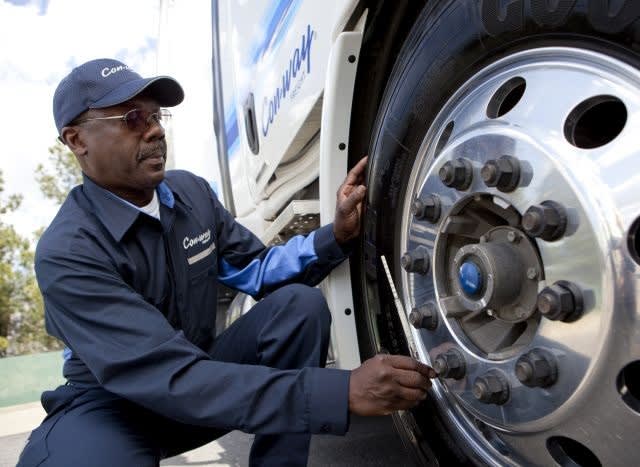
Thorough vehicle inspections by drivers ensure the loop is closed between the road and the shop to reduce CSA scores.
Safe equipment = happier drivers
Along with promoting a culture of safety in general and providing specific ongoing training and feedback on safe driving, a fleet can have a powerful impact on a driver’s safety performance by how its approaches vehicle maintenance. That, in turn, can make the fleet the kind of employer that drivers want to work for and keep working for.
“CSA has increased the need to have more reliable equipment and to make that commitment visible to drivers,” says Mike Spence, senior vice president, fleet services for Fleet Advantage, Fort Lauderdale, Fla., which provides financing and cost management to private fleets. “That’s helped lead to shorter trade cycles. It’s a business model based on staying up with technology.
“When we talk with customers that have converted to newer trucks,” he continues, “they report that equipment complaints from drivers have melted away. This approach boosts fuel economy, reduces maintenance expenses and increases the likelihood drivers will stay with the fleet. By keeping CSA scores low, fleets are protecting their drivers, too.”
Drivers who can point a finger at the shop after they’re pulled over for an equipment violation — especially if they had already reported it to the fleet — are likely to vote with their feet and sign on with a carrier that won’t ding their own safety scores by overlooking or deferring safety-related maintenance.
Indeed, the Vehicle Maintenance BASIC accounts for almost two-thirds of all CSA points. Lighting, brake, and tire violations make up the lion’s share. But insisting that drivers conduct thorough pre- and post-trip inspections and report what they find can ensure that problems are caught and fixed before they are spotted by an inspector.
Even a single non-required light that’s not working can trigger a roadside inspection. When it comes to brakes, drivers need to be trained on what they should be looking for so they know when a technician should be consulted. As for tires, drivers should know how to properly check inflation with a gauge and what tread depths signal it is time for replacement rubber.

CVS says it helps keep CSA scores down by leveraging technology to simplify safety compliance for its 350 drivers.
Leveraging technology
“A good vehicle inspection is the first line of defense,” says Kelly Frey, vice president of product marketing for Telogis, a provider of automated compliance solutions. “Anything that does not look right gives a roadside inspector reason to look at a truck. And once they get into a secondary inspection, they will find something” to write up.
Frey says that once the electronic logging device mandate is rolled out, “that will take away a major reason for secondary inspections — log violations. [When enforcement begins] every truck will have electronic logs. That will lead inspectors to pay even greater attention to the physical condition of trucks. So, there will be an obvious benefit to make trip inspections electronically as well. If a fleet has an ELD system, it’s very easy to add in a driver vehicle inspection report feature.”
Such E-DVIRs can be customized to ensure “drivers will be looking at what matters most on their specific vehicles,” he notes. “Also, photos can be incorporated so a driver can send an image of even a minor problem back to the shop so a repair can be scheduled before the problem worsens.”
As Frey sees it, when fleets and drivers both recognize the importance of CSA scores, it “increases the level of driver professionalism. Access to professional tools will help drivers do their jobs better, and it is the progressive fleets who provide these who will get and keep the best drivers.”
Nicholas Cindrich, director of enterprise safety and DOT compliance for Woonsocket, R.I.-based CVS Health, reports the fleet and its 350 drivers are doing “a very good job maintaining low CSA scores.” He attributes some of that success to taking potential violations off the table as much as possible by leveraging technology to simplify compliance for drivers.
“For example,” he says, “we run a governed speed of 63 mph wherever possible. Where speed limits are higher, we set an ‘overspeed’ in 5-mph increments over the posted limits with 70 mph as our maximum.” As of the first of this year, the fleet also has been using the Telogis onboard hours of service and integrated DVIR system to help keep CSA scores low.
“The inspection system is automated so it makes it simple for the drivers to conduct inspections with their smartphone or tablet,” Cindrich says. “They can also snap photos of any problems they spot and those are transmitted right through the DVIR system.”
Noting that the fleet currently enjoys a turnover rate of 4%, Cindrich regards leveraging the onboard HOS/DVIR system as “a tool to help us build on an already successful program. It’s all part of what’s required today because there’s too much at stake for all of us.”
Subscribe to Our Newsletter
More Fleet Management

Sponsored•September 16, 2026
Color Match Smarter: Tools That Restore & Perform
For fleet managers and collision repair professionals keeping heavy-duty trucks on the road, getting the color right the first time isn't just about appearance — it's about efficiency, turnaround time, and bottom-line results. Discover how today's digital color tools are transforming the repair process from guesswork to precision.
Read More →
FMCSA Pauses Biennial-Update Enforcement Amid Motus Transition
Carriers whose updates were due on or after June 1 have more time, while FMCSA works to stabilize its new registration system and warns of phishing sites impersonating its new carrier registration system, Motus.
Read More →
Sponsored•September 14, 2026
2026 Blueprint for Countering Smarter Supply Chain Theft
Cargo theft is no longer just the cost of doing business. It's a multi-billion-dollar criminal enterprise exploiting vulnerabilities across your fleet, drivers, and supply chain.
Read More →


Sponsored•September 1, 2026
How Telematics Improves Visibility, Control, and Performance in Refrigerated Fleets
Explore how telematics help refrigerated fleets improve visibility, uptime, efficiency, compliance, and cargo protection across connected cold chain operations.
Read More →
What the U.S.-Canada Trade War Means for Trucking
Escalating U.S.-Canada tariffs could disrupt cross-border freight, reduce truck volumes, raise costs, and create new uncertainty for carriers on both sides of the border.
Read More →
What Are Trucking’s Top Concerns for 2026?
The American Transportation Research Institute wants to know what's worrying trucking fleet managers, drivers, and other stakeholders in its annual Industry Issues survey.
Read More →
American Trucking Associations Looks for a New Leader
ATA President and CEO Chris Spear abruptly left his job at the association on August 21, at a pivotal time for the trucking industry.
Read More →
Public Wi-Fi Cybersecurity Risks: How Truck Drivers and Fleets Can Protect Their Data
Public Wi-Fi can expose truck drivers and fleets to credential theft, malware, and other cyber threats. Here’s how to reduce the risk on the road.
Read More →
For Nicky Cupp, Fleet Innovation Starts With Frustration
HDT Truck Fleet Innovator Nicky Cupp turns everyday pain points at Fraley & Schilling into opportunities for better technology and smarter processes.
Read More →
Adam Buttgenbach’s Approach to Electric Trucks: Start With Where They Fit
HDT Truck Fleet Innovator Adam Buttgenbach helped PepsiCo build one of North America’s largest EV fleets by focusing on where electric trucks make operational sense.
Read More →