




Carriers Want Support, Customization From Software Vendors
Vendor customization and electronic data integration were the top vendor and software factors fleet managers consider when buying software, according to a survey conducted by Carrier Logistics Inc.


Photo: iStockPhoto.com, Arda Guldogan

Photo: iStockPhoto.com, Arda Guldogan
Vendor customization and electronic data integration were the top vendor and software factors fleet managers consider when buying software, according to a survey conducted by Carrier Logistics Inc.
Like other vendors, the New-York-based software provider routinely surveys customers and potential customers. CLI’s recent survey of 200 trucking executives asked them to rate various factors they consider when considering vendors and software.
The top factor in selecting a vendor to work with was the vendor’s ability to customize software to a company’s specific needs. Close behind was the ability to easily reach engineers when questions or problems arise.
These findings are somewhat different than they were 10 years ago, says Gary Snyder, manager of business development, CLI. Customers stressing the importance of vendor customization “really surprised us,” he said. Snyder said company officials had expected today’s customers to be more interested in a “plug and play” option.
The fact that so many listed availability of support as a top consideration was also a surprise, says Ken Weinberg, vice president and co-founder CLI. “I thought that was significant. We thought some of the other items would be more important than support.”
For instance, having access to the software’s source code did not score high. “I think they are still looking for vendors to understand their needs,” as opposed to customizing the software in-house.
Weinberg says the results suggest that carriers are not evaluating software as much on functionality. “They assume that’s there.”
As for the software itself, survey respondents listed EDI and other electronic integration capabilities as the number one factor when considering a product.
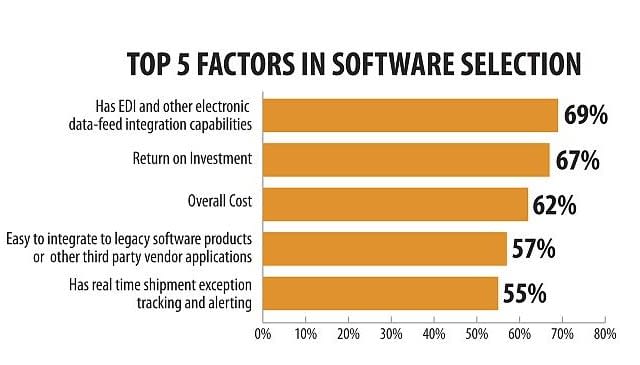
The top five factors fleet managers identified when choosing a software vendor, according to a recent survey by Carrier Logistics Inc.
Return on investment ranked a close second, with overall cost ranked third. Ease of integration with legacy products and third-party applications and the capability for real-time shipment tracking/alerting rounded out the top five concerns.
Snyder was surprised that the ability for the software to run on multiple platforms — which would track the current mobility trend — wasn’t ranked higher. “But people are more concerned with other factors,” he says. “All of the IT questions: whether or not it’s in the cloud, or if it’s Windows-based, did not come up as high.” What the results show, he says, is that “our job is to give [customers] support. Even if they are happy, it doesn’t mean we don’t continue working with them.”
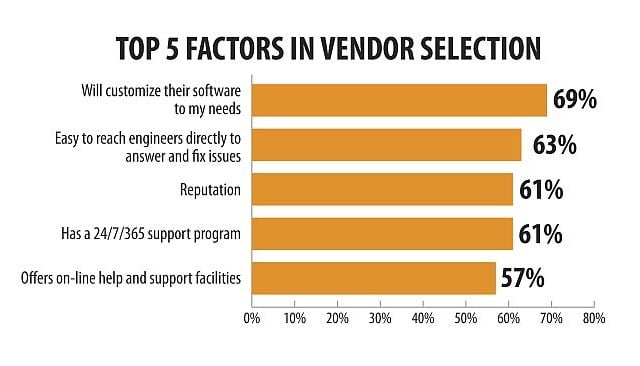
Above are the top five factors fleet managers cited in choosing a software
The importance of vendor customization also underscores the trend toward less in-house IT programming and customization. Fleets still want to be able to customize software to their needs, but want their vendors to do the work rather than bringing that work in-house.
The results, Weinberg says, “support the fact that every carrier is the same, but different. We have to acknowledge that.”
That means making the changes customers want and need. On the other hand, not all customization is cost-effective, he pointed out. “We have to temper some of the requests that don’t improve things, but just increase costs.”
Snyder believes the survey underscored the importance of vendors and carriers understanding what the system will be like up front.
More Fleet Management

Color Match Smarter: Tools That Restore & Perform
For fleet managers and collision repair professionals keeping heavy-duty trucks on the road, getting the color right the first time isn't just about appearance — it's about efficiency, turnaround time, and bottom-line results. Discover how today's digital color tools are transforming the repair process from guesswork to precision.
Read More →
FMCSA Pauses Biennial-Update Enforcement Amid Motus Transition
Carriers whose updates were due on or after June 1 have more time, while FMCSA works to stabilize its new registration system and warns of phishing sites impersonating its new carrier registration system, Motus.
Read More →
2026 Blueprint for Countering Smarter Supply Chain Theft
Cargo theft is no longer just the cost of doing business. It's a multi-billion-dollar criminal enterprise exploiting vulnerabilities across your fleet, drivers, and supply chain.
Read More →


How Telematics Improves Visibility, Control, and Performance in Refrigerated Fleets
Explore how telematics help refrigerated fleets improve visibility, uptime, efficiency, compliance, and cargo protection across connected cold chain operations.
Read More →
What the U.S.-Canada Trade War Means for Trucking
Escalating U.S.-Canada tariffs could disrupt cross-border freight, reduce truck volumes, raise costs, and create new uncertainty for carriers on both sides of the border.
Read More →
What Are Trucking’s Top Concerns for 2026?
The American Transportation Research Institute wants to know what's worrying trucking fleet managers, drivers, and other stakeholders in its annual Industry Issues survey.
Read More →
American Trucking Associations Looks for a New Leader
ATA President and CEO Chris Spear abruptly left his job at the association on August 21, at a pivotal time for the trucking industry.
Read More →
Public Wi-Fi Cybersecurity Risks: How Truck Drivers and Fleets Can Protect Their Data
Public Wi-Fi can expose truck drivers and fleets to credential theft, malware, and other cyber threats. Here’s how to reduce the risk on the road.
Read More →
For Nicky Cupp, Fleet Innovation Starts With Frustration
HDT Truck Fleet Innovator Nicky Cupp turns everyday pain points at Fraley & Schilling into opportunities for better technology and smarter processes.
Read More →
Adam Buttgenbach’s Approach to Electric Trucks: Start With Where They Fit
HDT Truck Fleet Innovator Adam Buttgenbach helped PepsiCo build one of North America’s largest EV fleets by focusing on where electric trucks make operational sense.
Read More →