





Related: Autonomous Freightliner Premieres With Hoover Dam Fanfare
How Regulations Inspired Daimler's Autonomous Truck
As it showcased its Freightliner Inspiration Truck automated truck, Daimler Trucks North America talked about sources for its inspiration -- primarily customers, but also other factors, including regulations.
May 6, 2015
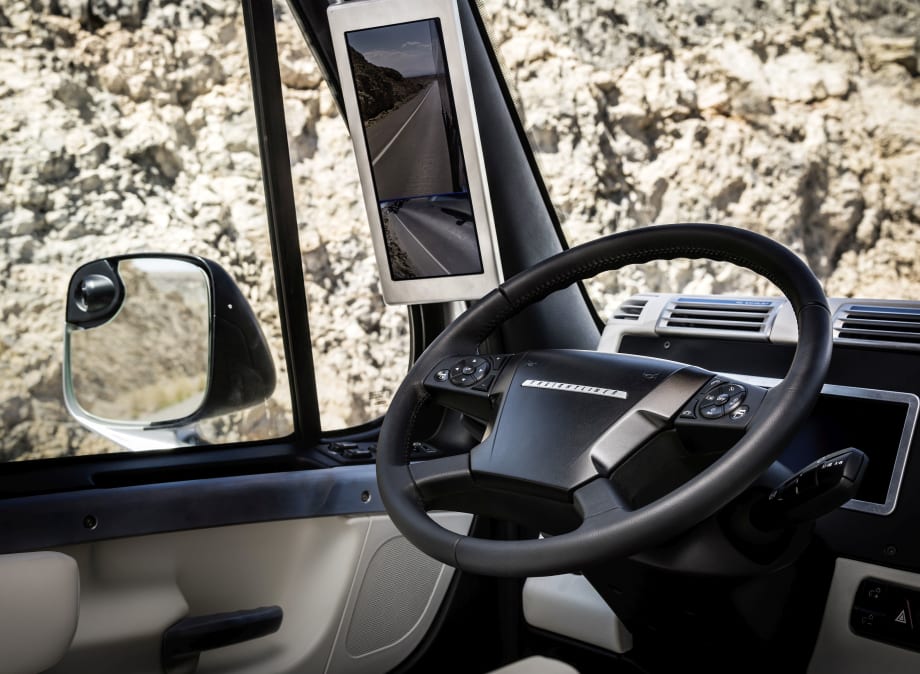
Regulations can inspire, or they can be a roadblock in the case of requirements for side view mirrors. Photo: Daimler Trucks
3 min to read
Regulations can inspire, or they can be a roadblock in the case of requirements for side view mirrors.Photo: Daimler Trucks
As it showcased its Freightliner Inspiration Truck automated truck at a global media event in Las Vegas, Daimler Trucks North America talked about sources for its inspiration — primarily customers, but also other factors, including regulations.
"We do find inspiration in certain government regulations," explained Sean Waters, director of compliance and regulatory affairs for DTNA. "Regulations and law can generate new thinking; they can be a catalyst for change."
As DTNA CEO Martin Daum said during the introduction, talking about the company's research and development efforts of which the Inspiration Truck is only the latest, "If everything comes together, we are ready to fulfill our customers' dreams," he said, referring to a graphic that also included regulations.
"And regulations are the nightmares of our customers. But we want to shape regulations as well. Sometimes regulations are necessary. We all want a safe world, we all want that everyone plays by the book. So regulations are not all bad."
Company officials emphasized how they worked with the state government of Nevada to get the first licensed autonomous trucks in the world. It's Daimler's job, Daum said, to talk with regulators with a credible voice, to be able to provide real hard, scientific facts to regulators and lawmakers that help the trucking industry.
For instance, Daum said, if DTNA can bring scientific evidence to regulators that drivers operating under autonomous mode experience decreased fatigue (and it's already found that's the case in tests on tracks), it could possibly get regulations changed for more flexible and even longer hours of service, which in turn could improve productivity. "Then we come into a real business case for our customers."
In the case of the Nevada licensing for the Inspiration Truck, state officials emphasize that they recognized the need to work closely with industry to try to make sure regulations keep pace with fast-changing technology.
They also worked with the insurance industry and law enforcement to try to address some of the questions raised about autonomous driving technology, such as liability issues.
As a result, the regulations call for some interesting restrictions on the autonomous trucks.
As would be expected, they call for drivers to have a commercial driver's license as well as additional training on the operation of the autonomous vehicle.
In addition, a requirement that an onboard data recorder, or "black box," will let accident investigators or law enforcement know if the vehicle was in autonomous mode in the 30 seconds leading up to the crash.
One requirement that raised a few eyebrows among the trucking press in attendance was that there be a second "driver" in the passenger seat. That second person need not have a CDL.
While regulations when done properly may be an "inspiration," they can also be a roadblock. Waters said a perfect example is the requirement for side view mirrors.
These "were an important advancement for their time," Waters said, but rules that require these mirrors have not caught up with technology where tiny cameras can provide drivers with even better views of their blind spot, he said. Removing those mirrors could improve fuel economy by 1.5%, he said, and DTNA has petitioned the National Highway Traffic Safety Administration for a change in the rules.
Subscribe to Our Newsletter
More Fleet Management

Sponsored•September 16, 2026
Color Match Smarter: Tools That Restore & Perform
For fleet managers and collision repair professionals keeping heavy-duty trucks on the road, getting the color right the first time isn't just about appearance — it's about efficiency, turnaround time, and bottom-line results. Discover how today's digital color tools are transforming the repair process from guesswork to precision.
Read More →
FMCSA Pauses Biennial-Update Enforcement Amid Motus Transition
Carriers whose updates were due on or after June 1 have more time, while FMCSA works to stabilize its new registration system and warns of phishing sites impersonating its new carrier registration system, Motus.
Read More →
Sponsored•September 14, 2026
2026 Blueprint for Countering Smarter Supply Chain Theft
Cargo theft is no longer just the cost of doing business. It's a multi-billion-dollar criminal enterprise exploiting vulnerabilities across your fleet, drivers, and supply chain.
Read More →


Sponsored•September 1, 2026
How Telematics Improves Visibility, Control, and Performance in Refrigerated Fleets
Explore how telematics help refrigerated fleets improve visibility, uptime, efficiency, compliance, and cargo protection across connected cold chain operations.
Read More →
What the U.S.-Canada Trade War Means for Trucking
Escalating U.S.-Canada tariffs could disrupt cross-border freight, reduce truck volumes, raise costs, and create new uncertainty for carriers on both sides of the border.
Read More →
What Are Trucking’s Top Concerns for 2026?
The American Transportation Research Institute wants to know what's worrying trucking fleet managers, drivers, and other stakeholders in its annual Industry Issues survey.
Read More →
American Trucking Associations Looks for a New Leader
ATA President and CEO Chris Spear abruptly left his job at the association on August 21, at a pivotal time for the trucking industry.
Read More →
Public Wi-Fi Cybersecurity Risks: How Truck Drivers and Fleets Can Protect Their Data
Public Wi-Fi can expose truck drivers and fleets to credential theft, malware, and other cyber threats. Here’s how to reduce the risk on the road.
Read More →
For Nicky Cupp, Fleet Innovation Starts With Frustration
HDT Truck Fleet Innovator Nicky Cupp turns everyday pain points at Fraley & Schilling into opportunities for better technology and smarter processes.
Read More →
Adam Buttgenbach’s Approach to Electric Trucks: Start With Where They Fit
HDT Truck Fleet Innovator Adam Buttgenbach helped PepsiCo build one of North America’s largest EV fleets by focusing on where electric trucks make operational sense.
Read More →