




Life in the Refrigerated Business
From a very young age, Ralph Moyle was drawn to trucking. So when given the chance, he didn’t let the lack of a driver’s license – or the fact that he was only 14 years old – stand in his way.

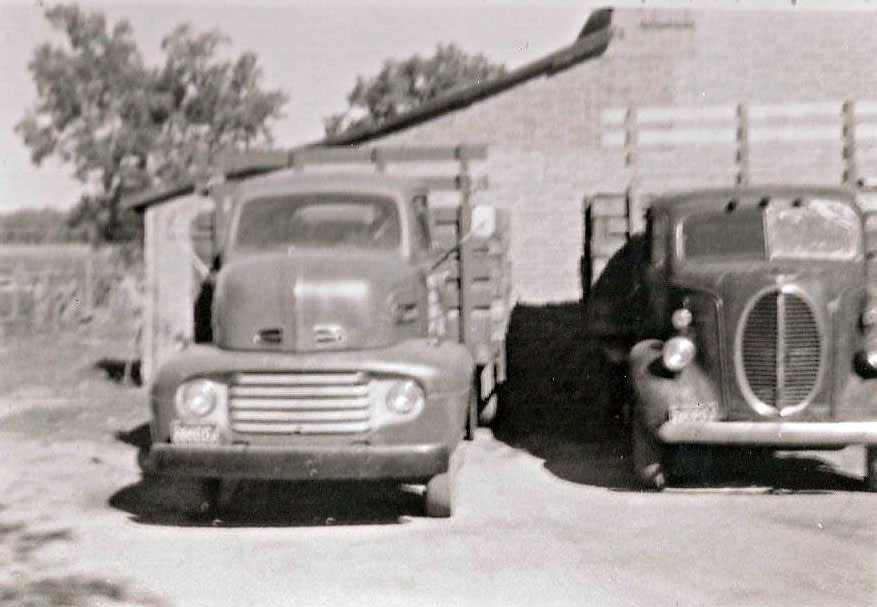
Ralph Moyle’s first truck, on the right, was a 1940 Ford. Next to it on the left is the third truck that Ralph
purchased, a 1950 Ford.

Ralph Moyle’s first truck, on the right, was a 1940 Ford. Next to it on the left is the third truck that Ralph
purchased, a 1950 Ford.
From a very young age, Ralph Moyle was drawn to trucking. So when given the chance, he didn’t let the lack of a driver’s license – or the fact that he was only 14 years old – stand in his way.
Near the end of World War II, most of the male workforce was overseas in the fight. There was no one left to haul the grapes grown in the local farms around Mattawan, Mich., the 5 to 10 miles to the Welch’s processing plant in town. So 14-year-old Ralph hopped into the seat of his father’s Ford 14-foot straight truck and began a lifelong career in trucking.
Ralphs father had bought the truck intending to get Ralph’s older brothers, Jim and Harry, to drive it (which they did) to help local farmers deliver their grapes, according to Jon Moyle, Ralph’s youngest son.
“Jim, Harry, and a family friend, Frank Farthing, added a Model T truck rear end behind the back axle and installed a bed, and they used this 1-1/2 ton truck to haul 10 tons of grapes.”
Ralph’s company hauled grapes from local farms to Welch’s plants for almost 65 years.

This is the second tractor-trailer Ralph owned, a 1956 C600 Ford with an open-top trailer.
This tractor was used to haul grapes, apples, Christmas trees and pickles. It traveled as far away as Iowa from its home in Mattawan, Mich.
Growing the company
After serving for two years in the Army during the Korean War, Ralph began pursuing his dream of owning his own trucking company. He went back to driving local produce in 1955 while earning a business degree at Western Michigan University.
By the late 1950s, Ralph’s business had three trucks. He eventually incorporated the business in 1966 as Ralph Moyle Inc., and expanded the company to five trucks in the mid-1970s.
When a local canning plant was sold to Coca-Cola Foods in 1979, Ralph was invited to work with the new company and his business grew quickly. By the end of 1980, he had more than 30 tractors as well as refrigerated, food grade liquid bulk and dry vans.
In the 1990s, Ralph’s sons, Mike and Jon, joined him in running the trucking business, along with a warehousing business that Ralph started. Mike currently serves as the company’s COO, while Jon has the role of CFO.
It’s a plan Ralph wrote about when he was still in college.
“In 1961, several years before he even met my mother, Dad wrote a term paper for a small business class at Western Michigan University describing the business he had developed and steps he hoped to take to foster growth,” Jon says. “In the conclusion to that report, he stated that he hoped one day to turn the business over to his two sons — which is exactly what happened.”

Ralph Moyle (left) received a Michigan Trucking Association Fleet Safety Award in 2008.
The company today has more than 150 employees. They are a regional carrier that runs primarily in the Midwest, operating in 35 states from Texas to Massachusetts.
The company runs a fairly high trailer-to-tractor ratio (280 trailers to 80 trucks) in order to take advantage of drop trailer programs and minimize drivers’ loading and unloading time. The trailer fleet is a wide mix, with Utility, Wabash and Great Dane the most common.
They run roughly 60% Thermo-King and 40% Carrier refrigeration units. Along with 116 reefers, the company runs 155 dry vans, plus nine stainless food grade tankers.
Food products and containers are the primary specialty, accounting for more than 80% of its freight. Fruit juices (both refrigerated and non-refrigerated) account for the greatest volume, followed by general food products, food containers and pharmaceuticals. The average length of haul last year was 275 miles.
State of the industry
In the recent economic downturn, Ralph Moyle Inc. was not negatively affected to the extremes that many other Michigan trucking companies were.
“Since our primary customers produce food staples, we weren’t affected as severely as many trucking companies, especially Michigan trucking companies who are traditionally automotive-related,” Jon says. “We went from 80 trucks in 2008 down to 77 in 2009, but we’ve been back at 80 most of this year.”
As the economy works to right itself, there are still many other challenges facing the refrigerated trucking business.

Jon says two of the biggest are the impact of environmental regulations relating to transport refrigeration units in California (and their implications for future regulations in other states), and the increase in customer interest in end-to-end temperature records due to federal regulation of food handling.
“In both cases, it’s increasingly difficult for smaller, regional carriers like us to update equipment fast enough to keep pace with regulatory demands,” Jon says. “Financially we’re not in a position to be able to upgrade all of our units at one time, so we have concentrated on developing processes and double checks to make sure our equipment is monitored closely and our drivers are trained well enough to prevent problems, and correct them quickly if they do occur.”
Fuel costs, of course, are a challenge for all fleets, even more so for those running reefers. The company has made aggressive strides on the tractor side of the fuel equation, but not so with their refrigerated units.
“On the reefer unit side, it’s much more difficult because there are fewer ways to increase fuel economy. Maintaining the temperature in the trailer to protect the integrity of the product has to be the number one concern, and fuel economy is a distant second. The best tools we have are just to keep the units in good repair, along with door seals and structural integrity, to try to prevent cold air from escaping.”
Ralph Moyle Inc. also is dealing with the repercussions of the new hours-of-service regulations that went into effect on July 1.
“We’ve had to do a better job of planning dispatches and making sure the drivers are trained to maximize their available hours due to the new rules relating to 34-hour restarts, and it has made life much more difficult for our driver managers,” Jon says.
“We’re almost halfway through implementation of e-logs in our fleet, so we have some good tools at our disposal to help manage it, but it has definitely added one more variable to an equation that already has several.”
More Drivers

Driver Trust Can Make or Break the Success of Fleet Safety Technology
New Teletrac Navman research suggests that onboarding, transparency about driver data, and positive feedback can play a significant role in how commercial drivers respond to safety and coaching technology.
Read More →
EEOC Sues KLLM Over Alleged Sex Discrimination in Driver Training
KLLM is facing a federal sex-discrimination lawsuit over policies the EEOC alleges put female truck driver trainees at a disadvantage.
Read More →
FMCSA Moves to Codify English Language Requirements for Commercial Drivers
By changing regulations on English-language proficiency requirements for commercial drivers, rather than relying on a guidance memo, the FMCSA said future administrations won't be able to walk back the Trump administration's stricter enforcement with just a memo.
Read More →
Drivers Put Western Star Trucks to the Test at Star Nation Experience
Watch to get an inside look at the Western Star trucks, technology, and community behind the Star Nation Experience 2026!
Read More →
Trump Administration Looks to Put More Veterans Behind the Wheel
The Freedom Haulers program pulls together existing and expanded programs at several federal agencies to recruit veterans to drive commercial heavy-duty trucks and cut the red tape for them to get a CDL, training, and employment.
Read More →
Putting Mack’s Command Steer to the Test
A test drive of Mack’s Command Steer active steering system evaluates how it can make truck driving easier and less tiring.
Read More →
Competition Heating Up for Truck Drivers
New report reveals rising driver hiring costs, the return of sign-on bonuses, growing AI advantages, and the operational factors shaping driver retention.
Read More →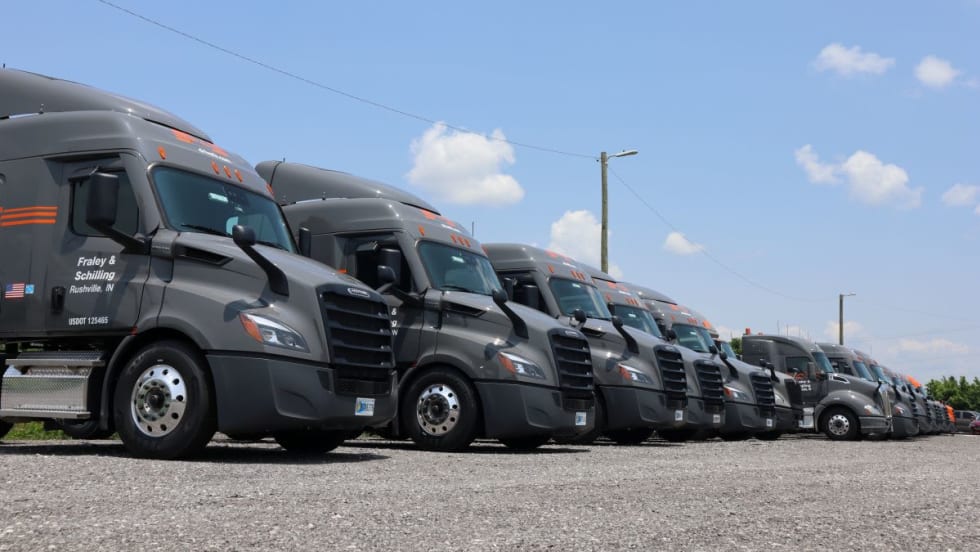
How Fraley & Schilling Improved Logbook Compliance by Over 50%
Fraley & Schilling needed a way to close a compliance workflow gap in its ELD system without adding more work from driver training, reminders, and back-office follow-ups. It found the answer in a custom driver app.
Read More →
Volvo Goes Gaming
Volvo has roared into American Truck Simulator with two new flagship trucks.
Read More →
What the Best Fleets to Drive For Teach About Driver Retention
Survey fatigue, AI-powered routing, owner-operator expectations, and the decline of social media all emerged as themes from this year's Best Fleets to Drive For program.
Read More →