




7 ways to improve trucking's image
Trucking image. It's something just about everyone in the industry wants to improve, but it's a moving target, a never-ending battle

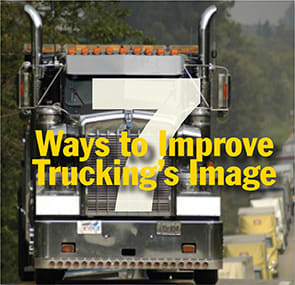
Trucking image. It's something just about everyone in the industry wants to improve, but it's a moving target, a never-ending battle.
"A lot of times we go to Truckload Carriers Association or American Trucking Associations meetings, and we're very involved in committees on things like highway policy and government regulations, those tangible things," says Dennis Dellinger, president of North Carolina-based Cargo Transporters Inc. and co-chair of TCA's image committee. "CEOs, VPs, COOs, they like something they can take home and measure," he says. "It's hard to do that with image. To change a mindset takes a long time."
Nevertheless, Elisabeth Barna, vice president of outreach at ATA, reports an increase in the number of requests for talking points and for industry and safety statistics. "I think people are more engaged now than they ever have been."
We've come up with the following seven ways you can work to improve the image of trucking - and of your fleet:
"There are so many opportunities at the local grass roots level to change [trucking's] image," Barna says.
Groups such as rotary clubs or chambers of commerce, for instance, are always looking for speakers, she says, recommending you bring a truck and get people up in the cab.
Trucks are also great to enter in parades and exhibit at local events. Cargo Transporters does just that with its two patriotically decorated Freightliner Rolling Thunder Ride of Pride trucks, displaying them at truck shows, driving them in parades, taking them to school events and granting requests to have them at Harley dealer events.
"Most of our neighbors don't understand what we do," says Aaron Tennant, president and CEO of Iowa-based open deck carrier Tennant Truck Lines. "When we explain it to them, they get excited, and they start talking to somebody else."
Tennant talks to junior high and high school students about opportunities in the industry. It's not too early to start in preschool, he says, pointing out that there's no real equivalent of the beloved Thomas the Tank Engine for trucks.
"I took a couple trucks up to my son's preschool and took them coloring books," he says. "The kids loved it, they talked about it for weeks."
Dellinger says he didn't realize the impact school visits had until a new driver told him, "Ever since you had a truck at my 6th grade class, I've wanted to drive a truck."
Many trucking companies actively work to help charitable organizations, either in their communities or on a national basis.
For instance, Indiana-based Baylor Trucking is very involved in Breast Cancer Awareness Month, with special company events raising money that goes both to the national Susan G. Komen for the Cure breast cancer awareness and research efforts, as well as to a local hospital to buy wigs for breast cancer survivors. There are raffles to raise money and days when employees can donate money to be allowed to wear jeans.
Another favorite Baylor charity is a local home for children who have been separated from their families. The company uses its relationship with customer Toys 'R' Us to get a few of the hottest toys each holiday season to raffle off and raise money for the home.
Government officials, from the town hall to Capitol Hill, get their image of trucking partly from their constituents and partly from their own experience.
ATA organizes a Call on Washington program, where state associations bring in members and non-members to DC to get briefed on legislative issues and meet with their local representatives.
Barna encourages trucking companies to extend personal invitations for government officials to visit fleet facilities.
"There's no better way to educate members of Congress or their staff, than to invite them out to your facility and get them up in the cab of a truck, whether it's for 15 minutes or an hour or more," she says.
There are a number of programs that help trucking's image, such as the ATA's America's Road Team and Share the Road programs, TCA's Highway Angels program, Goodyear's Highway Hero, Trucker Buddy and more.
For instance, National Truck Driver Appreciation Week is not only about showing drivers you appreciate them - it's also about reaching out to the larger community and to the media to explain why drivers are worthy of appreciation.
Wreaths Across America is another program that is gaining participation. This non-profit organization coordinates wreath-laying ceremonies each December at Arlington National Cemetery and nearly 800 additional veteran cemeteries and memorials. Fleets have been donating trucks and drivers to transport the wreaths for years, and this fall, TCA is working with WAA to coordinate wreath delivery logistics.
Two years ago, TCA created a moving TV ad about trucking and Wreaths Across America, and is encouraging members to buy airtime to run it in their local communities. Last year, more than a dozen fleets did so, and TCA estimates the ads reached 1.5 million people.
You may be buying new clean-die-sel trucks, testing natural gas engines or adding aero improvers because it'll save money on fuel in the long run, or because government regulators or shippers are demanding it, but being environmentally friendly is also an image-building opportunity.
"Our industry is safer and cleaner than ever," says Cari Baylor, vice president of Baylor Trucking. "I loved the recent University of California study about chargrilled hamburgers putting out more air pollution than diesel trucks."
She says the company uses information from sources such as ATA and OEMs to show reporters, shippers and government officials how truckers are investing in sustainability.
A couple of years ago, she says, a shipper called her to complain that the company's trucks were idling in its yard despite a no-idling policy. Baylor's explanation of how EPA 2010 trucks are actually putting out cleaner air than they're taking in caused the shipper to change its policy.
When you have a good story to tell, whether it's winning a safety competition, raising money for a local charity, or having a driver named to the state or national Road Team, be sure to reach out to the local media.
"Local papers eat that stuff up," says ATA's Barna. For instance, she says, when Washington state recently had a woman driver win its truck driving championship, "She was on every local station out there."
If possible, get reporters into a truck for a more compelling experience - and great photo and video ops.
Baylor Trucking worked with a Cincinnati-based TV station to put together a segment on infrastructure. Cameras mounted on Baylor trucks Showed the reality of driving on construction-heavy 1-75. The reporter also got a tour of high-tech goodies such as electronic logs, lane departure warnings and tire pressure warnings.
Many trucking company executives are hesitant to talk to the media, fearful of mangled quotes and "gotcha" journalism. One who's not is Kevin Burch, president of Jet Express Inc. in Dayton, Ohio.
"It's all about communication, and I like to communicate with the media," he says. "If you don't, you get yourself in a box, and when you do have a story to tell, they won't listen."
Saying "no comment" when the media comes calling just makes you look bad, he says.
"When you keep the media informed, they call YOU for advice," Burch says, whether it's to ask about a truck wreck, a dangerous local intersection, high fuel prices or the driver shortage.
"It gives me the opportunity to turn a negative into a positive, to tell them we're going more miles with less fatalities. We have a story to tell on safety."
That's not to say you don't need to be careful about what you say. Burch recommends role-playing. Get someone to pretend to be the journalist and throw tough questions at you.
"Keep your points very simple," recommends ATA's Barna. "Talk about the essentiality of the industry and the safety record. Especially bring home the point that without trucks, you would not have the medicine at the hospital you need or the groceries in the grocery store; your kids wouldn't have their soccer balls or ice skates."
As Cari Baylor says, "These men and women are missing the soccer games for their kids to make sure the soccer balls are delivered."
If you quote statistics, make sure you have a good source for them, such as the ATA. Incorrect or misleading numbers may just make you look bad.
If a TV, radio station or newspaper calls about something negative, Barna says, "You still need to talk with the reporter. It may not be exactly what you want to tell them, but if you're honest with them, they may use you later down the road.'"
And if you don't talk to them, you can be sure that someone else - a truck-accident attorney, a safety advocacy group, a random driver found at a truckstop - will.
All the positive press a person sees can be wiped out by a single negative one-on-one experience.
Keep equipment clean and in good repair. Do trucks have any accessories or add-ons that can be perceived as negative, such as naked-lady chrome mudfiap decorations? Make sure drivers' personal appearance and actions show respect for themselves, fellow drivers and motorists.
At Tennant, drivers get the message from the top down, through operations and their fleet managers.
"They know how important image is, and that we won't tolerate a poor appearance," Aaron Tennant says.
The company put shower rooms and a laundry room in its new facility for drivers, and there's a truck wash as well. The company offers low-cost uniform options for those who want to take advantage of them.
Aaron Tennant says the industry also needs to look at the root of the problem: If drivers don't have respect for themselves, it's going to be hard to get the general public to respect them.
"We've had a lot of bad apples out there, and now we've got to clean it up, put safety first and image a very close second."
There are many existing image-related programs you can get involved in, including the following. Check with your state trucking association, as well.
ATA America's Road Team, www.americasroadteam.com
ATA Image Committee, www.truckline.com/About/PolicyCommittees/Pages/CIPC.aspx
ATA National Truck Driving Championships, www.truckline.com/Federation/Councils/slpmc/NTDC/Pages/Default.aspx
ATA Share the Road program, www.atastr.org
Good Stuff: Trucks Bring It campaign, www.trucksbringit.com
Goodyear Highway Hero, www.goodyear.com/truck/news/hero.html
National Truck Driver Appreciation Week, www.ntdaw.org
TCA Highway Angels, www.truckload.org/highway-angel
TCA Image Committee, LINK COPY GOES HERE
www.truckload.org/committees
Truckers Against Trafficking, www.truckersagainsttrafficking.org
Trucker Buddy, www.truckerbuddy.org
World's Largest Truck Convoy
Wreaths Across America, www.wreathsacrossamerica.org
From the November issue of HDT magazine.
More Fleet Management

Geotab Links Fleet Card to Vehicle Data
The new card combines fuel discounts with telematics-based purchase controls. Geotab’s analysis also points to potential savings from choosing lower-priced fuel stops.
Read More →
How MFA Helps Protect Trucking Fleets
Multi-factor authentication adds protection when passwords are stolen. Here’s how it works and where fleets should start.
Read More →
How Better Freight Data Helps Trucking Teams Get Ahead of Disruption
Trucking and logistics teams have plenty of data. The problem is getting the right information in front of the right people soon enough to act. Better-connected data can help teams spot trouble earlier and make smarter decisions before small problems become big ones.
Read More →

Trimble: Taking Artificial Intelligence in Trucking Beyond Faster Tasks
At Insight 2026, Trimble executives argued that fleets may need to redesign workflows to get more from AI as it introduced new products and enhancements. AI’s value will depend on how fleets combine automation with their people's knowledge.
Read More →
Build a bulletproof fleet: Uniting ELDs and dash cams for total compliance
An ELD can prove compliance, but it cannot always prove what happened on the road. Discover how uniting accurate ELD data with AI-powered dash cam video can help your fleet strengthen compliance, defend against liability, protect drivers and reduce operational costs.
Read More →
Nominations Open for HDT Emerging Leaders
Heavy Duty Trucking is looking for accomplished trucking fleet professionals under 40 who are making an impact and helping lead the industry forward.
Read More →
Why Private Fleets Are Taking More Freight
Private fleets are putting their own trucks on demanding customers and high-cost lanes as companies seek greater control over service, costs, and capacity.
Read More →
Color Match Smarter: Tools That Restore & Perform
For fleet managers and collision repair professionals keeping heavy-duty trucks on the road, getting the color right the first time isn't just about appearance — it's about efficiency, turnaround time, and bottom-line results. Discover how today's digital color tools are transforming the repair process from guesswork to precision.
Read More →
FMCSA Pauses Biennial-Update Enforcement Amid Motus Transition
Carriers whose updates were due on or after June 1 have more time, while FMCSA works to stabilize its new registration system and warns of phishing sites impersonating its new carrier registration system, Motus.
Read More →
2026 Blueprint for Countering Smarter Supply Chain Theft
Cargo theft is no longer just the cost of doing business. It's a multi-billion-dollar criminal enterprise exploiting vulnerabilities across your fleet, drivers, and supply chain.
Read More →