




Fleets Find Benefits in EOBRs
In the first year after adopting electronic logs, Cargo Transporters, Claremont, N.C., had not only reduced out-of-service violations related to hours of service, but it also had improved its CSA "Driver Fatigue" BASIC score and was able to cut its compliance staff by 50%

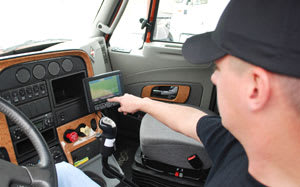
While the federal government's efforts to require electronic logging devices have suffered a setback, many in the industry are working to get ahead of an expected mandate.
In the first year after adopting electronic logs, Cargo Transporters, Claremont, N.C., had not only reduced out-of-service violations related to hours of service, but it also had improved its CSA "Driver Fatigue" BASIC score and was able to cut its compliance staff by 50%.

Speaking at a recent industry conference, Chairman John Pope said his company wanted to address a number of challenges with regards to hours of service in its 500-truck fleet. Among these were drivers being placed out-of-service for not having current logs, lack of real-time visibility into available hours and after-the-fact analysis of logbooks.
Pope's company added an hours-of-service app to its existing mobile communications system. After starting with a test on 50 trucks, within 45 days the company decided to implement the system fleetwide.
"We haven't had a driver put out-of-service for a log violation in some time," he said. In addition, the company saved significant money from not having to use third-party log auditing.
While the federal government's efforts to require electronic logging devices have suffered a setback, many in the industry are working to get ahead of an expected mandate. Others, such as Cargo Transporters, are finding that electronic onboard computers offer many benefits beyond e-logs.
Tom Cuthberson, vice president, regulatory compliance at Xata, Eden Prairie, Minn., says some fleets, seeing a mandate down the road, say they want to get ahead of the curve. "Others say they value what the devices can do in terms of reducing paperwork, providing better visibility of available hours and the other byproducts of using the things."
Norman Thomas, general manager of CarrierWeb, Atlanta, explains that "it's both the specter of future regulations and the productivity gains that are moving fleets to adopt the technology." Some, he says, "see it as a necessary evil."
Others see it as a way to become safer. Thomas says he sees a mindset change among smaller fleets from, "I have to have this because I'm forced to have it" to "I've got to have it because I need it."
Not all e-logs, or automated logging devices, are EOBRs as defined in FMCSA rules. With some e-logs, drivers keep track of their duty status by recording information into a program on a laptop computer or smartphone app rather than filling out a paper log.
EOBRs, however, as defined by the FMCSA, must link into the truck's central computer to record odometer readings and other information and must provide GPS data to track vehicle movement, among other technical requirements (many of which are still being hashed out for the upcoming new rules).
The fact that an EOBR must be linked to the vehicle's computer means fleets can take advantage of the devices beyond keeping driver logs, and a number of fleets are doing just that.
Qualcomm Enterprise Services announced last month that its QHOS hours-of-service application now has 140,000 users. Fleets are discovering that the technologies have other benefits, which gives them a "huge advantage over their peers," that don't have the technology, says Norm Ellis, vice president sales, service and marketing for the San Diego-based company.
Many fleets report discovering an extra one to 2.5 hours a week of driving time per driver - time they didn't know they had before because the fleet managers had to wait until paper logs got back to the office to find out. When tied into a back office dispatch system, an automated log allows dispatchers to know which drivers have the most hours in real-time.
"When the paper log is in the truck, you have no way of knowing which driver actually has the hours left to pick up a load," Ellis says.
"There's more beyond this than logs," CarrierWeb's Thomas says. "You get data you can use to make better decisions regarding driver behavior, vehicle behavior and fuel consumption."
Xata's Cuthberson agrees. "When you hook to the engine, there is a lot of byproduct information that you get for fuel management, idle time, driver performance scorecards and vehicle performance score cards, for instance," he says. "They've seen improvement in these areas because they can measure these things now."
As Cargo Transporters discovered, many trucking management systems feature an hours-of-service option that integrates data from the fleet's mobile communications systems, or vice versa. Some of the companies offering these systems include Qualcomm, PeopleNet, Xata and CarrierWeb.
However, fleets don't have to already have a TMS or mobile communications system to use EOBRs. There are stand-alone products that offer EOBR functionality plus other features, and Continental Commercial Vehicle and Rand McNally recently introduced two such products.
Continental, Allentown, Pa., introduced its VDO RoadLog EOBR into the U.S. market. The company has been selling EOBRs in Europe and other areas for 30 years and currently has 6 million units on the road, according to Alexis Capelle, segment leader, tachograph, telematics and services for the company.
The device records more than hours of service, as it comes with a suite of applications including an automated vehicle inspection report function and fuel tax and mileage reporting for IRP purposes.
The RoadLog is mounted on the cab and connects to the engine's ECU via an engine diagnostic port. The unit features integrated GPS and a printer that can print out hard copies of a driver's log or the VIR. When a driver logs on to the unit via a USB key, his current status and available hours are displayed.
The relatively low price of the unit, combined with the fact there is no monthly service charge, makes the unit attractive to small fleets and owner-operators, says Continental Sales Manager Jeff Waterstreet. "We've seen large fleets interested in the product for their owner-operators."

Chicago-based mapmaker Rand McNally has been producing an in-cab navigation device for the trucking industry since 2009. The company introduced an EOBR application for its TND 760 in-cab device in May. According to Mason Meadows, product manager for the EOBR group, e-logs seemed a natural progression for their product line, and the new unit includes features beyond automated logging.
"Based on the fact we have a device in the cab, we have GPS data. We have data from the vehicle's engine computer coming back to us, we can look at how a driver actually drives a truck - is he speeding, braking too hard, using the cruise control, how his fuel economy compares to other drivers?" Meadows says. That data can be combined to develop driver performance scorecards.
Meadows says few of Rand McNally's customers are interested in only logging. "There is far more interest in the full capabilities of our products," he says. "Probably less than 10% have interest in just logs." Meadows says another 30%, typically small- to medium-sized fleets that don't have integration with a fleet management system, are after logs plus driver performance information.
Driver acceptance is a key concern for many fleets contemplating automated logs, yet the pushback many expected has turned into broad acceptance.
"Drivers were concerned about the 'Big Brother' aspect of mobile comm technology when it was introduced in the early '90s," says Xata's Cuthberson. "But then drivers started seeing they were getting more loads, their revenue was more consistent, and the Big Brother thing faded. I've seen the same thing over the last few years with respect to a
More Fleet Management
AUCTION OF EQUITY INTEREST IN HEAVY HAUL TRUCKING COMPANY!!
Mark your calendar: June 30, 2026 (10:00 a.m. PDT). MagnaTrans, LLC, a California limited liability company doing business as Magna Transportation Group is going to auction! Bid on a 37.5% ownership interest in this Rancho Cucamonga-based heavy haul and over-dimensional trucking company operating across California, Oregon, and Arizona. The equity interest will be sold to the highest bidder or bidders under Article 9 of the Uniform Commercial Code at 10:00 a.m. PDT.
Read More →
Volvo Trucks Adds Unattended Over-the-Air Software Update Capabilities
The latest evolution of Volvo’s over-the-air update technology allows software updates to run while trucks are parked, helping fleets keep vehicles current without disrupting operations.
Read More →
How Waste Connections is Using Data, Telematics, and AI
How do you manage and maintain more than 18,000 connected trucks? Data. Lots of it.
Read More →
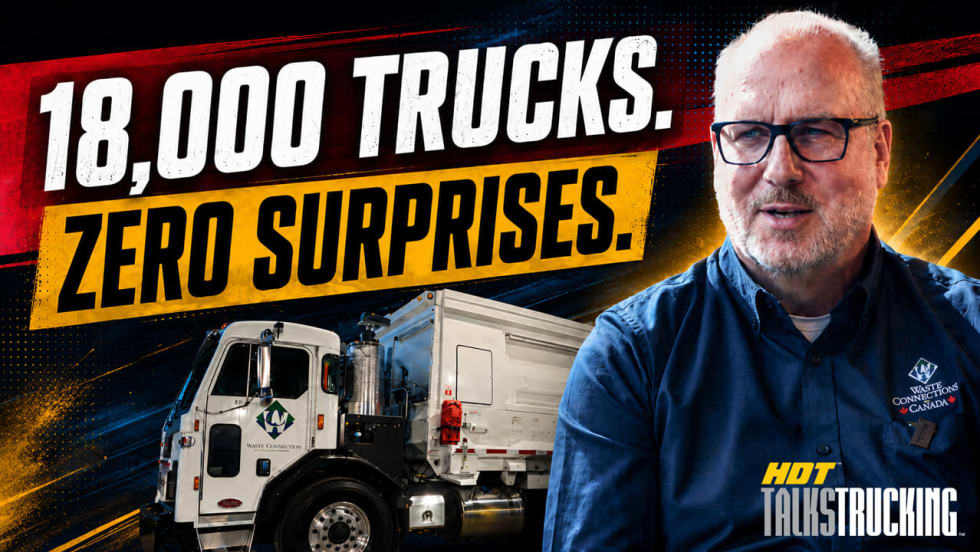
Why Fleet Data Matters More Than Ever at Waste Connections [Watch]
Waste Connections' Chuck Palmer explains how telematics, predictive maintenance, safety analytics, and AI help keep vehicles on the road and drivers safe in this episode of HDT Talks Trucking.
Read More →
NMFTA Launches Free, Anonymous Cybersecurity Threat Report Portal
Organizations are encouraged to anonymously report freight fraud, cargo crime, and cyber threats while gaining visibility into incidents reported across the transportation sector.
Read More →
AI Can Optimize a Fleet. Can It Replace Human Judgment?
Fleets fear falling behind if they don’t adopt AI quickly enough. They also fear what happens if the technology makes the wrong decision.
Read More →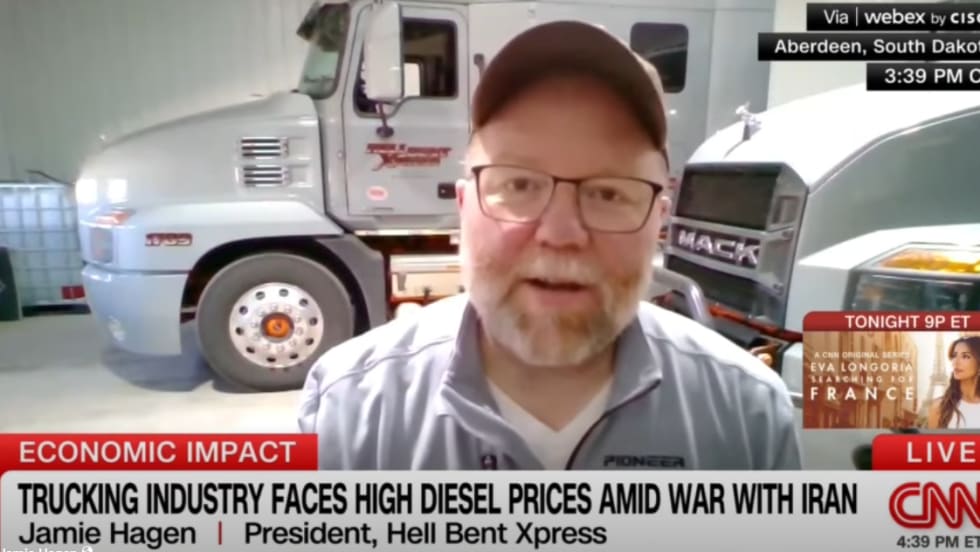
Jamie Hagen Gets Real About Running a Small Fleet in an Uncertain Economy
Small fleet owner Jamie Hagen says new legal risks, volatile fuel prices, and a changing freight market are forcing small carriers to rethink how they operate — and what they can afford.
Read More →
Jamie Hagen Gets Real About Freight, Fuel Prices, Safety, and Small-Fleet Survival
Running a small trucking fleet right now isn’t easy, especially right now. And Jamie Hagen doesn’t sugarcoat it.
Read More →
Jamie Hagen Gets Real About Freight, Fuel Prices, Safety, and Small-Fleet Survival
Running a small trucking fleet right now isn’t easy, especially right now. And Jamie Hagen doesn’t sugarcoat it.
Read More →
Data Lock‑In or Integration Lock‑Out?
Data fragmentation is costing dealerships, OEMs, fleets, and upfitters millions. Here’s why interoperability may be the fix the trucking industry needs.
Read More →