




Technology in the Next Decade: Safety and Productivity to Drive Advancements
At its core, information technology is about managing data: the schedules, locations, miles, hours, fuel prices, rates, lanes, speeds, bills, invoices, settlements, etc., that trucking companies compile every day

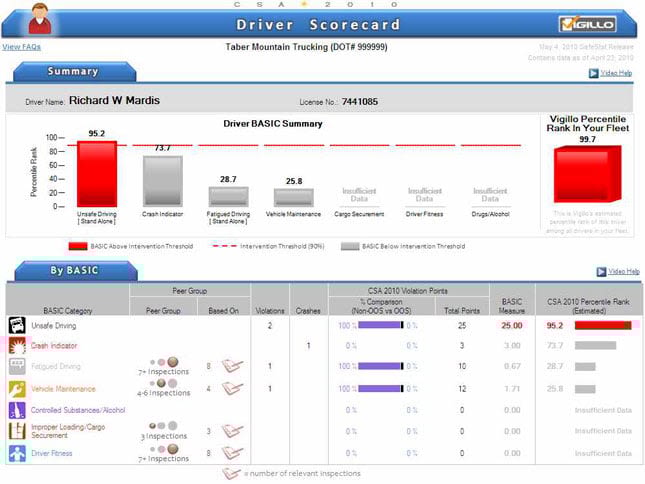
The new CSA enforcement program prompted many providers to offer their customers scorecards or other means of reviewing where a carrier stands in the new safety rating system.
At its core, information technology is about managing data: the schedules, locations, miles, hours, fuel prices, rates, lanes, speeds, bills, invoices, settlements, etc., that trucking companies compile every day.
But while productivity has been (and will continue to be) the primary factor behind developing and implementing new technologies, safety and compliance are fast becoming important drivers of future developments.
There is little argument that trucking management software systems, coupled with mobile communications, navigation, routing and other software products, have helped carriers become more productive.
"To be honest, it was never a safety consideration when we look at what data to push out; it is more why push it out from a productivity standpoint," says Ken Weinberg, vice president and co-founder of Carrier Logistics Inc. The focus, he says, was how to "get data to the truck to allow drivers to improve their productivity and get data back to improve the flow of information through the enterprise system," he says.
"Since we develop transportation management systems, our focus is automating dispatch and back-office operations, says Sean VanDyck, vice president of sales for PCS Software. These days, dispatchers do not have to verbally give drivers addresses and directions over the phone. Shippers do not have to wait for delivery information and billing does not have to wait to send out invoices.
But recently the focus has shifted more toward safety.
The Federal Motor Carrier Safety Administration's new CSA enforcement regime (which stands for Compliance, Safety, Accountability) is changing the way the government evaluates carrier safety, and there are many new software options to help carriers understand and manage their scores.
FMCSA also is expected to expand its rule mandating electronic on-board recorders and electronic logs for certain carriers, and the agency was expected to propose revised hours-of-service rules last month. Other federal agencies, along with some safety groups, are calling on the FMCSA to do more to mandate other technologies designed to improve truck safety.
For instance, the National Transportation Safety Board has recommended FMCSA require all heavy commercial vehicles to be equipped with video event recorders and require all motor carriers to adopt a fatigue management program. NTSB also repeated recommendations made previously for mandatory collision warning systems on new commercial vehicles and technologies to reduce fatigue-related accidents.
Technology providers say all this focus on safety and compliance plays a role in product development.
"It is important as a provider that we provide the tools that the customer wants," to improve their business results, says Jim Angel, product manager of safety and compliance solutions for PeopleNet. "But we also point out new regulations, and we want to help them make an impact on their safety bottom line. We want the device to give them the tools to keep a driver on their regular hours-of-service or provide sudden start and stop warnings, for instance."
Charlie Mohn, Xata product marketing manager, says safety is "absolutely" a key factor alongside operational efficiency. "The core of our product focuses on compliance, safety and helping fleets drive down the cost of operating their business," he says.
Inspections
FMCSA is also investigating new technologies for safety enforcement. It recently held demonstrations in Tennessee featuring technologies for its Wireless Roadside Inspection Program and Smart Infrared Inspection System.
The WRI program inspects the condition of a vehicle or driver by examining data collected by an on-board system. The data, called the Safety Data Message Set, is transmitted wirelessly from the vehicle to fixed or mobile roadside readers. FMCSA says the data will help enforcement officers determine which vehicles to pull over for closer inspection. The agency says the technology can assess commercial vehicles and drivers 50 times more frequently than is now possible, increasing the number of inspections.
The inspection information can be automatically transmitted to the agency's CSA database, updating carriers' scores in real time. This should benefit safe carriers as they earn credits for good safety scores.
The Smart Infrared Inspection System demonstrated is a prototype system designed to detect vehicle brake, wheel and tire problems. It's based on the premise that faulty brakes or wheel bearings and under-inflated tires will run hotter (or colder in some cases) than other components on the same vehicle. The system scans both sides of a vehicle as it passes through a scale or inspection lane and detects actual temperatures.
Fatigue detection
The FMCSA has also been exploring technologies to detect fatigue. In a report released in June 2009, the agency evaluated a number of systems. The report looked at four categories of alertness monitoring and fatigue detection and prediction technologies:
1. Readiness-to-perform and fitness for duty technologies try to determine a driver's alertness before he drives by measuring reaction time or eye movements.
2. Mathematical models/algorithm technologies use mathematical models to predict driver alertness based on individual patterns of sleep, work, and rest.
3. Vehicle-based performance technologies measure things such as steering movements, vehicle speed and the vehicle's movement with lane markers to find evidence of driver fatigue.
4. Vehicle-based operator alertness/drowsiness/vigilance monitoring technologies use cameras or other sensors inside the truck to monitor eye gaze, eye closure, head movement, brain wave activity and heart rate and other factors that might indicate the driver is fatigued or falling asleep.
Compliance issues
Xata's Mohn says there has been an increased focus on compliance in the past year - not necessarily the same thing as safety.
"Safety is inherent in compliance," he explains. "What fleets are doing now deals with CSA 2010, EOBR regulations, hours-of-service. But safety is a key thing we are working at as we develop our products."
The CSA program is prompting technology providers to offer customers ways to keep track of their safety scores. Some examples:
Vigillo offers CSA scorecards for carriers, brokers, shippers, and most recently, drivers. It introduced a free driver scorecard service in December called Roadside Resume. The company develops software products to "mine" a carrier's database in order to produce safety information in a scorecard format. The Roadside Resume will present CSA driver scores so truck drivers can see how they are rated under the new system.
TMW Systems announced a free service to monitor and manage CSA safety scores and data. The Web-based CSA Management service gives carriers extended capabilities for analyzing and transforming all of their FMCSA safety rating data for further insight and action, including government data challenge.
McLeod is working on enhancements to the safety module of its LoadMaster Enterprise product that will incorporate the new Behavior Analysis and Safety Improvement Categories (BASICs) used in the CSA system. It will allow carriers to keep track of each driver's BASIC scores well ahead of federal database updates by allowing carriers to enter roadside inspection reports directly as they are received from drivers.
EBE Technologies offers a Web-based CSA 2010 carrier and driver dashboard. It's designed "for carriers who are seeking a management tool, not simply a scorecard posting scores and percentiles," said Cindy Nelson, EBE's vice president of marketing and business development. "A carrier's score is reflective of the collective results of its individual drivers. If you can identify and correct at-risk behavior before it becomes a pattern or causes a serious safety incident, th
More Fleet Management

AUCTION OF EQUITY INTEREST IN HEAVY HAUL TRUCKING COMPANY!!
Mark your calendar: June 30, 2026 (10:00 a.m. PDT). MagnaTrans, LLC, a California limited liability company doing business as Magna Transportation Group is going to auction! Bid on a 37.5% ownership interest in this Rancho Cucamonga-based heavy haul and over-dimensional trucking company operating across California, Oregon, and Arizona. The equity interest will be sold to the highest bidder or bidders under Article 9 of the Uniform Commercial Code at 10:00 a.m. PDT.
Read More →
Volvo Trucks Adds Unattended Over-the-Air Software Update Capabilities
The latest evolution of Volvo’s over-the-air update technology allows software updates to run while trucks are parked, helping fleets keep vehicles current without disrupting operations.
Read More →
How Waste Connections is Using Data, Telematics, and AI
How do you manage and maintain more than 18,000 connected trucks? Data. Lots of it.
Read More →

Why Fleet Data Matters More Than Ever at Waste Connections [Watch]
Waste Connections' Chuck Palmer explains how telematics, predictive maintenance, safety analytics, and AI help keep vehicles on the road and drivers safe in this episode of HDT Talks Trucking.
Read More →
NMFTA Launches Free, Anonymous Cybersecurity Threat Report Portal
Organizations are encouraged to anonymously report freight fraud, cargo crime, and cyber threats while gaining visibility into incidents reported across the transportation sector.
Read More →
AI Can Optimize a Fleet. Can It Replace Human Judgment?
Fleets fear falling behind if they don’t adopt AI quickly enough. They also fear what happens if the technology makes the wrong decision.
Read More →
Jamie Hagen Gets Real About Running a Small Fleet in an Uncertain Economy
Small fleet owner Jamie Hagen says new legal risks, volatile fuel prices, and a changing freight market are forcing small carriers to rethink how they operate — and what they can afford.
Read More →
Jamie Hagen Gets Real About Freight, Fuel Prices, Safety, and Small-Fleet Survival
Running a small trucking fleet right now isn’t easy, especially right now. And Jamie Hagen doesn’t sugarcoat it.
Read More →
Jamie Hagen Gets Real About Freight, Fuel Prices, Safety, and Small-Fleet Survival
Running a small trucking fleet right now isn’t easy, especially right now. And Jamie Hagen doesn’t sugarcoat it.
Read More →
Data Lock‑In or Integration Lock‑Out?
Data fragmentation is costing dealerships, OEMs, fleets, and upfitters millions. Here’s why interoperability may be the fix the trucking industry needs.
Read More →