




Japanese Truck Market: Takeaways for the North American Trucking Industry
The Japanese economy has remained in a state of recession for the better part of this current decade. The Japanese truck industry therefore has come to rely on export sales to not only remain stable but also to grow

The Japanese economy has remained in a state of recession for the better part of this current decade. The Japanese truck industry therefore has come to rely on export sales to not only remain stable but also to grow.
This offers a key pointer to the North American truck industry if the economy continues to remain weak for the next several years, or even if it does not and starts to rebound. The key to attaining sustainable growth is to expand sales to encompass global markets. This will not only expand the revenue stream for North American truckmakers and suppliers, but also offer some level of insulation from the weakness in the local market.
We at Frost & Sullivan recently published a study, "Strategic Analysis of the Japanese Commercial Vehicle Industry," as part of our global commercial truck market coverage spanning North America, Europe, and key economies such as China, India and Russia. The study reports that 49 percent of all trucks sold by Japanese truckmakers in 2008 were actually sold in export markets. Another key finding was the growth of the mini-small truck segment in Japan. Japanese truckmakers, cognizant of the global trend towards polarization of truck classes, have embarked in an aggressive growth strategy that leverages light commercial vehicles such as mini-trucks and light trucks to penetrate and grow market share in emerging economies around the world. These economies show very healthy growth rates in demand for light and heavy commercial vehicles.
In 2008, 1.6 million commercial vehicles were manufactured and sold by Japanese truckmakers. The average age of trucks and buses in Japan is increasing, while the population of commercial vehicles has been shrinking steadily since 1992. This implies that the demand for new trucks will increase over the next four to five years. Frost & Sullivan forecasts that Japanese truck sales will grow at a compound annual rate of 2.1 percent over the 2008-2015 period.
Exports have helped Japanese truckmakers remain afloat. Japanese trucks have been adopted not only by consumers in developing nations, but also by consumers in North America and Europe. However, the emergence of China, India and Korea in the global commercial truck market is elevating competitive pressures on Japanese truckmakers. The price competitiveness of Chinese, Indian and Korean trucks is making it difficult for Japanese truckmakers to retain and expand market share in developing economies where the level of price sensitivity among commercial vehicle fleets is relatively higher than in developed economies.
Here in North America, there are several reasons to track the activities in the Japanese market, as it will have rippling effects in the American and Canadian markets. The fledging hybrid truck product portfolio of Japanese truckmakers and the expertise and pivotal hybrid powertrain system position of Japanese suppliers indicate that light- and medium-duty Japanese hybrid trucks will soon be introduced here. Moreover, the steady pace of urbanization and creation of networked cities in North America coupled with the rapid growth of the mini-small truck segment in Japan seems to suggest that a new category of commercial trucks may soon enter the North American market.
Sandeep Kar is a global program manager and senior industry analyst with the North American Automotive & Transportation Practice at Frost & Sullivan. He specializes in advanced automotive technologies with expertise in light vehicle and heavy truck systems and technologies, automotive infotainment systems, and vehicle networking technologies.
More Fleet Management

AUCTION OF EQUITY INTEREST IN HEAVY HAUL TRUCKING COMPANY!!
Mark your calendar: June 30, 2026 (10:00 a.m. PDT). MagnaTrans, LLC, a California limited liability company doing business as Magna Transportation Group is going to auction! Bid on a 37.5% ownership interest in this Rancho Cucamonga-based heavy haul and over-dimensional trucking company operating across California, Oregon, and Arizona. The equity interest will be sold to the highest bidder or bidders under Article 9 of the Uniform Commercial Code at 10:00 a.m. PDT.
Read More →
Volvo Trucks Adds Unattended Over-the-Air Software Update Capabilities
The latest evolution of Volvo’s over-the-air update technology allows software updates to run while trucks are parked, helping fleets keep vehicles current without disrupting operations.
Read More →
How Waste Connections is Using Data, Telematics, and AI
How do you manage and maintain more than 18,000 connected trucks? Data. Lots of it.
Read More →
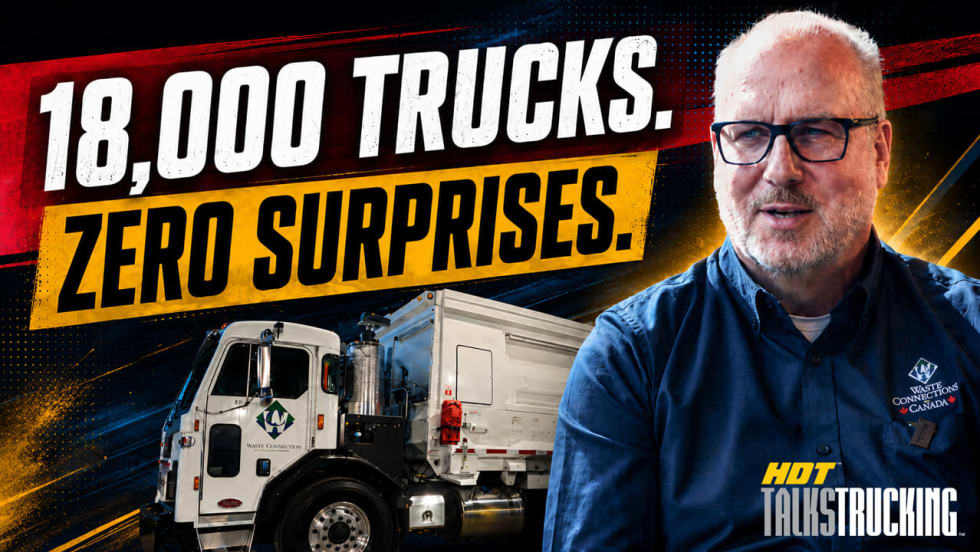
Why Fleet Data Matters More Than Ever at Waste Connections [Watch]
Waste Connections' Chuck Palmer explains how telematics, predictive maintenance, safety analytics, and AI help keep vehicles on the road and drivers safe in this episode of HDT Talks Trucking.
Read More →
NMFTA Launches Free, Anonymous Cybersecurity Threat Report Portal
Organizations are encouraged to anonymously report freight fraud, cargo crime, and cyber threats while gaining visibility into incidents reported across the transportation sector.
Read More →
AI Can Optimize a Fleet. Can It Replace Human Judgment?
Fleets fear falling behind if they don’t adopt AI quickly enough. They also fear what happens if the technology makes the wrong decision.
Read More →
Jamie Hagen Gets Real About Running a Small Fleet in an Uncertain Economy
Small fleet owner Jamie Hagen says new legal risks, volatile fuel prices, and a changing freight market are forcing small carriers to rethink how they operate — and what they can afford.
Read More →
Jamie Hagen Gets Real About Freight, Fuel Prices, Safety, and Small-Fleet Survival
Running a small trucking fleet right now isn’t easy, especially right now. And Jamie Hagen doesn’t sugarcoat it.
Read More →
Jamie Hagen Gets Real About Freight, Fuel Prices, Safety, and Small-Fleet Survival
Running a small trucking fleet right now isn’t easy, especially right now. And Jamie Hagen doesn’t sugarcoat it.
Read More →
Data Lock‑In or Integration Lock‑Out?
Data fragmentation is costing dealerships, OEMs, fleets, and upfitters millions. Here’s why interoperability may be the fix the trucking industry needs.
Read More →