




Proper Spec'ing Helps Septic Service Improve Productivity
McNel Septic Services in Ravensdale, Wash., has doubled productivity on a route by properly spec'ing a Kenworth T880 to maximize payload while still being nimble enough to maneuver in residential neighborhoods, according to Kenworth.
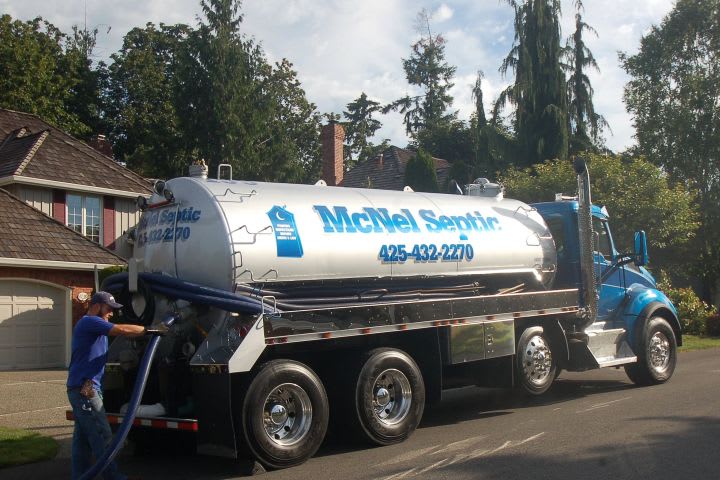
Photo courtesy of Kenworth.
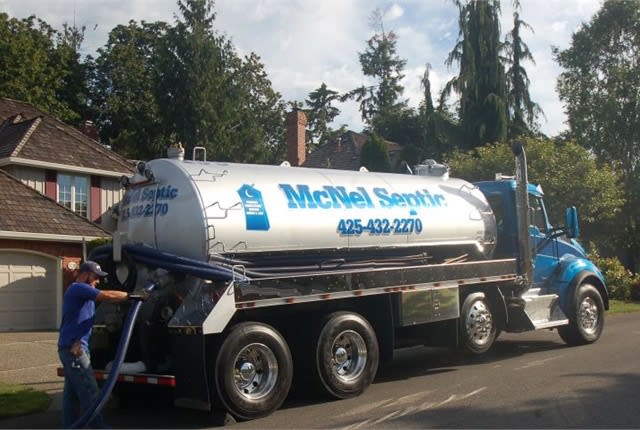
Photo courtesy of Kenworth.
McNel Septic Services in Ravensdale, Wash., has doubled productivity on a route by spec'ing a Kenworth T880 to maximize payload and easily maneuver in residential neighborhoods.
The company's owner, Shawn Carlton, set up the truck to handle more payload while still being nimble enough for the constrained sites and long driveways of residential septic work. He also wanted a truck that presented a professional image that would generate referrals and repeat business.
"While there are plenty of jobs out there, there’s a lot of competition for the best jobs," Carlton told Kenworth. "The Kenworth T880 is custom-built to get more work done in a day, and it looks fantastic. It’s my calling card."
McNel Septic’s T880 makes four to six stops a day in suburban and rural Seattle, one of the fastest-growing housing markets in the country. It has been equipped with a 4,000-gallon steel vacuum tank.
Carlton considered buying a used vehicle – he even flew across the country to test drive one – but ultimately decided it was better to spec a truck that would meet his exact needs. His local dealer, Kenworth Northwest, and the body manufacturer, Erickson Tank & Pump, worked together to get the weight distribution just right across the 20,000-pound steer axle, 46,000-pound rears, and 13,000-pound pusher.
"With the 4,000-gallon tank and the payload distributed properly, I can do twice the work with the T880 compared to my old truck," Carlton said.
The T880's cab measuring 2.1 meters (82.7 inches) is 10 inches wider than its predecessor and has 23 inches of room between the seats. The extra space gives Carlton the space he needs to work comfortably and stay organized.
"I have paperwork to fill out after every job so my truck is my mobile office," Carlton said. "When you have wet gear, a couple of lunch pails, and a helper riding along who wants to get out of the rain, you appreciate the cab when you have to haul your briefcase out."
More Equipment

How Volvo Updated Its D13 for EPA 2027 [Watch]
Volvo’s updated D13 promises lower emissions without sacrificing performance or fuel economy. Take a closer look at what changed inside the engine in this HDT Spotlight video.
Read More →
Michelin Tire Improves Efficiency and Durability for Regional Fleets
The Michelin X Multi Energy D2 is a regional haul drive tire engineered to help fleets improve fuel efficiency, durability and traction in demanding stop-and-go operations.
Read More →
ZF Expands Commercial Vehicle Push in North America
ZF is expanding its North American commercial-vehicle presence with new transmission applications, electrification, trailer technology and autonomous-driving systems.
Read More →
Tesla Wants a Self-Driving Semi. Are Cameras Enough?
Could Tesla’s camera-only autonomous driving technology work on an 80,000-pound Semi? In this commentary, HDT's Deborah Lockridge takes a look at Tesla, Cybercab, and how autonomous trucks see the road.
Read More →
Kodiak: Driverless Long-Haul Truck Launch on Track for 2026
Kodiak AI says its driverless long-haul safety case is 93% complete and it remains on track to begin commercial operations by year-end 2026.
Read More →
What DOT’s Automated Vehicle Strategy Means for Trucking
The U.S. Department of Transportation issued a new automated-vehicle strategy that outlines plans for driverless-truck regulations, cross-state freight corridors, and federal safety standards.
Read More →
East Coast Port Launches $45M Electric Truck Push
The Port Authority of New York and New Jersey announced millions in incentives for zero-emission drayage trucks, yard tractors, and new charging hubs near the port.
Read More →
PlusAI Going Public to Fund Autonomous Truck Launch
A SPAC deal could provide PlusAI with up to $300 million as it works toward a 2027 commercial launch of factory-built autonomous trucks.
Read More →
NHTSA Moves to Rewrite Truck Fuel-Economy Rules
The National Highway Traffic Safety Administration says it lacks authority to regulate medium- and heavy-duty truck engines separately from complete vehicles, but the existing standards have not yet been eliminated.
Read More →
Detroit Opens Orders for EPA 2027 Engines
Detroit isn’t starting from scratch to meet EPA 2027 diesel emissions standards. Its Gen 6 DD13 and DD15 engines keep much of today’s platform while updating the fuel and aftertreatment systems.
Read More →