




Commentary: The Winner of the ATD Commercial Truck of the Year Is…
Senior Editor Tom Berg writes about his experience judging the ATD Commercial Truck of the Year contest.
Who won the 2013 Commercial Truck of the Year award? Sorry, I can’t tell you, even if I knew. I should know because I’m the chief judge and have the tally sheets from the judging, but they’re still in my briefcase and I won’t look at them until after I write this.
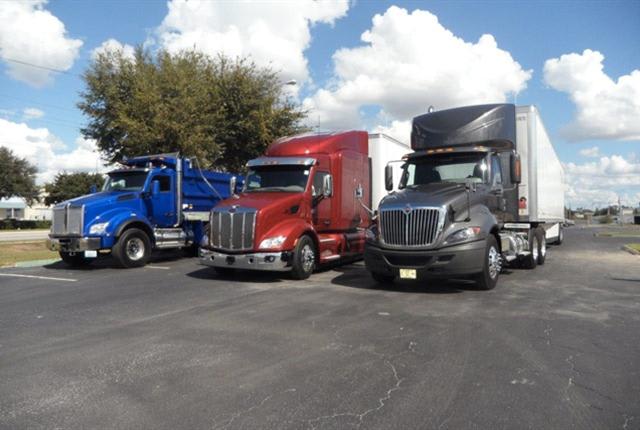
Three heavy duty entries rest at day's end. From left, Kenworth T880 dump, Peterbilt 579 sleeper-cab tractor and International ProStar+ daycab tractor.
There’s no hurry to add up the points because the winners of the heavy and medium-duty categories won’t be announced until next February at the American Truck Dealers convention in New Orleans. ATD sponsors the annual competition, now in its sixth year, and Barbara Robinson, ATD’s executive director, hasn’t bugged me about it, even though it’s been a couple of weeks since the judging was done on Oct. 18.
That was a warm and humid Friday, when representatives of four builders presented seven trucks to three judges. This was at Manheim Auto Auction’s facility in Orlando, Fla., which had the space and people with the willingness to accommodate us.
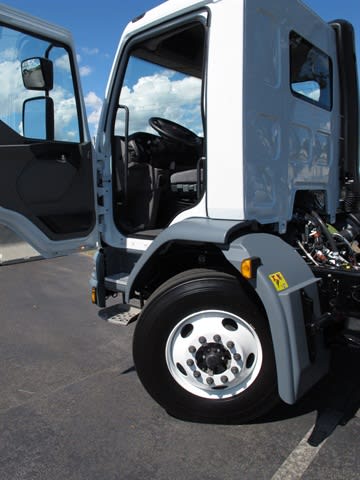
KW's K370 low cabover had normal left-hand steering and also lacked a body.
Scott Zahn, Manheim’s specialty manager in Orlando, suggested a route that we could drive. I ran it the day before in my rental car and decided that it was a good one, combining streets and expressway running to give us a taste of what each truck and tractor could do.
At first it was fun for us judges, but then became work as we listened closely to what the reps said about their trucks before taking them out on the course. We did the three heavy trucks first, then the four mediums, and it seemed like a long day even though it spanned only eight or so hours.
There was a bit of tension because we wanted to make fair and proper judgments in each of 19 scoring categories. The object was to judge each truck based on its intended application, not against competitors. This removes the apples-to-oranges problem when trucks are set up for different hauling roles.
Several builders who entered trucks in previous contests were notably absent this time. They didn’t say why, but we think they got tired of spending money to send some very able vehicles and earnest people to the judging, only to see competitors repeatedly win. A few builders have never won – something which has surprised and bothered me – and are the ones who didn’t show up this year. I can’t blame them for being glum, except to say that we judges scored all the trucks as we saw them and let the points fall where they did.
I feel that there are no losers in this competition because all entries have been excellent trucks, and said so during the last announcement at the ATD meeting earlier this year in Las Vegas. But that sounds pretty hollow when a few minutes later, reps from a competitor are on the stage, smiling broadly as they accept a trophy, and you’re not.
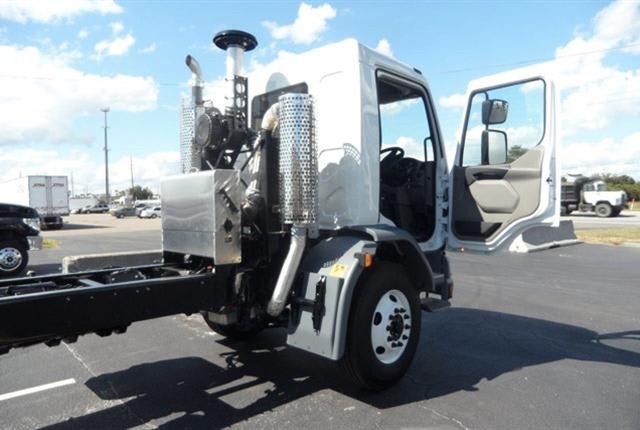
Peterbilt 220, built for street sweeping, has right-hand drive, while exhaust-aftreatment equipment is stacked close to the cab's rear to leave frame rails bare.
There were also fewer judges this time than in past years, because not as many reporters had planned to be in Orlando for the big ATA management meeting which had been the hoped-for draw. And, two of the five judges scheduled to be there had to suddenly cancel for personal and business reasons. That left me; Jim Park, HDT’s equipment editor; and Jack Roberts, CCJ’s executive editor. We all have CDLs, so could drive the heavies as well as the mediums.
The fall-off in entries and attendance caused us to talk with Barbara Robinson about the judging procedure, and we came up with some ideas: Invite a few professional drivers, truck technicians, and fleet managers to act as judges, along with the magazine editors who have been doing it. They’d provide perspectives that we scribes don’t have, and might see things that we miss. But they’d have to be from “neutral” companies (leasing firms?) to avoid any biases for or against particular truck brands. We’ll be talking further about this.
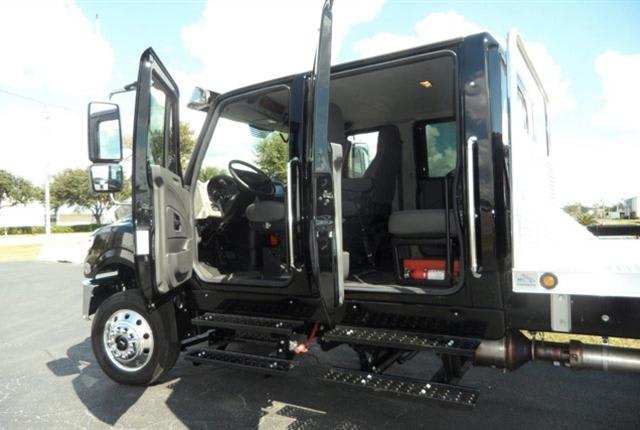
International TerraStar crewcab has considerable interior space. Rear seat has room and belts for four people.
Anyway, here are the trucks entered this year, in the order that I inspected and drove them. Don’t take the comments as hints, because I really don’t know yet who won:
Kenworth T880 dump truck – This new model was among a few construction trucks entered over the years, as most have been freight haulers. And it was one of the nicest, with an upscale interior, strong Paccar MX-13 diesel and Eaton UltraShift Plus automated transmission. A dump truck has never won before, but who knows?
Peterbilt 579 sleeper-cab tractor – Cushy and comfortable, it also had an MX-13/UltraShift powertrain, and loads of nicely organized living space. If you’ve gotta go out on the road for weeks at a time, this is one of the finest ways to do it.
International ProStar+ daycab tractor – Work-a-day trim and a 10-speed Fuller manual gearbox did not overshadow a decent ride and other attributes, including a 450-horse Cummins ISX15 that was satisfying to drive. And re-embracing Cummins is one of the wiser things that Navistar’s new management has done.
Hino 195h CC – The crew-cab version of last year’s medium-duty winner provides room for three more people while retaining its slick diesel-electric hybrid operation. The cab doesn’t tilt, so pre-trip checks require lifting a seat and pulling up a foot cushion to look at oil and transmission dipsticks, and I’m not sure about serious servicing. Hmm.
International TerraStar crew-cab 4x4 – This black-and-chrome show truck had a serious flatbed body and towed an equipment trailer toting a backhoe to add some weight and further demonstrate its workability. The long cab is rather roomy, and the MaxxForce 7 V-8 diesel and Allison automatic made it scoot. The 2-speed transfer case and front-driving axle were ready but not needed where we drove.
Peterbilt 220 right-hand-drive – The special chassis had air tanks between the frame rails and all exhaust aftertreatment equipment stacked close to the cab’s rear, thus keeping the frame almost completely clear for a bulky body. It was absent, but the truck was built for street sweeping, which explained the British-style controls. Driving from the right side of the cab didn’t feel as strange as I expected.
Kenworth K370 – A more normal take on the Paccar-built low-cab-forward series, this truck likewise had no body, though a van of some sort seems logical. A Pete version won the midrange class a couple of years ago, but a cab-and-chassis-only truck is hard to judge. Let’s see what the points bring – and that goes for all of these trucks.
More Equipment

How Volvo Updated Its D13 for EPA 2027 [Watch]
Volvo’s updated D13 promises lower emissions without sacrificing performance or fuel economy. Take a closer look at what changed inside the engine in this HDT Spotlight video.
Read More →
Michelin Tire Improves Efficiency and Durability for Regional Fleets
The Michelin X Multi Energy D2 is a regional haul drive tire engineered to help fleets improve fuel efficiency, durability and traction in demanding stop-and-go operations.
Read More →
ZF Expands Commercial Vehicle Push in North America
ZF is expanding its North American commercial-vehicle presence with new transmission applications, electrification, trailer technology and autonomous-driving systems.
Read More →
Tesla Wants a Self-Driving Semi. Are Cameras Enough?
Could Tesla’s camera-only autonomous driving technology work on an 80,000-pound Semi? In this commentary, HDT's Deborah Lockridge takes a look at Tesla, Cybercab, and how autonomous trucks see the road.
Read More →
Kodiak: Driverless Long-Haul Truck Launch on Track for 2026
Kodiak AI says its driverless long-haul safety case is 93% complete and it remains on track to begin commercial operations by year-end 2026.
Read More →
What DOT’s Automated Vehicle Strategy Means for Trucking
The U.S. Department of Transportation issued a new automated-vehicle strategy that outlines plans for driverless-truck regulations, cross-state freight corridors, and federal safety standards.
Read More →
East Coast Port Launches $45M Electric Truck Push
The Port Authority of New York and New Jersey announced millions in incentives for zero-emission drayage trucks, yard tractors, and new charging hubs near the port.
Read More →
PlusAI Going Public to Fund Autonomous Truck Launch
A SPAC deal could provide PlusAI with up to $300 million as it works toward a 2027 commercial launch of factory-built autonomous trucks.
Read More →
NHTSA Moves to Rewrite Truck Fuel-Economy Rules
The National Highway Traffic Safety Administration says it lacks authority to regulate medium- and heavy-duty truck engines separately from complete vehicles, but the existing standards have not yet been eliminated.
Read More →
Detroit Opens Orders for EPA 2027 Engines
Detroit isn’t starting from scratch to meet EPA 2027 diesel emissions standards. Its Gen 6 DD13 and DD15 engines keep much of today’s platform while updating the fuel and aftertreatment systems.
Read More →