





Related: Finding a Good Fit When Selecting a Service Provider
Keeping Truck Bodies Repaired Is Good for the Bottom Line
Keeping truck cabs in good repair has always been good for a fleet’s image. And today, it’s good for the bottom line as well.
March 19, 2018
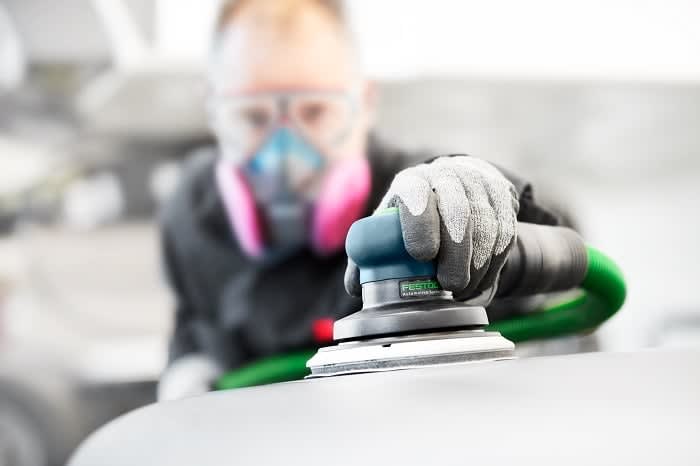
As truck OEMs use more advanced materials for body surfaces, education and training has become vital for body and paint technicians. Photo: 3M
6 min to read
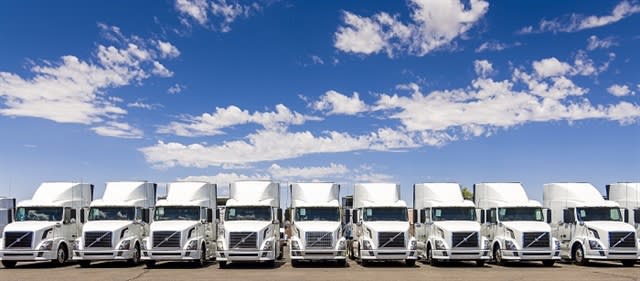
Keeping fleets looking sharp is always a challenge. But new products and materials are making doing so easier than ever.Photo: Sherwin Williams
Trucks live hard lives. Dents and dings simply go along with the job. But while the temptation to overlook damaged vehicles can be overwhelming during peak business times or when money is tight, experts say doing so can actually cost you more money in additional repairs later on — as well as hurt your company image and degrade fleet fuel efficiency.
“Not many fleet managers get excited about pulling a truck out of service to address cosmetic issues,” says James Svaasand, vice present of collision center development and operations for Penske Truck Leasing. “But at some point, most of them recognize that there is great benefit to taking care of these issues before they get out of hand.”
Svaasand is responsible for a chain of collision repair centers across the United States and Canada. He works with both OEMs and body material and paint suppliers to continuously refine the products and procedures used to keep truck exteriors in good shape.
Complicating matters is the fact that modern truck exterior design relies on advanced components and materials that were unheard of just a few years ago. Svaasand says it is not uncommon to see OEMs use proprietary composites or metals in their designs.
“Daimler, for example, uses aluminum cabs, while Navistar uses high-strength steel,” he notes. “And you also see a great deal of lightweight fiberglass body panels today. So it can be challenging for our technicians to stay on top of the latest repair procedures, because things are so specialized today.”
Rush Truck Centers also maintains a nationwide network of body repair shops. Daniel Brown, the body shop manager at Rush’s Dallas dealership location, agrees with Svaasand’s appraisal of body materials in use today. “Without a doubt, metal was much easier to work with,” he says. “Today, our technicians have to deal with composite materials, plastics and aluminum. The repair procedures are far more complex, and the overall costs have gone up as well.”
Brown says glues and (often) two-part adhesives used in body repairs today can often cost $70 to $80. “Moreover, there are no shortcuts anymore,” he adds. “Technicians have to follow the repair procedures faithfully to fix the trucks correctly. And with the cost of these materials today, we just can’t afford to have them making any mistakes. The guys we have in our shops today doing body work are truly specialists. They have to be.”
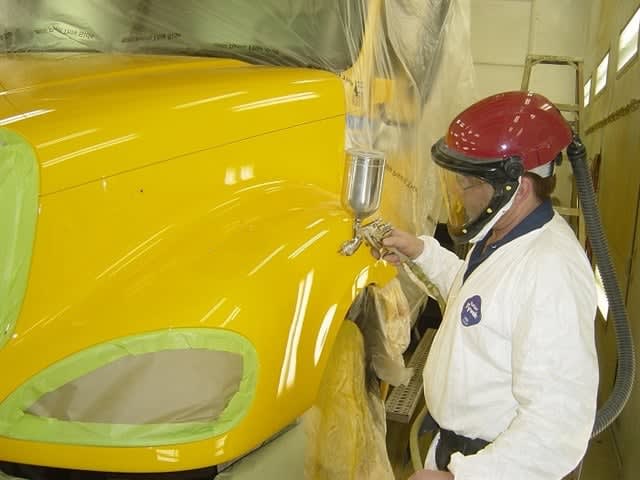
Resale values and corporate image are two major reasons Penske makes repairing body and paint damage a priority.Photo: Penske
Flexible materials for faster turnaround
The companies that develop and manufacture the materials used to repair truck bodies are under unrelenting pressure to stay current as well, says J.J. Wirth, brand manager, fleet segment, USCA Commercial Coatings — a division of PPG.
“One noteworthy trend in the Class 8 truck world is that fewer rivets are being used in the manufacturing process,” Wirth says. “This is a huge benefit to painters, making it much easier to get a good, final finish on paint jobs. At the same time, the structural adhesives used in repair instead of rivets are evolving daily as new production processes, materials and substrates — including plastics and composites — are used to improve weight (leading to better fuel economy), strength and durability. In light of these structural changes, following OEM repair procedures and selecting the correct coatings products are critical steps for achieving ultimate finish expectations.”
In response to the limited availability of repair procedures from the OEMs, 3M is focusing on developing repair procedures – including corrosion prevention -- to avoid galvanic corrosion by duplicating isolation that would be present in factory riveted attachment flanges. These processes include the proper use of seam sealers, foam installations and bonding adhesives for panels and joints. This helps deliver high-quality, more durable repairs.
Due to the push for lighter weight body components, the use of Metton LMR seems to be increasing, says Dale Ross, U.S. marketing operations manager for 3M Automotive Aftermarket Division, who says this can be attributed to lighter weight, design and cost advantages to the manufacturer. "Newer SMC panels used for hoods and fenders are getting thinner and lighter compared to years ago,” says Ross. “This can create a challenge, as technicians have questions about proper repair processes but aren’t finding this information readily available. We are working to provide the new information or training to ensure repairs are being done properly.”
Penske uses both 3M and PPG products in its body shops, and that relationship includes working with those companies as they develop new products and work to educate technicians on proper repair procedures. “The OEMs do a really good job getting support out for their powertrains and mechanical components,” Svaasand says. “But that support is sometimes lacking when it comes to new body components and their repair procedures.”
He says 3M’s new line of commercial vehicle repair materials has given his shops real advantages in terms of turnaround times and the overall fit and finish of the repair jobs. “Depending on the severity of the damage, we can often run minor bump and bruise repairs around in a day,” he says. “Larger jobs — like rollovers — obviously take more time because we have to assemble parts. But we want to be able to handle just about any type of body repair, and those materials give us that capability.”
Another example of advanced materials in use is Wabash Composite’s Duraplate composite sidewall panels, which Svaasand says can be used on both dry vans and tractor bodies. The plates are constructed of a high-density polyethylene (HDPE) core bonded between two high-strength steel skins for damage resistance. Penske technicians have found these plates to be quick and efficient to use in repairs — to the point he feels it is more cost-effective to replace a whole Duraplate panel, rather than cutting sections out to fill in damaged areas.
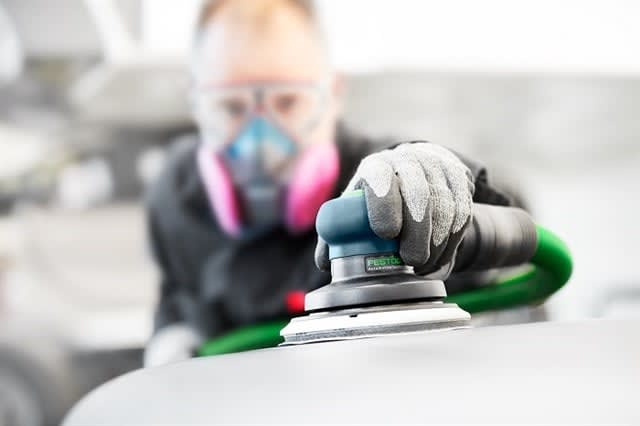
As truck OEMs use more advanced materials for body surfaces, education and training has become vital for body and paint technicians.Photo: 3M
Ross says minimizing the amount of time a truck spends in the body shop is a priority for PPG as well. It has developed a line of commercial grade products that allows technicians to take care of minor touch-up work without committing a vehicle to a paint booth. Any touch-up paint work that can be done at a fleet maintenance facility instead of in a paint booth is welcomed because it saves time, labor and money, as do rollable and aerosol products that are often used for touch up or wheel refurbishment as well.
Paint and body material suppliers are going the extra mile to help fleets deal with minor body and paint issues in a timely and affordable manner, says William Lemons, technical service manager, commercial vehicles, AkzoNobel. “We’ve been making some inroads with a new product for quick spot repairs, that uses ultraviolet light to cure paints,” he notes. “The product is available now for the passenger car market, and we’re looking closely at adapting it for commercial vehicles.”
Lemons says a handheld UV light allows technicians to identify and touch up hard-to-spot minor paint damage at a shop before corrosion sets in. “It’s always important to take care of minor paint and body issues before they turn into major ones,” he adds. “The more you do to prevent moisture and corrosion from making contact with metal, the longer you can keep a vehicle while protecting its resale value.”
Penske’s Svaasand also praises PPG’s Delfleet paint refinishing system and products, which takes much of the guesswork out of a notoriously difficult task — accurately matching paint colors on repair jobs. “Paint colors are often the stumbling block in achieving that goal. But PPG’s system enables our technicians to match the paint using a computer program, and then take into account factors like UV radiation and natural fading and discoloration that happens naturally over time.”
An ideal repair job is one where the truck doesn’t look like it has been in the body shop at all. The technicians who make a once-damaged truck look as good as new are as much artists as they are craftsman. The materials they work with today are complex and demanding. But the results they deliver are truly impressive.
Subscribe to Our Newsletter
More Equipment

How Volvo Updated Its D13 for EPA 2027 [Watch]
Volvo’s updated D13 promises lower emissions without sacrificing performance or fuel economy. Take a closer look at what changed inside the engine in this HDT Spotlight video.
Read More →
Michelin Tire Improves Efficiency and Durability for Regional Fleets
The Michelin X Multi Energy D2 is a regional haul drive tire engineered to help fleets improve fuel efficiency, durability and traction in demanding stop-and-go operations.
Read More →
ZF Expands Commercial Vehicle Push in North America
ZF is expanding its North American commercial-vehicle presence with new transmission applications, electrification, trailer technology and autonomous-driving systems.
Read More →
Tesla Wants a Self-Driving Semi. Are Cameras Enough?
Could Tesla’s camera-only autonomous driving technology work on an 80,000-pound Semi? In this commentary, HDT's Deborah Lockridge takes a look at Tesla, Cybercab, and how autonomous trucks see the road.
Read More →
Kodiak: Driverless Long-Haul Truck Launch on Track for 2026
Kodiak AI says its driverless long-haul safety case is 93% complete and it remains on track to begin commercial operations by year-end 2026.
Read More →
What DOT’s Automated Vehicle Strategy Means for Trucking
The U.S. Department of Transportation issued a new automated-vehicle strategy that outlines plans for driverless-truck regulations, cross-state freight corridors, and federal safety standards.
Read More →
East Coast Port Launches $45M Electric Truck Push
The Port Authority of New York and New Jersey announced millions in incentives for zero-emission drayage trucks, yard tractors, and new charging hubs near the port.
Read More →
PlusAI Going Public to Fund Autonomous Truck Launch
A SPAC deal could provide PlusAI with up to $300 million as it works toward a 2027 commercial launch of factory-built autonomous trucks.
Read More →
NHTSA Moves to Rewrite Truck Fuel-Economy Rules
The National Highway Traffic Safety Administration says it lacks authority to regulate medium- and heavy-duty truck engines separately from complete vehicles, but the existing standards have not yet been eliminated.
Read More →
Detroit Opens Orders for EPA 2027 Engines
Detroit isn’t starting from scratch to meet EPA 2027 diesel emissions standards. Its Gen 6 DD13 and DD15 engines keep much of today’s platform while updating the fuel and aftertreatment systems.
Read More →