Why U.S. Xpress Uses Automated Manual Transmissions
Automated manual transmissions rule the roost at U.S. Xpress today. Out of some 7,000 U.S. Xpress trucks running today, the fleet is down to just 16 “legacy” models still equipped with manual transmissions.
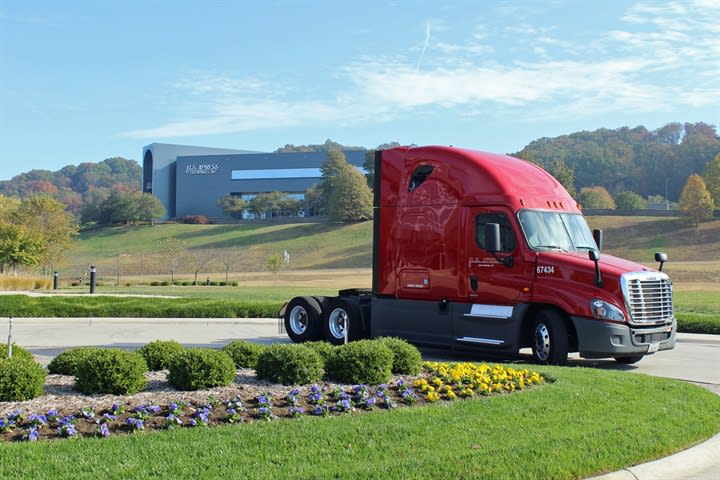
Out of 7,000 U.S. Xpress tractors running on the road today, only 16 “legacy” units are still equipped with manual transmissions.Photo: Jack Roberts
2 min to read
Out of 7,000 U.S. Xpress tractors running on the road today, only 16 “legacy” units are still equipped with manual transmissions. Photo: Jack Roberts
Automated manual transmissions rule the roost at U.S. Xpress today. During an event in early November to the fleet’s headquarters in Chattanooga, Tennessee, senior vice president of maintenance Gerald “Gerry” Mead noted that out of some 7,000 U.S. Xpress trucks running today, he’s down to just 16 “legacy” models still equipped with manual transmissions.
Ad Loading...
“Our last tractor buy was 100% AMTs,” Mead explained. “And at this point, we just can’t see a valid reason to spec a manual transmission – or even an application that would absolutely demand one.”
Ad Loading...
Mead noted that early versions of the latest-generation of AMTs suffered through some relatively minor teething problems (usually centered on the shifter). Overall, however, he said the integration into U.S. Xpress’ fleet has been mostly painless, with the shift toward nearly 100% AMT specs happening far faster than he imagined it would a few years back.
U.S. Xpress specs its AMTs with some unique (and secret) algorithms to meet the fleet’s performance and efficiency requirements. While the units have delivered in a big way on fuel economy, they’ve paid off in other ways as well.
“The drivers love them, so they help with recruiting and retention,” Mead said. “And our maintenance costs are way down. Everyone talks about no longer replacing clutches and greater brake life. And we’re seeing those things, too. But we’re also seeing reduced overall maintenance costs and greater overall vehicle durability because AMTs don’t shake, rattle and vibrate the truck as much when they get going. And reduced vibration is always a good thing from a maintenance point of view.”
Mead noted that manual transmissions are increasingly becoming the “brains” of a truck, coordinating and controlling almost every driving and safety system on the vehicle. “We’re in a new age of trucking,” he said. “And I think soon, fleets that aren’t running AMTs just won’t be able to compete with fleets that are.”
Fleet Snapshot
Who: U.S. Xpress
Where: Chattanooga, Tennessee
Fleet: 7,000 tractors, 19,000 trailers
Operations: National/international truckload and intermodal from 11 terminals covering the East Coast, Great Lakes, Midwest and Texas.
Fun fact: In the summer of 2010, the fleet purchased its 50,000th Freightliner truck, a Cascadia 72-inch raised roof sleeper model with a Detroit DD15 engine.
Challenge: Continuously pushing the envelope on vehicle efficiency

SAF-Holland reengineered the UltraLite40 Slider for the ULX40 Mechanical Sliding Suspension and Axle System to reduce weight, improve durability, extend trailer life, and increase payload efficiency.
Volvo Trucks North America highlighted new connectivity, safety tech and production investments at TMC. The OEM also signaled that a new heavy-haul flagship tractor is coming soon.
The company’s expanded EPEQ ecosystem includes flexible solar panels, lithium batteries, hydraulic power systems, and a portable fast charger for electric trucks.
Phillips Connect Smart Trailer enhancements give fleets deeper operational insights from trailers -- even when another provider supplies basic GPS tracking.
New approval for Valvoline Premium Blue One Solution Gen2 allows fleets running Cummins X15 engines to extend oil drain intervals by up to 25,000 miles -- reaching intervals as high as 100,000 miles.
Peterson’s Genesis lighting system and repairable J560 connector target two persistent fleet problems: LED light failures and costly electrical connector downtime.
Many fleets extended truck replacement cycles during recent market disruptions. But holding equipment too long can lead to higher repair costs, longer downtime, and new operational risks.