




Quick Spin: Paccar’s New Powertrain
With two of the three major components in place, Paccar touts the advantages of an integrated powertrain.

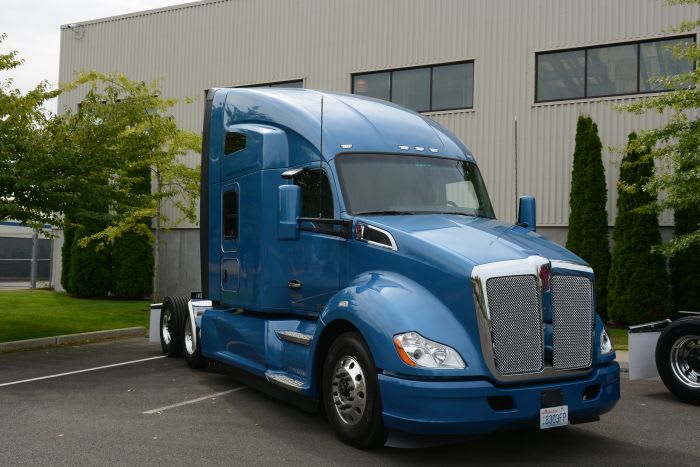
The test truck was a 2017 Kenworth T680 with a 76-inch high-roof sleeper. Photos: Jim Park
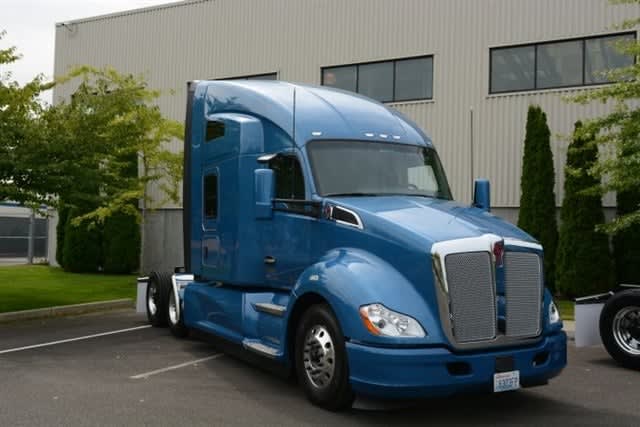
The test truck was a 2017 Kenworth T680 with a 76-inch high-roof sleeper.Photos: Jim Park
Paccar, parent company of both Kenworth and Peterbilt, recently announced its updated engine lineup for 2017 and a new proprietary drive axle that takes the standard position in both data books. The axle represents another step toward a fully vertically integrated powertrain, though it still lacks a homegrown transmission.
I had a chance to drive a couple of trucks at Kenworth’s Research and Development center in Renton, Washington, prior to the official launch of these upgrades at the American Trucking Associations’ Management Conference and Exposition in Las Vegas on Oct. 2.
The truck I drove was a 2017 Kenworth T680 with a 76-inch high-roof sleeper. It was equipped with the new 40,000-pound Paccar drive axles (2.67:1 ratio) and a 2017 MX-13 engine rated at 455 hp and 1,650 lb-ft (not the new top-of-the-line rating of 510 hp and 1,850 lb-ft.)
Kenworth’s chief engineer, Kevin Baney, explained that the 2017 engine uses two different variable geometry turbochargers, one for ratings below 485 hp and another for higher-powered engines, so this truck would have the one for engines rated below 485 hp. However, 455/1,850 is a popular rating for linehaul operators, so a good choice for a test drive that represents a typical fleet spec.
The automated manual transmission was an Eaton FAO-16810S-EP3 10-speed optimized for the MX-13 engine with a 0.79:1 overdrive. That rear axle/transmission combination gave us an engine cruise speed of 1,000 rpm at 57 mph in 10th gear – just 100 rpm above peak torque with the 2017 calibrations.
The route provided a good mix of two-lane and Interstate highway, with a few hills thrown in so we could check out the pulling power of the engine. Baney told us prior to the drive that peak torque on engines rated for less than 485 hp was at 900 rpm, while the higher rated engines produced peak torque at 1,000. The engine I drove should have gone down to 900, but it downshifted at close to 1,000 on the hills we were on.
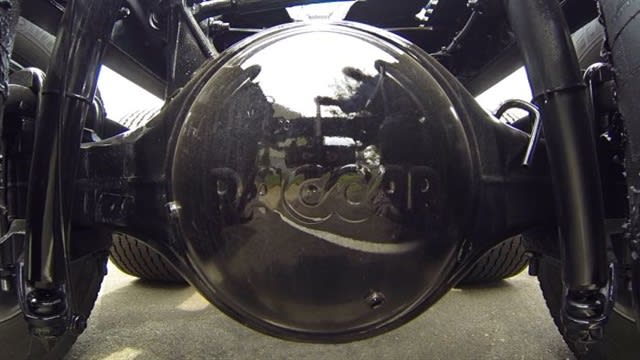
Paccar’s new drive axle is said to be more fuel efficient thanks to a new pinion through-shaft, and is 150 pounds lighter.
It’s hard to say if those shift points were the product of the predictive cruise control’s look-ahead capabilities determining that the truck would not have benefited from dropping to peak torque or initiating the shift sooner, or something else in the calibrations that triggered the downshift before hitting peak torque.
I was able to get it to 900 rpm on one occasion driving without the aid of cruise control where I more or less had control of the shifting. I let it lug down on one hill, and sure enough it went down to 900 before the engine and transmission ECMs seized control and made the downshift.
I can say, though, that drivers really don’t have to worry about that stuff anymore with all the automation onboard. All I had to do was keep my foot on the throttle, and the engine and transmission did all the calculating and shifting on their own.
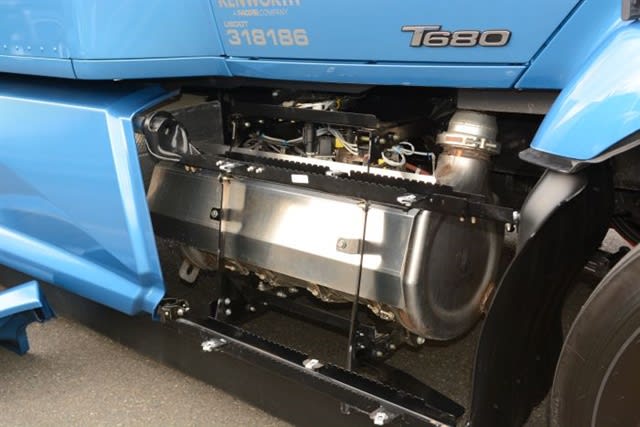
The new single-can aftertreatment system integrates the DPF, SCR and the DEF mixing pipe. It’s lighter than previous switch-back designs and occupies less frame space.
This may be an odd observation for a new product test drive, but it was difficult to perceive any difference from the 2016 version of the engine. But keep in mind, the changes consist mostly of some internal hardware, namely the oil and water pumps, the single-stage air compressor, the new single-canister aftertreatment system, and some rating alterations. Since our engine was rated at a previously available configuration, I failed to notice anything different there, but it is 50 pounds lighter thanks to the design changes. Baney also told me the engine would be about 3% or better more fuel efficient, which of course could not be verified on this short drive.
The new oil and water pumps are demand-driven, variable-speed devices. That means they are electronically controlled and respond to internal changes such as operating temperature and would, by design, go unnoticed by the driver. Same with the two turbochargers now offered on engines above and below 485 hp, for all intents and purposes. I can say the engine behavior was predictable and precise, as MX engines have always been. In this case, not noticing any difference is probably a good thing.
I guess I can say the same thing for the new axle and afterteatment device. They are there; they appear to work. Full stop. An axle isn’t something a driver would notice in the daily routine, while the aftertreatment system, when it goes south, is definitely something a driver would be aware of. During the course of our two-hour drive I saw no indication of a problem.
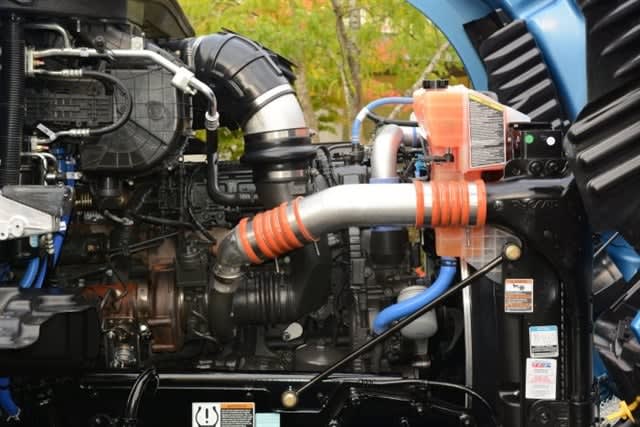
The MX-13 for 2017 is 50 pounds lighter than last year’s model and promises at least 3% better fuel economy.
The new proprietary axle is designed for linehaul, regional, and pickup and delivery operations, and is rated at 40,000 pounds for an 80,000-lb gross combination weight. It is available in ratios from 2.47 to 3.70 with torque capacity up to 1,650 lb-ft, or 1,750 lb-ft behind multi-torque engines.
Baney said the benefits of the axle are a proprietary pinion through-shaft for more direct power flow and fewer mechanical losses. It has laser-welded components rather than bolted parts for increased strength and lower weight. It’s about 150 pounds lighter than competitive offerings, he said.
With two of the three major powertrain components in place, the next big announcement we’ll be waiting on will be a proprietary transmission. My bet is on something automated from ZF. Stay tuned.
Related:
More Equipment

How Volvo Updated Its D13 for EPA 2027 [Watch]
Volvo’s updated D13 promises lower emissions without sacrificing performance or fuel economy. Take a closer look at what changed inside the engine in this HDT Spotlight video.
Read More →
Michelin Tire Improves Efficiency and Durability for Regional Fleets
The Michelin X Multi Energy D2 is a regional haul drive tire engineered to help fleets improve fuel efficiency, durability and traction in demanding stop-and-go operations.
Read More →
ZF Expands Commercial Vehicle Push in North America
ZF is expanding its North American commercial-vehicle presence with new transmission applications, electrification, trailer technology and autonomous-driving systems.
Read More →
Tesla Wants a Self-Driving Semi. Are Cameras Enough?
Could Tesla’s camera-only autonomous driving technology work on an 80,000-pound Semi? In this commentary, HDT's Deborah Lockridge takes a look at Tesla, Cybercab, and how autonomous trucks see the road.
Read More →
Kodiak: Driverless Long-Haul Truck Launch on Track for 2026
Kodiak AI says its driverless long-haul safety case is 93% complete and it remains on track to begin commercial operations by year-end 2026.
Read More →
What DOT’s Automated Vehicle Strategy Means for Trucking
The U.S. Department of Transportation issued a new automated-vehicle strategy that outlines plans for driverless-truck regulations, cross-state freight corridors, and federal safety standards.
Read More →
East Coast Port Launches $45M Electric Truck Push
The Port Authority of New York and New Jersey announced millions in incentives for zero-emission drayage trucks, yard tractors, and new charging hubs near the port.
Read More →
PlusAI Going Public to Fund Autonomous Truck Launch
A SPAC deal could provide PlusAI with up to $300 million as it works toward a 2027 commercial launch of factory-built autonomous trucks.
Read More →
NHTSA Moves to Rewrite Truck Fuel-Economy Rules
The National Highway Traffic Safety Administration says it lacks authority to regulate medium- and heavy-duty truck engines separately from complete vehicles, but the existing standards have not yet been eliminated.
Read More →
Detroit Opens Orders for EPA 2027 Engines
Detroit isn’t starting from scratch to meet EPA 2027 diesel emissions standards. Its Gen 6 DD13 and DD15 engines keep much of today’s platform while updating the fuel and aftertreatment systems.
Read More →