




Heavy Duty Trucking Logo
MenuMENU
SearchSEARCH

The Future of Refrigerated Trailers

What will the refrigerated trailer of the future be made of? Strong, lightweight and corrosion-proof composites? Very possibly. Economical, efficient aluminum sheet-and-post design, like now? Yes, for a number of years yet.

Tom Berg
Tom BergFormer Senior Contributing Editor
Read Tom's Posts
November 21, 2016
The Future of Refrigerated Trailers

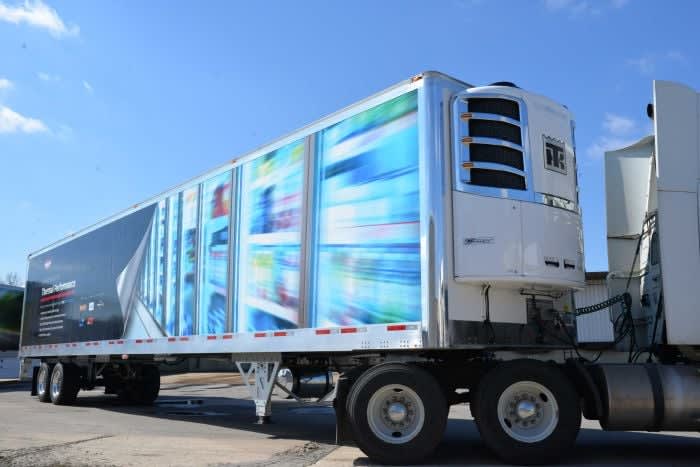
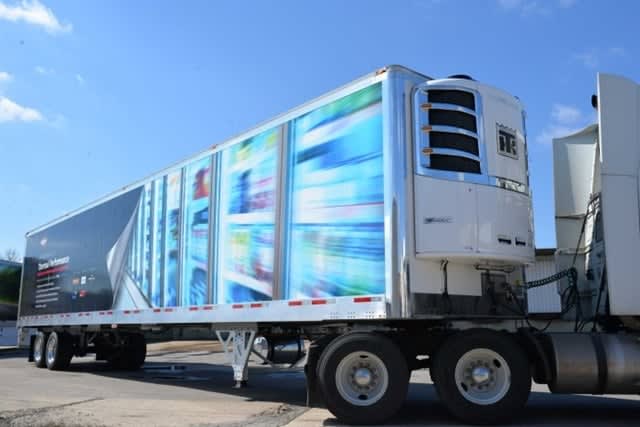
Wabash National’s prototype composite reefer trailer uses fiberglass, carbon fiber and resin in its panels, including the floor and supporting structure. It’s said to weigh and perform about 20% better than conventional temperature-controlled trailers. Photo: Wabash National

3 min to read


Wabash National’s prototype composite reefer trailer uses fiberglass, carbon fiber and resin in its panels, including the floor and supporting structure. It’s said to weigh and perform about 20% better than conventional temperature-controlled trailers. Photo: Wabash National

What will the refrigerated trailer of the future be made of? Strong, lightweight and corrosion-proof composites? Very possibly. Economical, efficient aluminum sheet-and-post design, like now? Yes, for a number of years yet. So say engineers engaged in designing and building temperature controlled trailers.

Ad Loading...

Today, these are made of sheet-and-post walls on floors supported by underbody crossmembers. Walls are sandwiches of inner and outer metal panels with aluminum posts inside the cavity, and the void is filled with polyurethane foam insulation. All components, including the foam, lend strength, and of course, the foam acts as insulation, limiting conduction of ambient heat and cold to the trailer’s interior. The thicker the walls and the amount of foam inside, the greater the vehicle’s “R” rating, and its ability to help the mechanical reefer unit maintain a desired temperature inside. But thicker walls also add tare weight and reduce payload capacity.

Ad Loading...

“I do see more use of non-metallic materials,” says Charlie Fetz, recently retired research and development engineer at Great Dane Trailer and author of a Future Truck paper on temperature controlled trailers for ATA’s Technology & Maintenance Council. “Aluminum is a great material, but it conducts heat. If they’re inside the wall cavity, the aluminum posts do contribute to heat conduction. Manufacturers minimize that with careful design.”

One way is to surround narrow posts with foam, minimizing the conduction of heat. One-inch posts inside a 2-inch wall, for example, allows room for injecting foam around the posts and throughout the wall cavities. Another way is to improve the foam’s efficiency, which manufacturers have repeatedly done over the years. Another round of change is due in January of 2020, when federal rules will require more environmentally friendly foam, primarily through a change in the “blowing agent” used to form and install the product. Several are being tested by chemical makers.

Another way to improve efficiency is use of aerospace-like composites. Wabash National showed a prototype composite refrigerated trailer with very few bolts, no rivets and no crossmembers at the TMC’s equipment expo in March. The panel-type trailer is similar in concept to vehicles produced in Europe; it uses molded structural composites, or MSCs, developed over the last three years. The material gives the 53-foot trailer up to 25% improvement in thermal performance and is up to 20% lighter compared to conventional designs, executives said. Interior puncture resistance is 25% better.

“The composite is a mixture of fiberglass, carbon fiber and resin,” says Larry Adkins, applications engineer for Wabash. “Carbon is for strength. It’s used only in areas where strength is needed, and some areas don’t have any. It’s needed in toward the center of a trailer,” which supports the load like a bridge span. Another advantage: “Composites are more corrosion resistant (than metals). Chemicals have no effect on the materials.”

The first trailer prototype units beyond the initial vehicle are to be produced later this year. Five “launch partners” will begin testing in normal fleet operations, Adkins says. “The plan is to get some miles on them. Miles can show what can’t be done in labs. Then we can alter the design if we have to. We expect to learn some things, like (better design for) transitions between walls and frame, and at the rear, for forklift use.”

Ad Loading...

Wabash first produced 10 prototype composite truck bodies and they are now in service, carrying various cargoes. The first one is delivering dairy products on Prince Edward Island in the Canadian Maritimes. Each body is 24 feet long by 102.3 inches wide.

What about repairs? “That seems to be what most people are asking, and it’s our biggest stumbling block” to acceptance, Adkins says. “But it’s glass fiber, so it’s much like working on truck hoods. You use a sidewall patching material with resin and gelcoat, and a structural adhesive. We have it developed, we have a part number for it.” How about cost? “We haven’t established a price. We know it will be a premium over our standard product,” which is sheet-and-post.

Like dry vans, most reefer trailers use sheet-and-post construction, a sandwich of metal skins, aluminum posts and insulating foam. Photo: Tom Berg

Are Electric Reefer Units in Your Future?

If you don’t already run them, electric transport refrigeration units are probably in your future, said a panel of specialists at TMC’s fall meeting in September. And solar-generated electricity to support trailer accessory loads is catching on. Both save fuel and money, and make reefer trailers more reliable.

Electric “standy” mechanisms are an effective way to cut exhaust fumes and greenhouse gases, according to Bill Maddox, Carrier Transicold’s service and training manager. “There’s infrastructure around the country, and it’s established, straightforward technology that’s been around for decades,” he said. Standby reefers are common in Europe where fuel is more expensive. They can be used for single- and multi-temp and stationary cold storage.

All-electric components run from an engine-generator setup, or plug into shore power. Electricity runs the compressor and fans for cooling, or the heater only. Cost is $1.10 to $1.15 per hour (at 15 cents per kW-hour) vs. $2.10 an hour for diesel (at $2.85 per gallon), according to the panel. And there’s 30% less maintenance per run-hour. On trailers, the plug is at the front in about 20% of installations — convenient for the driver, but requiring a long cable with all its attendant problems. So 80% are at rear, requiring only a 10-foot cable.

Use of shore power is easy at docks but expensive in yards, where long stretches of wiring must be buried and plug-ins installed. Human error — drivers moving away without unplugging — is the most common problem. That happens less often when a cord is plugged in at the trailer’s nose, where drivers can more readily see it, than with rear receptacles; back there, the receptacles are also more subject to damage from salt spray.

Mike Cornett, vice president, sales, for Thermo King Temperature Control Solutions, said TRUs can be ordered with electric standby in a 230-volt, 3-phase, 70-amp configuration, or with 460-volt, 3-phase, 40- or 60- amp. “It does add weight to a TRU, so it cuts capacity, but resale is good.” He advised fleet managers to order trailers with prep packages for shore-power receptacles and wiring.

Solar panels are being more widely used to generate power aboard the trailer, said Bob Doane of eNow, a maker of panels and electrical control systems. In addition to charging TRUs, he said, “Lift gate batteries are always charged, so trailers don’t have to be taken off a run and dropped at the terminal for plug-in charging.” Solar panels also charge pallet jacks, electric roll-up doors, lighting, start-up batteries, and tractor accessories, especially cab comfort items like HVAC.

To properly employ solar charging, Doane said:

  • Understand the application and know the energy needs.

  • Evaluate the geographic area and potential energy available (more is available in Southwest-style steady sunshine).

  • Size panels to the need (many sizes are available).

  • Make sure panels themselves and nearby components are flexible, tough, and don’t interfere with aerodynamics.

One Canadian company, Volta Air, is using solar panels to offer an all-electric TRU for medium-duty trucks. D&D Wholesale Distributors in City of Industry, Calif., recently installed one on a Hino box truck and is so far happy with its performance and quietness.

“If you’re stopped, you leave your engine off and the solar panels kick in to charge the batteries,” explains Volta Air’s Peter Johnston.

Solar panels go on the roof of the box, two to four panels depending on the size of the unit and the demand. A controller will send alerts if the power level is getting too low or the refrigeration box temperature is too high, and will monitor idle time and fuel saved.


Subscribe to Our Newsletter

More Equipment

Diagram of trailer tandem slider suspension
Equipmentby Deborah LockridgeMarch 19, 2026

SAF-Holland Redesigns Suspension Slider to Save Weight in On-Highway Trailers

SAF-Holland reengineered the UltraLite40 Slider for the ULX40 Mechanical Sliding Suspension and Axle System to reduce weight, improve durability, extend trailer life, and increase payload efficiency.

Read More →
Magnus Koeck, Volvo Trucks North America.
Equipmentby Jack RobertsMarch 18, 2026

Volvo Teases Next-Gen VNX as Platform Expansion Continues at TMC

Volvo Trucks North America highlighted new connectivity, safety tech and production investments at TMC. The OEM also signaled that a new heavy-haul flagship tractor is coming soon.

Read More →
Back of truck cab showing air and electrical line connections
Equipmentby Deborah LockridgeMarch 16, 2026

SAF-Holland Introduces SmartSto System for Safer Tractor-Trailer Uncoupling

The system combines a fifth-wheel air release with stowage for air and electrical connections, helping prevent damage and reducing driver injury risk.

Read More →
Ad Loading...
Diagram of SAF Holland BrakeSight
EquipmentMarch 16, 2026

SAF-Holland’s BrakeSight Aims to Take the Guesswork Out of Air Disc Brake Maintenance

New Haldex sensor technology from SAF-Holland integrates with telematics systems to give fleets continuous insight into air disc brake condition.

Read More →
Solar panels on top of a red Class 8 truck sleeper cab
Equipmentby Deborah LockridgeMarch 15, 2026

Vanair Introduces Solar, Battery Power Ecosystem for Class 8 Trucks

The company’s expanded EPEQ ecosystem includes flexible solar panels, lithium batteries, hydraulic power systems, and a portable fast charger for electric trucks.

Read More →
Phillips Connect Smart Trailer technology.
Equipmentby Jack RobertsMarch 15, 2026

Phillips Connect Expands Smart Trailer Platform with New Safety, Cargo and Equipment Intelligence

Phillips Connect Smart Trailer enhancements give fleets deeper operational insights from trailers -- even when another provider supplies basic GPS tracking.

Read More →
Ad Loading...
Accuride ProShield XGT.
Equipmentby Jack RobertsMarch 15, 2026

Accuride Unveils ProShield XGT Aluminum Wheel Coating at TMC

Accuride’s patent-pending surface-coating technology targets filiform corrosion and promises easier cleaning, longer-lasting gloss, and greater durability for aluminum truck wheels.

Read More →
Valvoline at TMC 2026.
Equipmentby Jack RobertsMarch 15, 2026

Valvoline, Cummins Extend X15 Oil Drain Intervals to 100,000 Miles

New approval for Valvoline Premium Blue One Solution Gen2 allows fleets running Cummins X15 engines to extend oil drain intervals by up to 25,000 miles -- reaching intervals as high as 100,000 miles.

Read More →
Al Anderson, Peterson.
Equipmentby Jack RobertsMarch 15, 2026

A New Approach to Lighting Reliability

Peterson’s Genesis lighting system and repairable J560 connector target two persistent fleet problems: LED light failures and costly electrical connector downtime.

Read More →
Ad Loading...
Illustration of a row of trucks with question marks overlaid
EquipmentMarch 12, 2026

The Hidden Cost of Delaying Truck Replacement

Many fleets extended truck replacement cycles during recent market disruptions. But holding equipment too long can lead to higher repair costs, longer downtime, and new operational risks.

Read More →







