




Eaton Showcases Near- and Far-Future Technology
You may think of Eaton as primarily a transmission company, but at the IAA Commercial Vehicle Show in Hannover, Germany, this fall, they showed a range of future technologies both near and far, from transmissions for electric vehicles to autonomous vehicle technology to waste heat recovery.

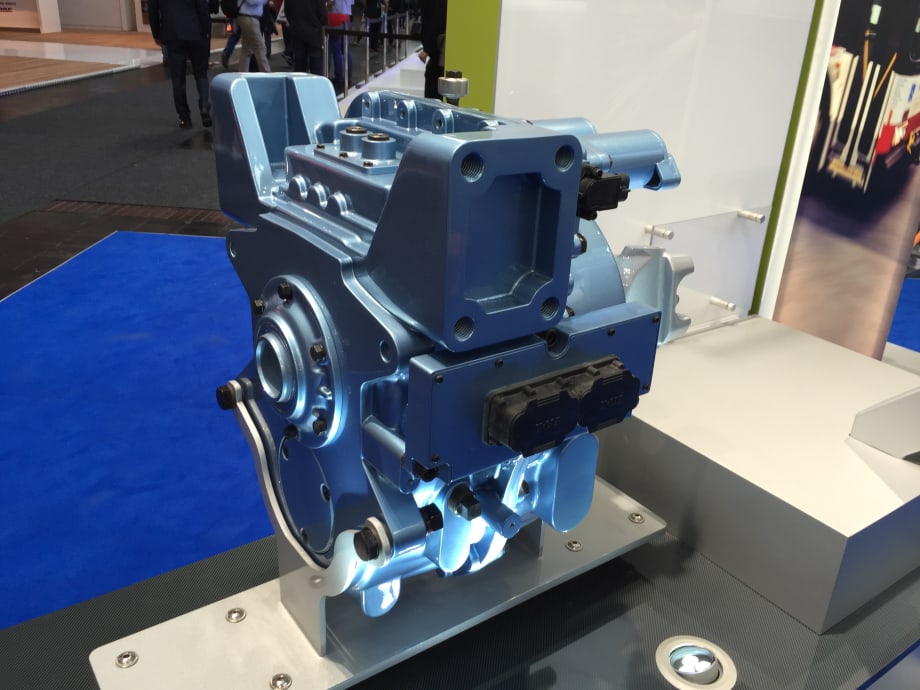
Eaton showed off a four-speed transmission designed for electric vehicles, with the initial target being city buses for urban areas. Photo: Deborah Lockridge
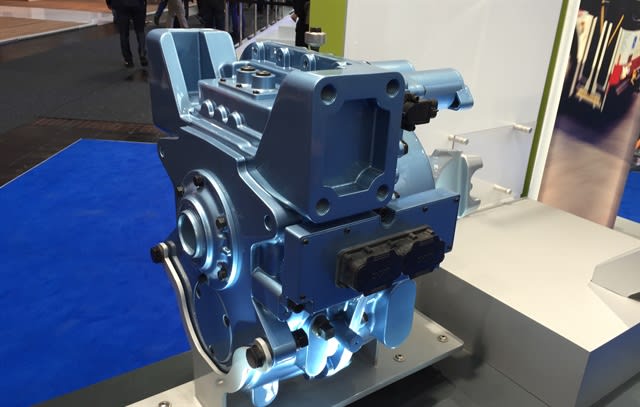
Eaton showed off a four-speed transmission designed for electric vehicles, with the initial target being city buses for urban areas.Photo: Deborah Lockridge
You may think of Eaton as primarily a transmission maker, but at the IAA Commercial Vehicle Show in Hannover, Germany, this fall, the company showed a range of future technologies both near and far, from transmissions for electric vehicles to autonomous vehicle technology to waste heat recovery.
Transmission for electric medium- and heavy-duty vehicles
Starting with the near future, Eaton announced it has developed a 2-speed transmission for heavy- and medium-duty electric commercial vehicle applications to meet growing demand in the European and other markets, which will be in full production this fall.
Eaton partnered with UQM Technologies, Longmont, Colorado, and Pi Innovo, Plymouth, Michigan, to design and produce the UQM PowerPhaseDT system. Eaton developed and will supply to UQM a 2-speed transmission for an electric vehicle application, and Pi Innovo will develop and supply to UQM the transmission control unit. Together, the components will be combined with UQM’s current PowerPhase HD220/HD250 motor and inverter system to create the UQM PowerPhase DT, a full electric drive system.
For medium- and heavy-duty electric commercial vehicles, the system offers better grade performance, acceleration and efficiency. Eaton’s 2-speed transmission provides a greater speed and torque range, which allows a smaller electric motor to power large vehicles. The smaller drive train also allows for improved packaging efficiency, greater payload capacity, and lower cost when compared with direct drive or single speed drivetrain strategies.
In addition, the 2-speed transmission keeps the electric motor operating in the highest efficiency region for a greater portion of the drive cycle. Combined with the high efficiency of the UQM PowerPhaseDT electric drive system, it will allow greater overall vehicle efficiency, save on the cost of batteries, and increase driving range.
Eaton is also working on developing a four-speed transmission for electric vehicles.
Driver assist systems and steps to autonomous operation
Eaton has been building on its transmission technology to develop an autonomous driving system for commercial vehicles that will initially allow for self-docking of a commercial truck.
The Advanced Driver Assist System (ADAS) Dock Assist feature uses software upgrades to communicate with the control modules in Eaton’s automated, manual and dual-clutch automatic transmissions. By controlling the vehicle speed and electronic brake (if a vehicle is equipped with one), the Dock Assist ADAS feature can eliminate damage to a trailer, loading dock and vehicle driveline. No additional sensors or hardware are required to activate the system, just a software upgrade.
As the driver begins backing into the loading dock, the driver applies the service brake, comes to a stop, and activates the ADAS Dock Assist function by flipping a dashboard switch. The Dock Assist then engages the transmission controls to moderate vehicle range and speed. When the transmission “detects” the dock based on the torque being applied while pushing against the dock, the system controls the speed of the truck to ease it into position and allows it to self-park.
Dock Assist is an ADAS Level 2 system and requires someone in the driver’s seat. However, Eaton also showed off a concept of what it could do with the next level of autonomy with this technology.
This would involve a tractor or tractor-trailer combination being self-parked in a parking lot or loading dock environment, using GPS technology that allows the vehicle to find its destination – without driver intervention. In distribution center environments, a driver could pull a truck and trailer anywhere into the lot and leave it. The lot manager would then be able to command the truck and trailer to autonomously park at a specified dock.
Beyond the self-docking applications, ADAS could also be used to support vehicle platooning functionality and stop-and-go traffic assistance applications, Eaton says.
Waste heat recovery system concepts
Beyond the transmission, and looking farther ahead, Eaton showed off waste heat recovery system concepts that could help improve fuel economy and reduce emissions under stricter government regulations.
The concepts include Eaton’s Indirect systems, which are based on the Organic Rankine Cycle, and its Direct system, which uses an electrified approach.
The Indirect systems use organic fluids from the aftertreatment system or engine, such as coolant/antifreeze or diesel exhaust fluid, to convert energy normally lost in the form of heat into useful power by boiling it and using the steam to run something like a turbine. Through simulations, the Indirect systems have shown fuel economy improvements in the range of 5%. Eaton is working with Shell, Paccar, and Mississippi State on a Department of Energy research program.
The Direct system uses Eaton’s Electrically Assisted Variable Speed Supercharger (EAVSS) and Electric Waste Heat Recovery Device to deliver precise air flow control to the engine, optimize EGR flow, and control the breathing of the engine. This system has shown through simulation more than a 20% improvement in fuel economy while also reducing emissions and NOx. The next step in this project is to build one for a light-duty truck and see how it works.
More Equipment

How Volvo Updated Its D13 for EPA 2027 [Watch]
Volvo’s updated D13 promises lower emissions without sacrificing performance or fuel economy. Take a closer look at what changed inside the engine in this HDT Spotlight video.
Read More →
Michelin Tire Improves Efficiency and Durability for Regional Fleets
The Michelin X Multi Energy D2 is a regional haul drive tire engineered to help fleets improve fuel efficiency, durability and traction in demanding stop-and-go operations.
Read More →
ZF Expands Commercial Vehicle Push in North America
ZF is expanding its North American commercial-vehicle presence with new transmission applications, electrification, trailer technology and autonomous-driving systems.
Read More →
Tesla Wants a Self-Driving Semi. Are Cameras Enough?
Could Tesla’s camera-only autonomous driving technology work on an 80,000-pound Semi? In this commentary, HDT's Deborah Lockridge takes a look at Tesla, Cybercab, and how autonomous trucks see the road.
Read More →
Kodiak: Driverless Long-Haul Truck Launch on Track for 2026
Kodiak AI says its driverless long-haul safety case is 93% complete and it remains on track to begin commercial operations by year-end 2026.
Read More →
What DOT’s Automated Vehicle Strategy Means for Trucking
The U.S. Department of Transportation issued a new automated-vehicle strategy that outlines plans for driverless-truck regulations, cross-state freight corridors, and federal safety standards.
Read More →
East Coast Port Launches $45M Electric Truck Push
The Port Authority of New York and New Jersey announced millions in incentives for zero-emission drayage trucks, yard tractors, and new charging hubs near the port.
Read More →
PlusAI Going Public to Fund Autonomous Truck Launch
A SPAC deal could provide PlusAI with up to $300 million as it works toward a 2027 commercial launch of factory-built autonomous trucks.
Read More →
NHTSA Moves to Rewrite Truck Fuel-Economy Rules
The National Highway Traffic Safety Administration says it lacks authority to regulate medium- and heavy-duty truck engines separately from complete vehicles, but the existing standards have not yet been eliminated.
Read More →
Detroit Opens Orders for EPA 2027 Engines
Detroit isn’t starting from scratch to meet EPA 2027 diesel emissions standards. Its Gen 6 DD13 and DD15 engines keep much of today’s platform while updating the fuel and aftertreatment systems.
Read More →