




Trailer Tires: Choosing the Best Strategy for Your Fleet
Do you need to put new tires on a trailer? As it turns out, a lot of fleets do buy new tires for trailers, and for very good reasons.

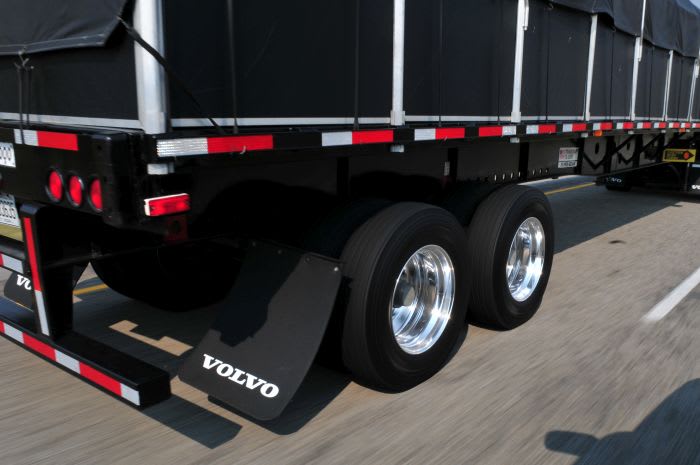
Trailer tires are often abused and neglected, but they still play an important role in getting freight delivered. They are worthy of more than a passing thought. Photo: Jim Park
Trailer tires are often abused and neglected, but they still play an important role in getting freight delivered. They are worthy of more than a passing thought.Photo: Jim Park
Do you need to put new tires on a trailer? As it turns out, a lot of fleets do buy new tires for trailers, and for very good reasons. But there are probably an equal number content to cycle their older drive and steer tire casings back to a trailer position to let the trailer finish them off.
Trailers don’t have to be a tire graveyard, but that’s often the case. They tend to be neglected and rarely see proactive maintenance. In the truckload sector, where trailers can disappear into drop yards scattered around the country, it’s not uncommon for a tire to go six months or longer without any attention. Tires are often stolen from trailers left in drop yards, too.
Fleet maintenance consultant Darry Stuart, operating as DWS Fleet Management Services, says crooks can steal a tire right off the rim of a parked trailer in less than 30 seconds.
“I had a tire guy show me how it’s done,” he says. “They take off the valve stem, let some of the air out and then punch in the sidewall. The air dumps and then they break the tire off the rim. They are gone with your tire in no time.”
That might seem a pretty compelling reason to limit your theft exposure by leaving some scabby old carcass on the trailer. Who’d want to steal something like that? On the other hand, if customer service and driver satisfaction are more important than losing a few tires to a five-finger discounter, then you can make a good business case for newer tires and even retreaded tires.
It’s common practice to retread a steer or drive tire once and place it into a drive position, then retread it a second time and move it to the trailer. Trailers in the truckload sector, where trailer to tractor ratios are up to three to one, will run as few as 40,000 miles per year. In that scenario, you can easily get up to seven years out of a well-maintained, deep-rubber tire, providing it suffers no catastrophic failures and doesn’t get stolen. In such a scenario, a retread or a new tire makes a lot of sense.
The deep rubber, Stuart says, is a hedge against perforation.
“I get arguments on this all the time,” he says. “Everybody is all over fuel economy, and so they run their tires down as low as they can to reduce the rolling resistance. And that’s fine, but what about protecting the tire against road hazards?”
Stuart says an average tire service call today runs close to $1,000 with a new tire, and rarely takes less than three hours from breakdown to back on the road.
“You’d have to make a lot of fuel savings to pay for that service call,” he points out. “And then you have the risk of making a driver angry and possibly the customer too with a late delivery. A lot of the big shippers today won’t even look at a bid from a carrier with a less than 98% on-time performance. That’s a lot to wager on a well-used, thin-tread tire.”
Stuart recommends pulling the tire at 6/32 or 7/32 rather than the federally required minimum. That thought is seconded by Gary Schroeder, director of commercial vehicle sales for Cooper Tires, assigned to the Roadmaster brand.
Schroeder notes that Department of Transportation regulations say steer tires must be pulled at 4/32-inch remaining tread depth and drive and trailer tires must be pulled at 2/32-inch remaining tread depth.
“Some fleets will pull steer or drive position tires early to help maintain traction and rotate them back to the trailer to run out their remaining tread life,” he explains. “If the fleet’s application tends to experience penetrations from nails or other road debris, then it’s probably a better practice to pull the tires early and retread them to help preserve the casing integrity.”

Urban and regional operations take the highest toll on tires. Don’t expect premium performance from the cheapest tire on the rack.Photo: Jim Park
Special applications
Tread depth is especially important for fleets using spread-axle trailers, which are notoriously hard on tires.
“Fleets that pull these trailers need tires with deep, 18/32 tread depth for extended life [or normal-life for a high-scrub tire], high-scrub compounds to help resist curb damage, durable casings and robust rib designs to help minimize tread tear,” says Evan Perrow, marketing manager at Goodyear.
Goodyear designed its G619 RST specifically for spread-axle trailers. Other companies make models that appear to thrive in that hostile environment, such as Continental’s HSR2, Michelin’s XZE and Bridgestone’s Ulti-Rib designs, which incorporate stabilizer ribs to combat irregular wear and rounded shoulders for spread axle applications.
Similarly, while long-haul fleets often seek wear-extending or low-rolling resistance attributes in their trailer tires, regional and urban operators seek a tire that easily shakes off the threats from curbing, scrubbing and scuffing common to that application.
“For regional applications, you want a tire with a thicker tread, say 19-23/32,” says Walt Weller, senior vice president of sales and operations at Double Coin Tires. “You’ll need a tire that’s cut- and scrub-resistant, and can take some abuse from drivers running up on curbs and over certain hazards. Just dragging a trailer around city street corners all day will take a toll on the tires sooner rather than later.”
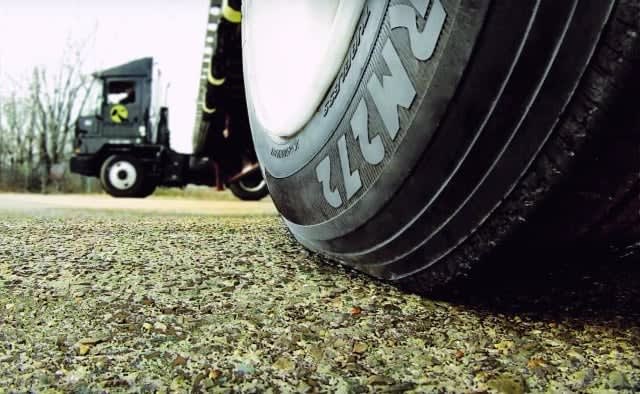
Scrubbing and curbing may be the biggest killer of trailer tires. A few extra dollars spent to guard against those threats is money well spent.Photo: Tom Berg
Acquisition strategies
Retreading is a cost-effective way of maintaining a stock of service-ready trailer tires. Top fleets know that retreads play a major role as a tire program best practice. Retreads for trailer tires are available in SmartWay-verified models, with tread designs tailored to fuel efficiency, wear battling, or extra long life.
“Given that retreads typically cost a fraction of a new tire and perform as well as or better, it makes sense for the bottom line to incorporate retreads into a tire program,” notes Sherrell Watson, communications specialist for commercial tires at Bridgestone Americas. “Truck tires are simply too big of an expense not to consider retreading.”
When considering this option, it’s important to take into account the quality of the casing.
“The casing quality will tell you a great deal about the tire – how it will hold up and the value the tire has for its second and third life in retreading,” says Schroeder. “Our Roadmaster brand tires offer a warranty of two retreads within six years.”
As Stuart suggests, a tire in a trailer position can last up to seven years, so a quality casing is certainly called for.
Another option is to spec new trailers with drive tires, which when retreaded will become trailer tires.
“There’s usually a pretty steep upcharge from the zero-dollar standard tire option when going up to a drive or steer tire,” cautions Stuart. “Often, the math just doesn’t work, but depending on how you account for the tire costs, it may work for some fleets.”
If it does, spec’ing drive tires on the trailer can be a cost-effective but labor-intensive way of building your drive tire inventory.
On the other hand, spec’ing a trailer tire with a shallow tread depth, say 11/32, will give a year or so of fairly fuel-efficient operation before you have to worry about the tread becoming too thin to resist punctures.
“There is just no way to say this option or that one will work for all fleets,” Weller reminds us. “Any number of strategies will work for most fleets, including combinations of new, used and retreaded tires.”
What’s important to remember is that the highest risk exists in the extremes. Thinner tread at end-of-life will yield the lowest rolling resistance, but it will also expose you to the greatest risk for a mission-crippling puncture. Cheaper tires from the outset may not provide the longest miles to take-off or multiple retread opportunities. Premium tires may get scuffed and curbed to a premature death by drivers who aren’t careful when driving in urban environments.
“Fleet managers should identify the average miles that can be expected on each wheel position and application within the fleet,” Perrow says. “This allows a fleet manager to identify areas of opportunity for improvement and create a set of best practices. It also helps with budgeting and fleet cost predictions.”
But keep this in mind: You can’t fix what you can’t measure. Determining which approach works best for trailer tires still requires tracking and monitoring to get a measurable result. From there, you can take steps to get the best performance from the tires themselves and the capital tied up in the program.
More Equipment

How Volvo Updated Its D13 for EPA 2027 [Watch]
Volvo’s updated D13 promises lower emissions without sacrificing performance or fuel economy. Take a closer look at what changed inside the engine in this HDT Spotlight video.
Read More →
Michelin Tire Improves Efficiency and Durability for Regional Fleets
The Michelin X Multi Energy D2 is a regional haul drive tire engineered to help fleets improve fuel efficiency, durability and traction in demanding stop-and-go operations.
Read More →
ZF Expands Commercial Vehicle Push in North America
ZF is expanding its North American commercial-vehicle presence with new transmission applications, electrification, trailer technology and autonomous-driving systems.
Read More →
Tesla Wants a Self-Driving Semi. Are Cameras Enough?
Could Tesla’s camera-only autonomous driving technology work on an 80,000-pound Semi? In this commentary, HDT's Deborah Lockridge takes a look at Tesla, Cybercab, and how autonomous trucks see the road.
Read More →
Kodiak: Driverless Long-Haul Truck Launch on Track for 2026
Kodiak AI says its driverless long-haul safety case is 93% complete and it remains on track to begin commercial operations by year-end 2026.
Read More →
What DOT’s Automated Vehicle Strategy Means for Trucking
The U.S. Department of Transportation issued a new automated-vehicle strategy that outlines plans for driverless-truck regulations, cross-state freight corridors, and federal safety standards.
Read More →
East Coast Port Launches $45M Electric Truck Push
The Port Authority of New York and New Jersey announced millions in incentives for zero-emission drayage trucks, yard tractors, and new charging hubs near the port.
Read More →
PlusAI Going Public to Fund Autonomous Truck Launch
A SPAC deal could provide PlusAI with up to $300 million as it works toward a 2027 commercial launch of factory-built autonomous trucks.
Read More →
NHTSA Moves to Rewrite Truck Fuel-Economy Rules
The National Highway Traffic Safety Administration says it lacks authority to regulate medium- and heavy-duty truck engines separately from complete vehicles, but the existing standards have not yet been eliminated.
Read More →
Detroit Opens Orders for EPA 2027 Engines
Detroit isn’t starting from scratch to meet EPA 2027 diesel emissions standards. Its Gen 6 DD13 and DD15 engines keep much of today’s platform while updating the fuel and aftertreatment systems.
Read More →