





Related: Ford Upgrading 2017 Super Duty's Brakes, Suspension
Test Drive: Ford's New F-650 Looks, Feels Familiar
If you found Ford’s previous F-650 and F-750 useful, comfortable and easy to drive, you’ll feel the same way about the new generation.
May 20, 2016
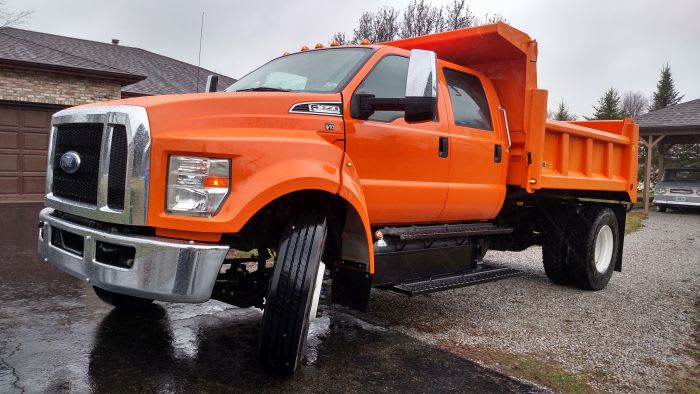
The front-end styling is fresh, but Supe rDuty steel cabs, including this five-man crew type, carry over from previous model. The tight front-wheel cut makes the truck highly maneuverable. Photos: Tom Berg
4 min to read
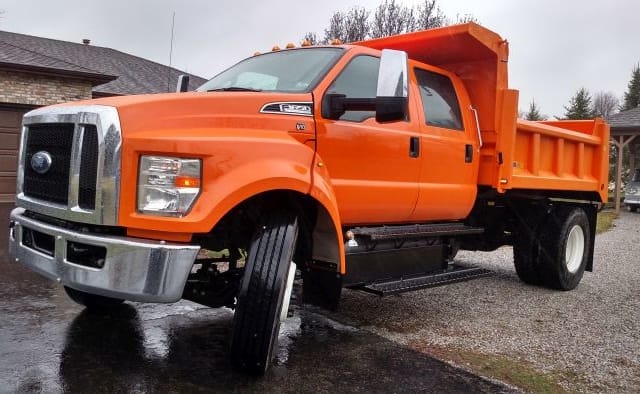
The front-end styling is fresh, but Supe rDuty steel cabs, including this five-man crew type, carry over from previous model. The tight front-wheel cut makes the truck highly maneuverable.Photos: Tom Berg
If you found Ford’s previous F-650 and F-750 useful, comfortable and easy to drive, you’ll feel the same way about the new generation.
The new series of medium-duty trucks looks and drives a lot like the older ones, even if the 2016s sit on new frames and are assembled in the U.S. instead of Mexico. The production change was the result of the expiration of the Blue Diamond deal with Navistar, which had assembled the midrange F-series using Ford cabs and many other components on Navistar-designed frames.
I can make comparisons because two years ago, Ford sent me a bright-white F-650 dump with the Triton V-10 engine outfitted to burn compressed natural gas. In the following week I found that, except for the large cabinet that housed the CNG cylinders, it ran like a gasoline-engine truck. My only concern was where to refuel it (I went online and quickly found a filling station).
Two months ago, from Ford headquarters in Dearborn, Mich., came a bright-orange F-650 dump, also with the Triton V-10. It burned gasoline and ran like that CNG-powered engine, but it didn’t have the tank cabinet and the other expensive equipment needed for CNG. There’s a lot to be said for traditional gasoline and diesel fuel. They contain a lot of energy for a comparatively small amount of storage space, and they’re available almost everywhere. A gasoline-powered V-10 F-650 lists at about $15,000 less than one with Ford’s Power Stroke V-8 diesel. (The Cummins ISB6.7 diesel and Allison automatic have been dropped.)
The new-series F-650/750 features fresh styling with attractive creases in its hood and a sleeker look to its grille. Headlamps are projector-beam halogens that light the way quite well. The hood-and-fender assembly opens fairly easily, revealing the shrouded engine and all the plumbing and wiring associated with it. (This kind of tilting hood would be a nice feature on lighter-weight F-series trucks that have top-opening alligator hoods, but they sell very well as they are.)
Cabs and interiors are carried over from the previous midrange models, and from behind the wheel things look similar. The gauges, controls and overall dash design were very much like those from the older series. That’s mostly a good thing, though for HVAC operation I’d have preferred three rotary knobs instead of the consumer-style push buttons Ford uses. They’re there because Ford’s medium-duty trucks borrow their cabs from the mass-market Super Duty pickups. This affords economies of scale that are reflected in pricing.
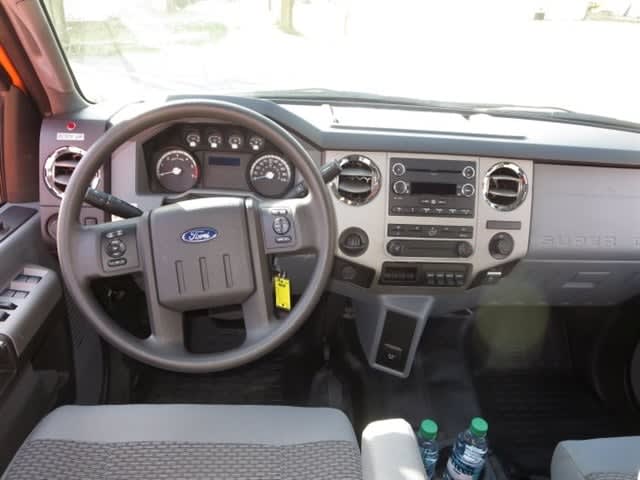
Front seats are comfortable and supportive cloth-covered buckets; the driver’s is air-ride via electric pump. Instruments and switches are also from the previous generation.
The midrange trucks can be had with three cab styles — 2-door Regular, and 4-door Super and Crew. This truck had the Crew Cab. With the orange paint, it almost shouted, “I’m a municipal truck!” Except you won’t find many muni vehicles with a chromed nose, or the XLT cloth-trimmed seats and plastic paneling over walls and doors inside. Front seats were buckets contoured for good support, while the rear seat was more bench-like. There was decent head and legroom front and rear, and power windows and door locks. So whoever ends up owning this truck will send out a crew in comfort and modest style.
The driving experience is much like the older series: an easy climb up, good visibility all around, and good ride. Springs are said to be longer, so the ride may be smoother, though I couldn’t say unless I had driven the two trucks in quick succession instead of two years apart. A very tight front-wheel cut made up for the longish wheelbase, and maneuverability was outstanding. Several times I was surprised and pleased at how easily I could jockey the truck through a right-angle turn in my driveway.
The engine’s behavior was somewhat more leisurely, operating several hundred rpm lower than the previous truck’s. Instead of regularly spinning to 3,300 and 3,500 rpm, this one upshifted at about 3,000 unless I put my foot into it, which I seldom did. The engine’s cruising speed was also a bit slower at given road speeds. The big V-10 ran well through the smooth TorqShift 6-speed automatic transmission, which is the only one you can get from Ford. Manual transmissions haven’t been available for years because there’s no call from them, product planners say.
A friend needed some gravel for his driveway, and I gladly obliged. We picked up 2 tons at a quarry, and the chassis settled down a bit and the ride was smoother than when empty. We drove a few miles to his house and I delivered the gravel where he wanted it, in a pile up near the house.
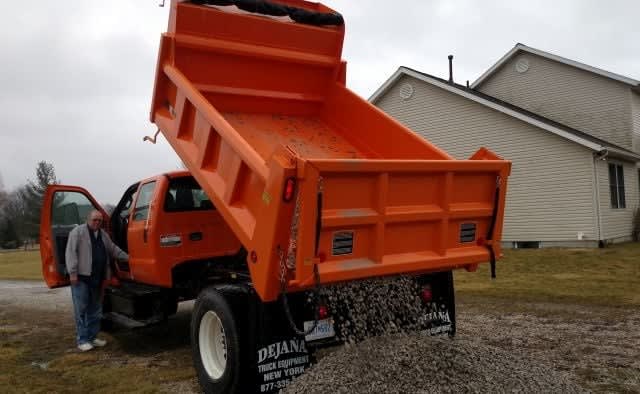
Friend Craig Scott operates push-button controls to finish depositing 2 tons of gravel on his driveway. The electric-over-hydraulic hoist could also tip the body to spread the load.
From a driver’s perspective, the new Ford mediums are very familiar vehicles. Specifications say the Ford-designed frame on my 2016 test truck is 50% stiffer than the one I had two years ago, which should make it tougher and longer-lived, especially if it goes off-road onto rough terrain where twisting occurs. Production at Avon Lake, Ohio, instead of Sautillo, Mexico, is a boon to about 1,000 workers who were added to produce the midrange trucks as well as lighter-duty Super Duty cab-chassis models. I’d call that a win-win.
Tom Berg holds a commercial driver’s license and does Test Drives of all classes of trucks. He also writes about vocational and medium-duty trucks, trailers and bodies, maintenance, and alternative fuels.
Subscribe to Our Newsletter
More Equipment

How Volvo Updated Its D13 for EPA 2027 [Watch]
Volvo’s updated D13 promises lower emissions without sacrificing performance or fuel economy. Take a closer look at what changed inside the engine in this HDT Spotlight video.
Read More →
Michelin Tire Improves Efficiency and Durability for Regional Fleets
The Michelin X Multi Energy D2 is a regional haul drive tire engineered to help fleets improve fuel efficiency, durability and traction in demanding stop-and-go operations.
Read More →
ZF Expands Commercial Vehicle Push in North America
ZF is expanding its North American commercial-vehicle presence with new transmission applications, electrification, trailer technology and autonomous-driving systems.
Read More →
Tesla Wants a Self-Driving Semi. Are Cameras Enough?
Could Tesla’s camera-only autonomous driving technology work on an 80,000-pound Semi? In this commentary, HDT's Deborah Lockridge takes a look at Tesla, Cybercab, and how autonomous trucks see the road.
Read More →
Kodiak: Driverless Long-Haul Truck Launch on Track for 2026
Kodiak AI says its driverless long-haul safety case is 93% complete and it remains on track to begin commercial operations by year-end 2026.
Read More →
What DOT’s Automated Vehicle Strategy Means for Trucking
The U.S. Department of Transportation issued a new automated-vehicle strategy that outlines plans for driverless-truck regulations, cross-state freight corridors, and federal safety standards.
Read More →
East Coast Port Launches $45M Electric Truck Push
The Port Authority of New York and New Jersey announced millions in incentives for zero-emission drayage trucks, yard tractors, and new charging hubs near the port.
Read More →
PlusAI Going Public to Fund Autonomous Truck Launch
A SPAC deal could provide PlusAI with up to $300 million as it works toward a 2027 commercial launch of factory-built autonomous trucks.
Read More →
NHTSA Moves to Rewrite Truck Fuel-Economy Rules
The National Highway Traffic Safety Administration says it lacks authority to regulate medium- and heavy-duty truck engines separately from complete vehicles, but the existing standards have not yet been eliminated.
Read More →
Detroit Opens Orders for EPA 2027 Engines
Detroit isn’t starting from scratch to meet EPA 2027 diesel emissions standards. Its Gen 6 DD13 and DD15 engines keep much of today’s platform while updating the fuel and aftertreatment systems.
Read More →