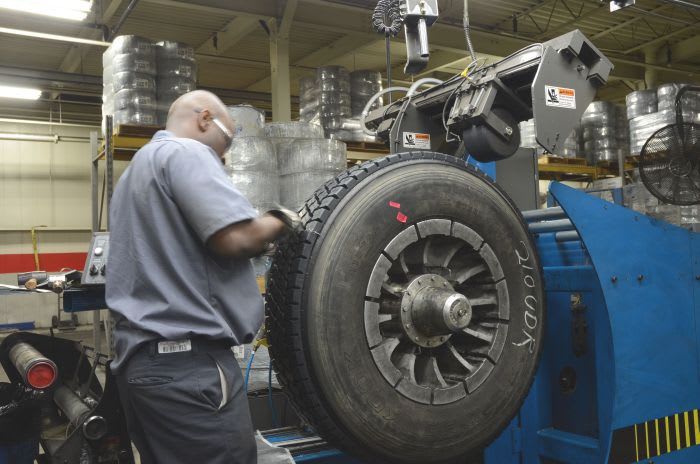
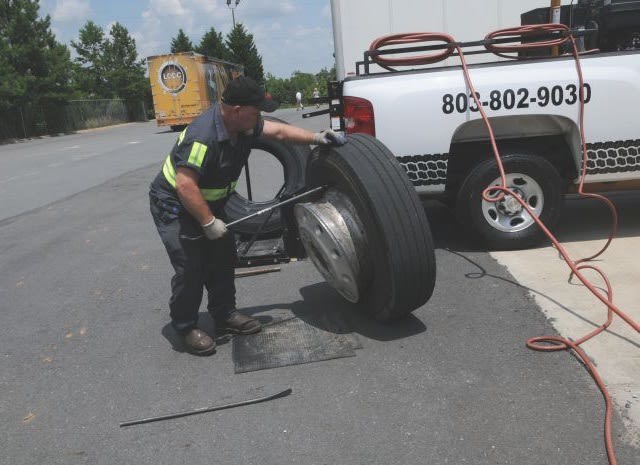
Anybody can change a tire, but does your dealer make yard calls and bring some inventory along so the necessary tires can be changed on site without delay?
Larger dealers are often associated with a retreader. Keeping all the services under one roof makes for easier tracking, billing and record keeping.
6 min to read
Anybody can change a tire, but does your dealer make yard calls, and bring some inventory along so the necessary tires can be changed on site without delay? Photo: Jim Park
The price of tires is enough to curl your hair, but the implications of poor tire maintenance — increased downtime, poor tire life, poor fuel economy — drive the stakes even higher.
Ad Loading...
Tire maintenance, perhaps one of the least attractive tasks in a fleet’s work roster, is becoming increasingly data driven. Fleet managers now have access to tire information they didn’t have just a few years ago, thanks to tire pressure management systems, telematics, etc., and they are using that information to inform their maintenance and service needs.
Fleets need tire departments that can respond to those challenges with expertise and vigor, which is often more than you could expect from an apprentice mechanic who’d rather be doing something more glamorous, like oil changes.
Ad Loading...
That’s why a good relationship with an outside tire dealer or service provider is vital.
“It really depends on the size of the fleet,” says Steve Wilton, vice president of operations, Goodyear Commercial Tire and Service Center. “Some fleets look at having an in-house tire person as an advantage, but when you get to the small and medium fleets, that particular person has to be a jack of all trades and can’t necessarily concentrate on the tire program.”
Often, tire service is delegated as one of the last responsibilities in the mechanic’s job description rather than the first, Wilton notes.
“While basic tire maintenance is part of the preventive maintenance program, a good technician is not going to feel good about dragging air hoses around, checking tread depth, making sure they are mated properly and things like that,” he says. “More and more, it’s about all-around best utilization of associates, and typically when you have a full-time tire man from a dealership, he can better assess the overall situation and know what to do and do it more quickly and efficiently.”
When you look at the menu of services offered through many name-brand service outlets as well as the smaller tire dealers, the obvious services such as regular yard checks, repairs, retreading service calls jump quickly to mind. But with more data at their disposal, and the expertise to manage and analyze it, the service provider can easily provide value-added thorough tire management programs.
Ad Loading...
“We can assist in the planning and budgeting process,” says Jeff Lecklider, president of Gem City Tire in Dayton, Ohio. “A lot of times these fleets will say we just seem to be going through a lot of tires. We try and show them why they are going through tires or why they might be scrapping more than they are capping. The reports we offer can show a fleet, for example, why retreader would scrap more of a particular tire or casing than it retreads. We try and coach them and say, ‘Hey, quit buying these things because you can’t retread them.’”
Larger dealers are often associated with a retreader. Keeping all the services under one roof makes for easier tracking, billing and record keeping.
Accuracy and consistency
Gem City Tire is a Goodyear affiliate and uses Goodyear’s TireTracs tire management system. The system records information such as the fleet’s equipment, including make, model, engine horsepower, unit number, etc. Regular data updates keep track of the miles and the tire wear and the maintenance and service requirements per truck and per tire by brand, wheel position, etc.
“Fleets often tell us they have tried some kind of approach to tire management, but they have never been able to do it,” he says. “When using TireTracs, they don’t have to add any staff or pay extra to have this done. It’s included in the service that we provide.”
You’ll find similar offerings form other providers, such as Michelin’s Commercial Service Network and Bridgestone’s National Fleet.
Ad Loading...
Two things you get with such programs are accuracy and consistency. Data entry and eventual display, the process and the recommendations all stem from a consistent process, so you’re not comparing apples and oranges. Individual mechanics in a fleet, perhaps in different terminals or under different managers, might do things differently, spoiling the quality of the data you’ll eventually use to help you make tire purchase decisions.
Michelin recently rolled out a new service called Michelin Tire Care that will collect fleet data digitally using calibrated tools that will sync with the database automatically, reducing or eliminating clerical errors that could spoil the data set.
“If you were do one vehicle, you would essentially take that information and sync it to the computer, which would instantly take that information and put it on to the fleet’s portal, where they could access one vehicle or see the total fleet condition,” says Stan Chandgie, business segment manager of Michelin North America Truck Division. “That information would then be rolled up into a number of different reports, depending on what the fleet would like to see.”
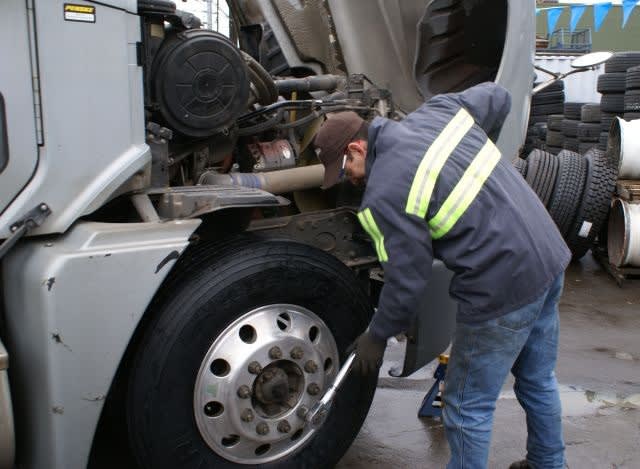
Retorquing is an oft-overlooked but vital part of tire and wheel maintenance program.
Too many numbers?
One of the challenges of dealing with vast amount of information is making sense of it all. Do you really need to know how much tread is left on the right-hand steer tire of unit 1311? Yes and no. It would be useful to know that the tire will be scheduled for removal in three months based on historic tread wear. That would help with purchasing and budgeting. Does your fleet have the analytic capabilities to make such a decision? A dealer affiliated with one of the major programs mentioned here probably could.
Ad Loading...
Likewise with retreadability. Which brands and models of tire are consistently getting two or even three caps in their lifetime with your fleet? Should you ditch the underperforming tires? Does the lifecycle cost of the tire make it a throwaway, or would a more expensive tire actually have lower total cost of ownership? Those are difficult numbers to crunch without a sophisticated management program, and the larger or more geographically diverse the fleet is, the greater the challenge becomes.
And speaking of numbers, since tires account for a significant number of Vehicle Maintenance BASIC points under the Federal Motor Carrier Administration’s Compliance, Safety, Accountability enforcement program, you can no longer afford to let your guard down on basic tire inspections.
“We are able to catch things the DOT is looking such as low tread depths, under inflation, exposed steel cords -- things like that can be caught very quickly and very easily with a program like TireCare,” notes Blair Scurlock, director of customer solutions at TCi Tire Centers.
When you look at DOT statistics, many of the tire violations are wear-related, such as tread depth less than 2/32. If someone is watching and tracking tire wear, many of 2013’s 209,600 tread wear violations might have been prevented.
You could draw up a very long list of the way a tire service provider could help a fleet better manage a tire program. Ten years ago, many of the items on today’s list might not have mattered that much. Certainly tires are more costly, and therefore worth the effort of looking after them, but it’s also fuel costs, downtime, CSA violations, customer confidence, driver confidence (drivers will leave a fleet over downtime and slow tire calls), budgeting, inventory control...
Ad Loading...
Do your technicians really have the time and expertise for all that on top of their other responsibilities? It might be time to call in somebody who can make it all happen.
Pick your partner
There are probably three or four good, reliable tire service providers within a 20-minute drive of your terminal. How do you choose the right one?
“I recommend using an interview checklist when trying to distinguish between a dealer who will be a true partner and one who simply takes orders,” says Patrick Gunn, director of sales and marketing for the commercial tire side of Giti Tire (USA). “You are probably looking for a dealer that provides quality goods and services, a demonstrated safety record and the ability to deliver value to you in everything they do, so make sure they can deliver on the promise.”
Gunn’s checklist would include the following:
Established expertise in preparing and managing a tire evaluation program, including yard checks, air pressure maintenance, scrap tire analysis, as well as maintaining out of service reports, and tire performance records.
A comprehensive menu of services that could includes sales and service in their shop, your yard or on the road with 24/7 availability, a wheel torqueing program, retreading, wheel reconditioning, wheel and accessory sales, alignment, light mechanical services and trailer readiness.
Consistent use of recognized safety practices and procedures such as vehicle tag-out procedures, eye protection, the use of jack stands and of course Tire Industry Association and OSHA-certified technicians.
“And don’t be shy about asking for references or case studies on how the dealer has provided savings to other fleet customers,” adds Gunn.
Gunn also suggests ensuring the service provider is easy to do business with, such as providing accurate purchase orders and invoices that can be electronically integrated into your purchasing and maintenance systems.
Volvo’s updated D13 promises lower emissions without sacrificing performance or fuel economy. Take a closer look at what changed inside the engine in this HDT Spotlight video.
The Michelin X Multi Energy D2 is a regional haul drive tire engineered to help fleets improve fuel efficiency, durability and traction in demanding stop-and-go operations.
ZF is expanding its North American commercial-vehicle presence with new transmission applications, electrification, trailer technology and autonomous-driving systems.
Could Tesla’s camera-only autonomous driving technology work on an 80,000-pound Semi? In this commentary, HDT's Deborah Lockridge takes a look at Tesla, Cybercab, and how autonomous trucks see the road.
The U.S. Department of Transportation issued a new automated-vehicle strategy that outlines plans for driverless-truck regulations, cross-state freight corridors, and federal safety standards.
The Port Authority of New York and New Jersey announced millions in incentives for zero-emission drayage trucks, yard tractors, and new charging hubs near the port.
The National Highway Traffic Safety Administration says it lacks authority to regulate medium- and heavy-duty truck engines separately from complete vehicles, but the existing standards have not yet been eliminated.
Detroit isn’t starting from scratch to meet EPA 2027 diesel emissions standards. Its Gen 6 DD13 and DD15 engines keep much of today’s platform while updating the fuel and aftertreatment systems.