




Test Drive: Peterbilt 567 - Driver’s Delight
Does a bigger cab merit a larger model number for a truck? It does with Peterbilt’s 567, the builder’s latest vocational truck, which will eventually replace the current 367.

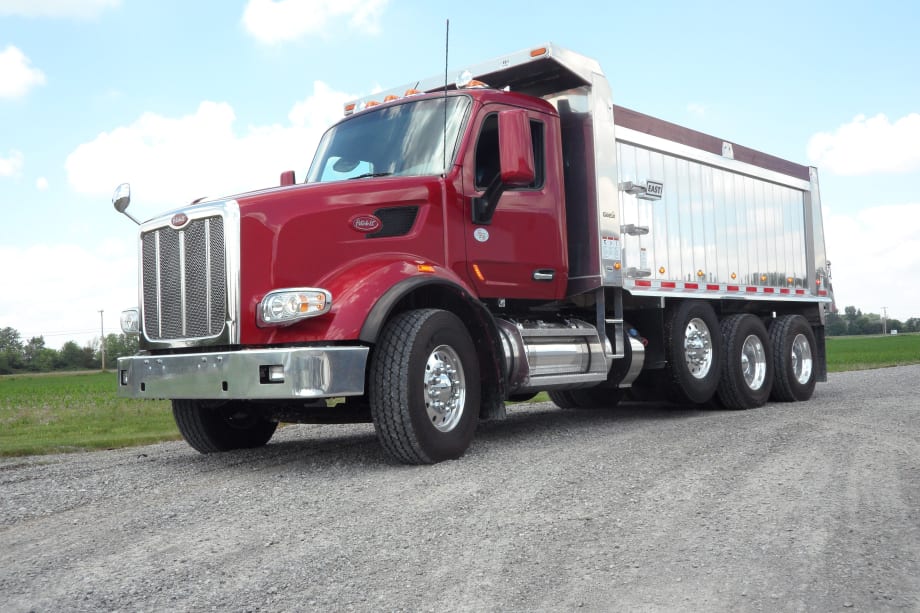
Built for shows, this Model 567 also goes, powerfully and smoothly. Bumper-to-back of cab length is 121 inches; a
115-inch BBC is also available. Set-back steer axle and single pusher axle suggests it’s built for an axle-weight state.

Does a bigger cab merit a larger model number for a truck? It does with Peterbilt’s 567, the builder’s latest vocational truck, which will eventually replace the current 367.
We could also look at it as a 367 with the wider Paccar cab that Pete numbers in the 500 series, as in the 579 highway tractor, although there are additional improvements that make this new model a joy to drive.
It didn’t hurt that our test truck was rather handsome, with sharp red metallic paint, plenty of bright-metal adornment and a gleaming East Genesis dump body. It was built as a show truck; you may have seen it at the Mid-America Trucking Show in March.
Let’s eyeball that wide aluminum cab. Its width is 2.1 meters or 82.67 inches, which is 8 inches wider than the long-utilized “narrow” cabs in earlier models. It’s basically the same cab used by Kenworth in its equally new T860 and T880 vehicles. The Pete and KW cabs share a lot of structural, skin, window and door parts. The dashboard structures are similar, but some switches and controls are arranged differently.

However, the rear cab structures are set up to suit disparate philosophies, according to Charlie Cook, Peterbilt’s vocational segment manager. The rear of Pete’s 5-series cab is designed to take a separate sleeper box, while KW’s would be grafted to an integrated sleeper. Each approach has advantages and disadvantages. Peterbilt designers believe it’s wiser to allow a sleeper to be removed (or added) if the truck’s role changes in a fleet, or to make it more attractive to prospective second owners.
Aside from the bigger cab, Cook said the 567 differs from the current Model 367 in other mechanical ways, including:
• A crossmember mounting for the new cab stretches over the transmission instead of under, which stiffens the chassis and cuts transmission vibrations and noise in the cab. For some installations this can also increase PTO clearance at the transmission, though this truck had a rear-engine PTO.
• The steering gear is angled 8 degrees from the frame rail to reduce right hand curb-to-curb turning radius by up to 9 feet.
• The three-piece Metton hood is more resistant to damage from impacts and road debris.
• The hood’s slope provides a 12% improvement in “ground strike” visibility.
Taking it on the road
Cook and I were at Link-Radlinski Inc. in East Liberty, Ohio, where specialists perform brake-testing work in a shop and at the nearby sprawling Transportation Research Center. The TRC was originally built by the state of Ohio and is now owned by Honda Motor Co., whose auto manufacturing plants employ thousands in the area. L-R technicians had put a load of sand aboard the Pete and the rig was all shined and ready to go.

The 567 really was smooth, quiet and comfortable. It rode well whether the single steerable pusher axle was up or down. It turned sharply, and steering feel through the TRW-Ross power gear was assuringly stable.
Large side portals and a big windshield provided picture-window views of the world, which got rather close directly ahead thanks to the steeply sloped hood. On the nose was a convex mirror that showed the areas directly ahead of the front bumper and alongside the right fender.
As time went on, I increasingly appreciated this truck’s comfortable premium interior trim. A large multi-function color screen in the center of the dash could display info about the truck, show a moving map and narrate navigational instructions, and project virtual gauges to supplement the permanent electro-mechanical gauges on the dash. This and more could be called up by the driver, though the screen can be somewhat obscured by direct sunlight.
HVAC controls were three simple rotary knobs housed in chrome-trimmed bezels – easy to comprehend, quick and accurate to use, and pleasing to look at.
Going under the hood
The Paccar MX-13 diesel performed well, even though its horsepower and pounds-feet figures were somewhat modest at 430 and 1,550, respectively.
A lot of the credit for that goes to the self-shifting Eaton UltraShift Plus, the automated version of the popular Fuller 9LL vocational transmission. All I had to do was start the engine, release the brakes, punch D for Drive and move out. A readout on the dash told me which of the tranny’s 11 ratios was being used at the moment, and its electronic controls always seemed to accurately sense what was going on and choose the right gear for a situation. Clutch engagement was flawless when starting from a standstill, and gear changes were done quickly and smoothly.

About two-thirds of the way into our brief journey on county and state roads and the nearby U.S. 33 freeway, I turned onto a country lane that climbed a steep ridge.
The road turned left and ascended what Cook estimated was a 9% grade. The tranny started out from a slow-rolling stop in 4th gear, then skip-shifted to 6th, went to 7th and 8th, then back to 7th as we ground up the hill with my foot maybe two-thirds down on the accelerator and the engine humming at 1,600 and 1,700 rpm.
Toward the top the road turned right as the grade eased, and the tranny upshifted into its top gears as we resumed level travel at a more brisk pace.
The UltraShift did all this quickly and precisely. I’d have preferred lower-rpm shift points, which can be done by reprogramming the gearbox’s controls, but Cook figured it was about right for a dump truck like this. On the freeway it cruised at 65 mph, its electronically limited top speed, at about 1,600 rpm, which is also correct for a vocational truck.
Depending on torque capacity for different engines, an automated LL might carry a $6,000 to $9,000 premium in this truck, Cook said.
That’s about half again as much as a simpler UltraShift in a highway tractor, but I’d find the money to buy it because it removes so much of the driving work, treats the driveline gently, and is drivable by rookies who might still be good workers.
Even with a manual tranny, this deluxe Peterbilt would certainly be attractive to a driver looking for a job or wondering if he should try to find greener grass.
For me it was a simple delight, and was one of those trucks that I didn’t want to turn in when my drive time was done.
More Equipment
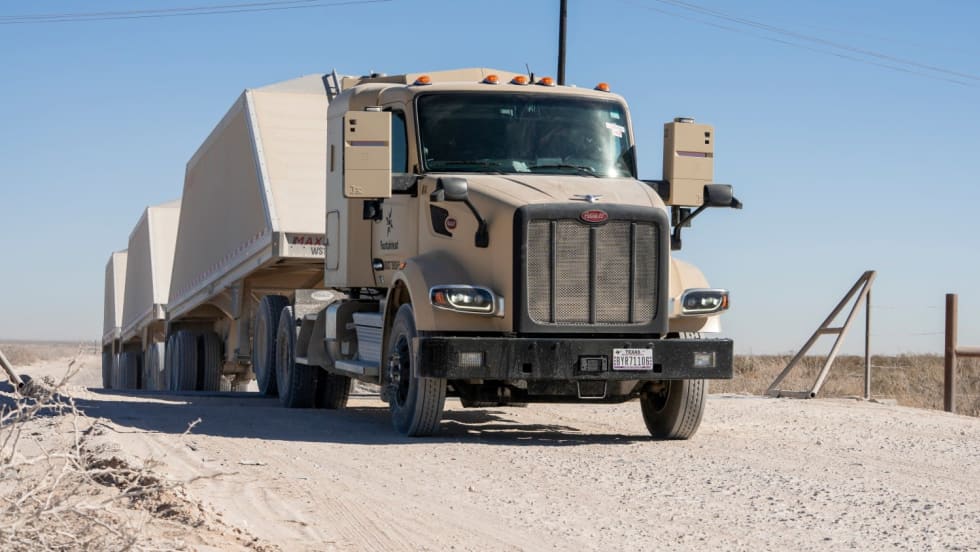
Atlas Expands Kodiak Driverless Truck Fleet in Permian Basin
Atlas Energy Solutions is expanding autonomous frac sand hauling in the Permian Basin with a second load-out location and plans for 100 driverless trucks by mid-2027.
Read More →
Putting Mack’s Command Steer to the Test
A test drive of Mack’s Command Steer active steering system evaluates how it can make truck driving easier and less tiring.
Read More →
Mack, Volvo Expand DEF Derate Software Updates
The updated software gives Mack and Volvo truck owners more time to address DEF-related issues before the engine derates or the vehicle goes into reduced-speed inducement, following new EPA guidance.
Read More →
Rush, MCT Team Up to Grow Refrigeration Service Network
The joint venture will operate MCT's network of Carrier Transicold dealerships and mobile service locations, with the companies promising greater service capacity and uptime for refrigerated fleets.
Read More →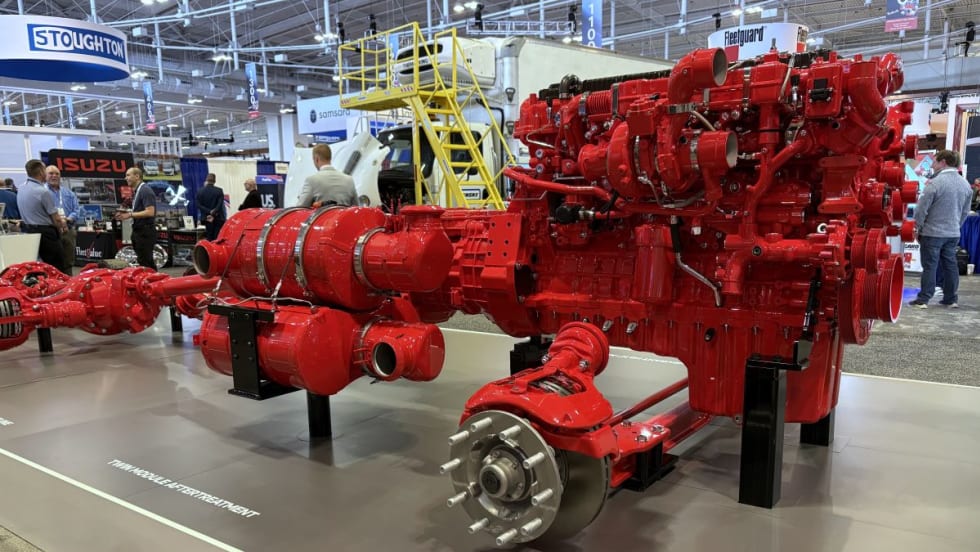
Cummins Adjusts 2027 Engine Rollout After EPA Proposal
The engine maker will gradually introduce its new Model Year 2027 diesel engines while continuing to offer current models during the transition, citing the EPA's proposed emissions rule changes.
Read More →
Aurora Rolls Out Next Generation of Driverless Trucks for Commercial Freight
Aurora's latest autonomous trucks it's rolling out with International feature lower-cost hardware designed for a million miles as the company expands commercial driverless freight operations across the U.S. Sun Belt.
Read More →
Peterbilt 589 Spotlight: A Close Look at a Custom Working Truck [Video]
There's more to this customized Peterbilt Model 589 and Great Dane refrigerated trailer than chrome and stainless (although there's plenty of that too!) A veteran driver explains the design choices and practical features behind this working truck.
Read More →
Continental Expands Retread Lineup With New ContiTread HDL 5 EP
New long-haul drive retread is designed to improve fuel efficiency, extend tread life, and lower fleets' cost per mile.
Read More →
EPA Proposal Could Ease 2027 Truck Costs and Buying Uncertainty
The proposal doesn't change the tougher NOx standard, but it would revise key implementation requirements that manufacturers say have driven up costs and complicated fleet purchasing decisions.
Read More →
Cummins, Paccar Ease DEF Derates After EPA Guidance
Updated diesel engine software gives truck operators more time to address emissions-system issues while staying compliant with EPA emissions standards.
Read More →