




Test Drive: Fuso FG 4x4 Goes Almost Anywhere
Unique to North America, this all-wheel-drive cabover is strong, maneuverable and fun to drive. Driving this Canter FG was like seeing an old friend who's aged gracefully

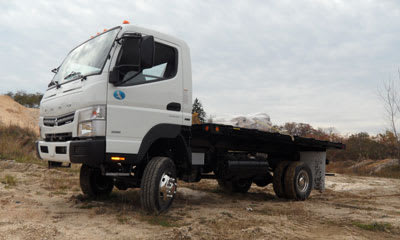
FG's go-anywhere mechanicals were hobbled by street-style tires that slipped on sandy soil of inclines at this quarry in northeastern Ohio, but block-treaded "traction" tires are available.
Driving this Canter FG was like seeing an old friend who's aged gracefully.
It'd been at least 10 years since I drove and wrote about an earlier version of Mitsubishi Fuso's unique-to-North America cab-over-engine 4x4. Now updated with a refined Canter cab and other advances, the recently introduced model was even better.
The FG is unique because all other 4x4s on this continent, whether from Ford, General Motors, Chrysler, Nissan or Toyota, are the conventional-cab style with a protruding nose that houses the engine. Most buyers prefer that style. The domestic Big Three all make trucks as heavy as the Fuso FG, but only the FG's a cabover. This matters to buyers who like a cabover's compactness and maneuverability.
Sometimes called low-cab-forward or tiltcab, this truck type is ubiquitous almost everywhere else in the world. Commercial-vehicle length limits overseas make the cabover all but mandatory, and even mini-trucks use the design. Fuso and others build cabovers for most of the world's markets, so they sell them here, too, though not in big numbers.
Early last year, Mitsubishi Fuso Truck of America began importing the Canters, which also have 2010-legal diesels and automated-mechanical transmissions as standard equipment. The parent company in Japan is 89% owned by Daimler Trucks of Germany, making Fuso a cousin to Freightliner and Western Star. Fuso's 4P10 four-cylinder diesel uses a Daimler-style BlueTec urea-injection system. The 3-liter engine's horsepower and torque numbers are modest - 161 and 295, respectively - but it scoots anyway, and the truck is fun to drive.
The dual-clutch AMT is called Duonic. It shifts quickly, smoothly and without the low-speed slippage inherent in torque converter-type automatics used by competitors. It replaces a five-speed manual tranny used on earlier FGs, making the truck easy to drive for the experienced and novice alike. The FG's single-speed transfer case is operated by a rocker switch on the dashboard, and manually locking hubs - not a very modern feature, I thought - engage the front wheels for off-road movement. Unlocking the TC and hubs enhances fuel economy during travel on pavement and graded trails.
For a given body length, a cabover's wheelbase and overall length are several feet shorter than a conventional's. This makes it easy to slip through urban traffic and scoot around job sites, and usually means outward visibility for its driver is better. This is a real plus off-road: When cresting a hill, you can see what's immediately ahead and below from behind the wheel of a cabover, but all you see with a conventional is its hood.
Off-road hill climbing - that's what we needed to do. So Tom Hotham, Fuso's representative in Ohio, arranged an excursion at a large quarry in a distant corner of the state. It's got trails and hills for us to drive over, he said, so off we went, only to find out that this FG's rib-type tires - optional fitment if a truck will spend a lot of time on pavement - slipped in the sandy soil at the quarry, and we were sadly confined to harder surfaces. Any FG destined for frequent off-road use ought to get block-treaded "traction" tires, and they are available.
However, the FG's high stance, at least a foot more than two-wheel-drive Canters, allowed it to shrug off obstacles on more solid terrain. The cab is also higher, which makes climbing in more of a chore, and I was pretty clumsy at first. But big grab handles on the A-pillars help driver and passenger pull themselves in (not that the younger and more agile Hotham needed much help). There's room for three people in the wide cab, and the center seat back folds down to make a work surface for a laptop or paperwork.
This FG was set up by Churney's Truck Center, a Fuso, Hino and UD dealer near Cleveland, Ohio, just for my test drive. The shop temporarily mounted a flatbed body, which carried about 1,000 pounds of borrowed building materials that we hauled to and from the quarry about 70 miles east of the city. The property, south of Thompson in northeastern Ohio, is owned by the Sidley Company, which has a division that sells Fuso and Mack trucks. People there showed us around the huge premises, now bustling with quarrying and filtering of sand to support natural gas drilling in the region.
Those rib-treaded tires proved quiet and comfortable on a high-speed run along Interstate 80, during which the FG's four-cylinder diesel busily spun at about 2,900 rpm at 70 mph. This was a function of the numerically high rear-end ratio and put the needle several hundred rpm outside the green zone arrayed on the tachometer, but still in its operating range so the engine didn't complain.
It also revved enthusiastically as the Duonic tranny went through its six ratios. Shouldn't it upshift sooner? I complained to Hotham, who was in the shotgun seat. He reached over and punched a rocker switch on the dash. This changed the tranny from Performance to Economy, and it then upshifted at lower revs, keeping the tach needle in that 1,500-to-2,500 green zone.
The Duonic seemed to know exactly what it was doing, always choosing a good gear for every situation. It can be controlled by slapping the selector to the left as it's in D, then up to make an upshift or down for a downshift. Usually it's better to leave it in D.
A few weeks later I went on a Fuso-sponsored trip to Japan, and drove another FG at the company's test facility. Here the tranny stumbled while assaulting a 12% paved upgrade. I had chosen Economy mode, and the Duonic got confused; it downshifted, then unwisely upshifted and the engine began bogging down and seemed about to stall. But I punched in Performance and it immediately recovered, downshifting again to let the engine rev and make some power. So Performance is the setting to use under demanding conditions.
The FG rode smoothly on well-maintained interstate pavement, but because it's a serious Class 4 truck with a stiff suspension, it bounced actively as we barreled over broken concrete on Cleveland-area streets.
A low cabover might look small in photos, but approach one and you'll see that it's really a sizeable thing. The tall FG is even more so. With a gross weight rating of 14,080 pounds, more than half of which is payload, it's not a light truck, either. Its primary competitor in North America is Ford's F-450 4x4, which sits low by comparison. The FG also has a larger price, but Mitsubishi Fuso claims it'll deliver a lower total cost of ownership. That includes low depreciation: Look for a 10-year-old FG and see what its seller is asking for it; you might be surprised.
Ease of maintenance is another cabover advantage. Most conventional-cab trucks in this weight class have automobile-like alligator hoods that open to reveal hoses, wiring and shrouding that hide the engine. Getting at it often requires removing something, then leaning over the radiator or fenders to reach what needs attention.
But the cab of a Fuso Canter tilts forward on front hinges - just snap loose a rear lock, grasp the cab's bottom and lift it, and up it goes, rather easily. Now you've completely bared the engine and all its accessories. Then you just step up to it and do what you must in the way of maintenance or repairs. Fluid checks can be done without even tilting the hood.
Aided by a pickup-like wheelbase of 134.4 inches, an FG's turning diameter measures 44.2 feet, which is 7 feet smaller than an F-450's, Fuso says. Yet there's enough room on the frame for a body that's 12 to 15 feet long. In fact, while going in circles with a low cabover such as this FG, I almost feel I could run into the body behind me.
Specifications
Truck: Fuso FG 4x4, low cab-over-engine, GVW 14,050 lbs., payload (w/ body) 8,130 lbs., cab-to-a
More Equipment

Detroit Opens Orders for EPA 2027 Engines
Detroit isn’t starting from scratch to meet EPA 2027 diesel emissions standards. Its Gen 6 DD13 and DD15 engines keep much of today’s platform while updating the fuel and aftertreatment systems.
Read More →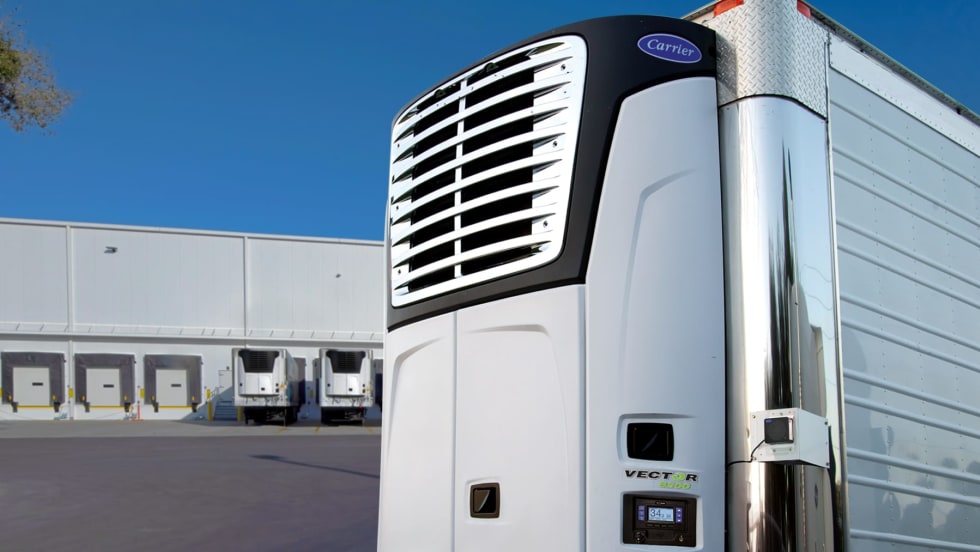
Carrier Transicold Adds All-Electric TRU for Stationary Cold Storage
Carrier Transicold’s new Vector 8200 all-electric transport refrigeration unit gives fleets a diesel-free option for temporary refrigerated and frozen trailer storage.
Read More →
A Closer Look at Kenworth’s Electric T880E Vocational Truck [Video]
Learn more about Kenworth's T880E battery-electric vocational truck at the Paccar Technical Center, including its range, applications, upfitting considerations, and PTO options, in this HDT Spotlight video.
Read More →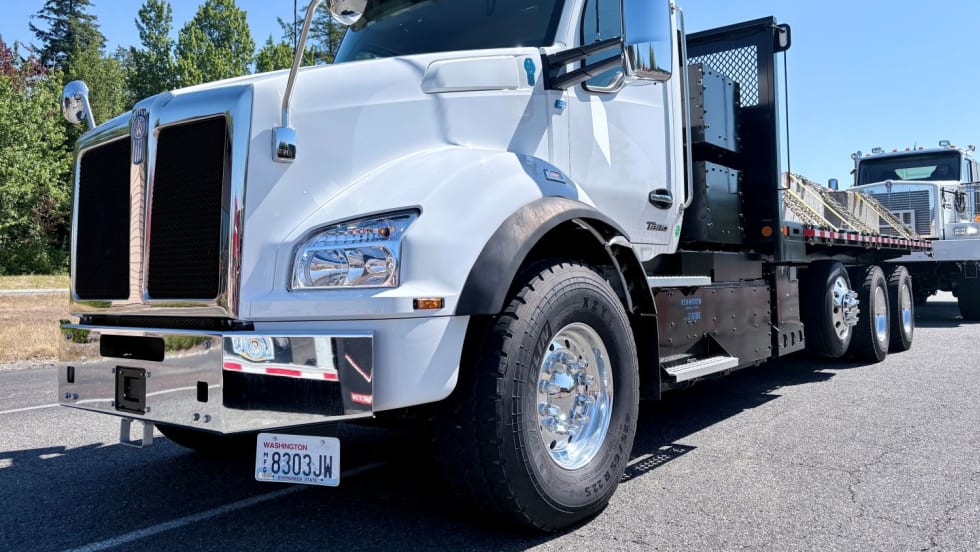
Kenworth T880E Brings EV Power to Vocational Trucks
A closer look at the Kenworth T880E’s range, charging, powertrain and upfit options — and where fleets are showing the most interest.
Read More →
What the U.S.-Canada Trade War Means for Trucking
Escalating U.S.-Canada tariffs could disrupt cross-border freight, reduce truck volumes, raise costs, and create new uncertainty for carriers on both sides of the border.
Read More →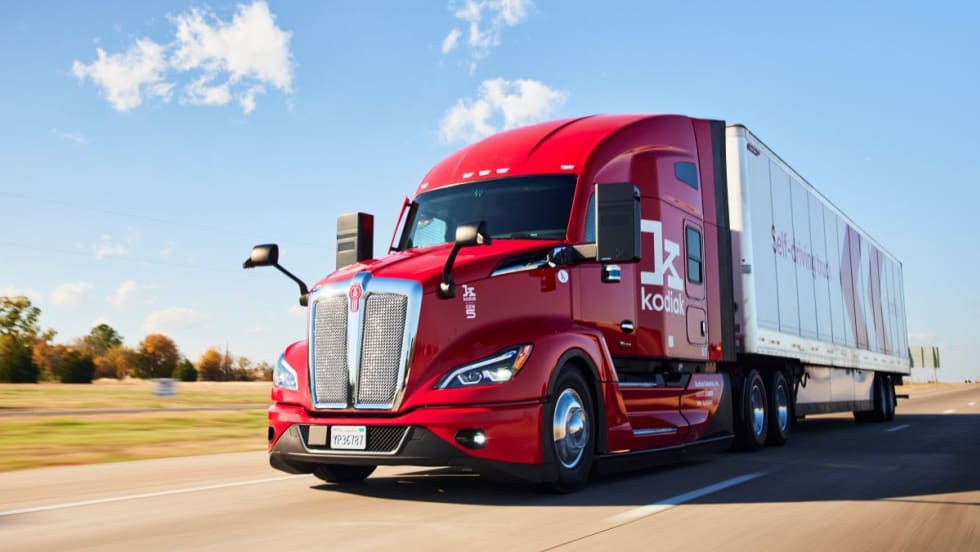
Autonomous Truck Testing Moves Ahead in California as Teamsters Challenge Rules
California has begun permitting heavy-duty autonomous truck testing, with Aurora and Kodiak among the first to receive approval, as the Teamsters sue the DMV over the new regulations.
Read More →
Behind the Wheel of the New Mack Anthem [Video]
HDT takes the new Mack Anthem around Mack’s Pennsylvania test track to see how its driver-focused design, technology, visibility and handling perform from behind the wheel.
Read More →
DTNA Plans New U.S. Truck Plant as Manufacturing Footprint Shifts
Daimler Truck North America is evaluating sites for a new assembly plant expected to open in 2029 while winding down operations at its longtime Portland manufacturing facility.
Read More →
Great Dane Flatbed Trailer Offers Light Weight and Strength
Freedom Ultra is designed for a wide range of open-deck applications, including building materials, lumber, machinery, steel products, industrial freight, and coil hauling.
Read More →
What It's Like Inside this Custom 2025 Peterbilt 589?
Take a driver's-eye tour of this customized 2025 Peterbilt 589 in this video, as longtime driver Ingrid Brown explains its features, compares it to previous models, and shares plenty of personality along the way.
Read More →