




Cargo Securement: What You Don't Know Can Hurt You Under CSA
You can hide a multitude of sins inside a van trailer, but with an open deck trailer, any indiscretions are out in the open for all to see – including DOT roadside inspectors

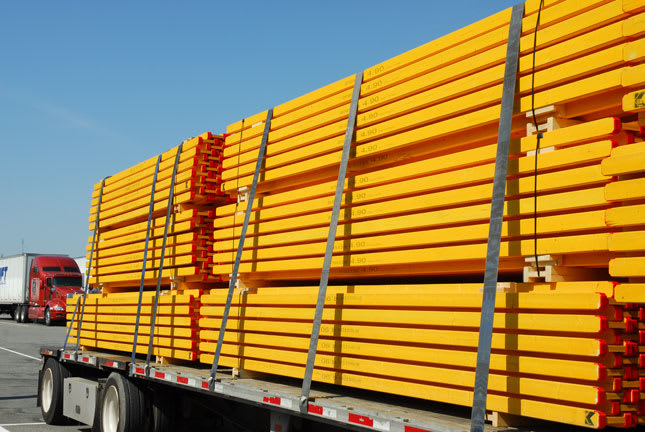
This great-looking load should be placed out-of-service for violations. How many can you spot? (See the answer at the bottom of the story.)
You can hide a multitude of sins inside a van trailer, but with an open deck trailer, any indiscretions are out in the open for all to see – including DOT roadside inspectors. Staying compliant means having a excellent understanding of the regulations as well as cargo securement equipment that is up to the task.
Keith Kerns, an investigator with the Public Utilities Commission of Ohio and a member of CVSA's International Safety Team, says the primary cause of cargo-related citations and out-of-service orders is not driver error or improper methods. It's the equipment itself.
"The statistics tell us that damaged or defective tie-downs, loose or unfastened tie-downs, and simply not having the required number of tie-downs are the most common violations we find at roadside," Kearns says. "The biggest issues related specifically to drivers are calculating the weight of the cargo plus any length requirements that might exist when determining the correct number of tie-downs required."
The two are related. If a driver correctly calculates the aggregate working load limits but uses sub-standard or under-rated equipment, he could still be cited, because the AWLL might be below minimums. That could result in one of several citations being issued, such as damaged securement systems, insufficient tie-downs or even cargo not immobilized or secured.
For example, a 5/16-inch grade 70 Transport chain has a WLL of 4,700 pounds, but if it's not marked as such, or the markings are not legible, an inspector would downgrade it to the equivalent of Grade 30 chain, which has a WLL of just 1,900 pounds.
"When using chains with binders and hooks, the 'weakest link' theory applies," Kearns points out. "The component with the lowest WLL in the assembly dictates the strength of the device. If you have a 4,700-pound chain with a 3,000-pound hook, the chain is only as good as its weakest link."
Similarly, unmarked webbed cargo straps in good condition are minimum-rated at 1,000 pounds WLL per inch of width. A properly marked 4-inch strap could be rated as high as 5,400 pounds. If that 5,400-pound strap were downgraded 4,000 pounds because the label or marking was missing or not legible, the driver could come up 1,400 pounds short per damaged strap in meeting the minimum AWLL for the cargo.
Damaged straps could be downgraded or zero-rated, depending on the extent of the damage, as determined by the strapping defect table in CVSA's Out-of-Service Criteria handbook.
"You can have a minimal amount of damage to the strap, and there are many variables there, but if the strap is so damaged that it meets the requirements of the defect table, the strap would be zero rated. In other words, it would be like that strap wasn't even there," Kearns says.
Why extra load securement straps aren't always a good idea
Ralph Abato, vice president of international sales at Ancra International, says drivers sometimes shoot themselves in the foot by using extra straps over a load.
"You can't have too many straps on a load, but if some of those straps are damaged, they will still be taken out of service and the driver cited," he says. "The truck may be okay to go because the driver has met the minimum with his good straps, but the extra straps he used – old straps laying in the bottom of the tool box – may end up causing a violation."
He advises going through your inventory and getting rid of all the damaged or worn-out devices and replacing them with good ones.
Another common driver mistake is not using the correct number of tie-down devices for the cargo. The driver has to consider the weight and length of the article(s) of cargo, and use the correct number of the proper tie-downs.
"We're looking for a minimum of one strap for every 10 feet and fraction thereof in length, with a minimum of two tie-downs for anything longer than 5 feet," says Kearns. "For example, an article that is 21 feet long and up against a header board would need a minimum of three straps based on its length and position on the trailer. If it's not against a header board or in contact with the cargo in front of it, it would need one additional strap. Drivers used to call this the penalty strap."
Weight also must be considered. Enough tie-downs are required to secure for half the weight of the article of cargo. For example, something weighing 20,000 pounds would require a minimum of 10,000 pounds WLL of cargo securement. Using the indirect method (over the cargo, anchor point to anchor point), two 5,400-pound rated straps (2 x 5,400 = 10,800 pounds AWLL), or three 4,700-pound-rated chains (3 x 4,700 = 14,100 pounds AWLL) would meet the AWLL requirements. In this case, two 4,700-pound chains would give you only 9,400 pounds AWLL; you need to secure for 10,000 pounds.
If the article was more than 10 feet in length (even if it were just 10 feet 1 inch), it would require an additional strap to satisfy the length requirements, as above, but the three chains would suffice.
If that article of cargo were a machine with built-in attachment points, and the driver used the direct method (a chain from a trailer anchor point to a cargo attachment point), five direct attachments would be needed - or four direct and one indirect.
When using the direct method, each tie-down device only gets half its rated working load limit. So, if the devices are rated for 4,700 pounds each, they would get a 2,350-pound allowance (5 x 2,350 = 11,750 pounds AWLL). Four 4,700-pound chains would give you only 9,400-pound AWLL.
Cargo securement isn't rocket science, but there's too much to be taken into account to let poorly trained drivers or sub-standard tie-down equipment ruin your company's safety record.
Answer to our cargo securement quiz:
The load appears to be unitized bundles stacked three layers high, so they must meet 393.118 and, accordingly, have tie-downs on both the second and third layers meeting all requirements of 393.100 through 393.114.
While difficult to see in the photo, the strap labels are badly frayed and the WLL markings are all but invisible. The WLL of the straps could be downgraded by inspectors.
The cargo straps should be strung inside of the rub rail "when practicable." In this case, it would have been practicable to route the straps accordingly.
Click here to read about the top cargo securement violations under CSA.
More Safety & Compliance

How Waste Connections is Using Data, Telematics, and AI
How do you manage and maintain more than 18,000 connected trucks? Data. Lots of it.
Read More →
Fleet Advantage: Top Logistics Fleets Outperform National Safety Benchmarks
Fleet Advantage's latest TRUST Safety Index found leading logistics fleets maintained significantly lower out-of-service rates and stronger safety scores than national averages, while highlighting persistent challenges related to tires, brakes, and unsafe driving behaviors.
Read More →
Why Fleet Data Matters More Than Ever at Waste Connections [Watch]
Waste Connections' Chuck Palmer explains how telematics, predictive maintenance, safety analytics, and AI help keep vehicles on the road and drivers safe in this episode of HDT Talks Trucking.
Read More →
Short Takes: How K&B is Using AI
Fleets need to "get on board the train" with AI, says Lance Evans of K&B Transportation in this HDT Talks Trucking Short Takes episode.
Read More →
Short Takes: Inside K&B’s Truck Safety Tech
Listen to learn how K&B Transportation uses cellphone-blocking technology, speed management systems, weather geofencing, bridge avoidance tools, and more to improve driver safety.
Read More →
The Biggest Gap in Driverless Trucking Isn’t Tech. It’s Safety Validation
Nauto’s Stefan Heck says autonomous trucks are advancing quickly but proving they’re safe enough for large-scale deployment may be the industry’s hardest challenge.
Read More →
Truck Crash Rates Are Down. So Why Do Insurance Costs Keep Rising?
ATRI’s latest research points to litigation, social inflation, and soaring claims costs as key drivers behind record-high liability premiums for trucking fleets. But there are things motor carriers can do.
Read More →
FMCSA Removes More Than a Dozen ELDs from Registered List
The FMCSA continues its efforts to fight electronic logging devices that don't meet federal requirements, removing more than a dozen from the registered ELD list in May.
Read More →
How the Supreme Court Broker Liability Ruling Could Reshape Trucking’s Safety Landscape
The Supreme Court’s May 11 broker-liability ruling may not radically rewrite transportation law overnight. But industry experts say it will intensify pressure on brokers, carriers, and shippers to prove they are prioritizing safety.
Read More →
Recall of Fontaine Fusion Flatbeds Warns Owners Not to Use the Trailers
Some Fontaine Fusion flatbed trailer manufactured between February 2025, and March 2026 could have mainbeams weakened by hydrogen embrittlement because of a problem in the galvanizing process.
Read More →