




The SCR Inducement Battle Wages On
"Inducement" is a word that is getting much play in the Selective Catalytic Reduction debate right now.
"Inducement" is a word that is getting much play in the Selective Catalytic Reduction debate right now.
What are inducements?
Let's step back and consider the SCR process. The diesel engine produces various combustion byproducts that include the nitrogen oxides (NOx) and particulate matter (PM) that have been the focus of EPA emissions regulation over the last 20 years. In the last go-around for 2010, most truck engine manufacturers decided that the final step in the reduction of NOx could best be achieved using SCR technology that chemically washes out the NOx in the exhaust stream after it has left the engine.
Injecting ammonia (NH3) into the hot exhaust reduces the NOx over a catalyst (hence "catalytic reduction" in the name). The result is the nasty NOx is reduced to nitrogen, which constitutes 80 percent of the air we breathe, and water, another very common constituent of our atmosphere. And a jolly good thing, too.
So the process is elegant. And it works. The technology has been used for decades in stationary power generation, and has been applied to heavy diesels over in Europe for more than three years to allow manufacturers there to reach compliance with the Euro V regulations.
But SCR is an aftertreatment process. The engine doesn't care whether it is functioning or not. And less than scrupulous truck operators could care less also, since the ammonia-containing fluid -- Ad Blue in Europe and Diesel Exhaust Fluid here in North America -- costs money.
In the European experience it was found that trucks were running with water in their DEF tanks as there was no anti-cheating strategy - or inducement -- to keep the DEF tank filled. Running without fluid defeated the NOx removal and meant engines were running at orders of magnitude above the NOx limits.
EPA was well aware of this shortcoming and as part of the guidelines to allowing SCR technology to meet EPA2010, the agency required SCR proponents to have strategies to induce operators to keep DEF on board and the aftertreatment systems functional.
As it has shaken out with the cooperation between the SCR proponents and the agency, there are inducements to the driver to fill the DEF tank when its level drops to around the 10 percent level. Then a light comes on or a message on the driver information display lets the driver know that DEF needs attention. At the 5 percent level, warning chimes and lights add to the general clamor and by this time a driver should be pestered enough to add DEF.
If this still doesn't do it, a further inducement is introduced. Here again, different truck manufacturers have their individual ways to get drivers to respond. In some cases, a derate is applied to the engine. It may be an across the board 25 percent reduction in torque, it may be a gradually increasing derate over miles up to 25 percent. For others, notably Detroit Diesel, the strategy is to keep full torque but to limit the truck's road speed to 55 mph.
If even that fails to get the driver's attention, there's a "hard" inducement that effectively stops the truck. Everyone agrees this is 5 mph so that the truck has some mobility. But the trigger has been chosen so as not to endanger the general motoring public with a truck stranded on the highway.
This trigger is at fuel fill, so that a driver could limp in at a 75 percent of torque to a fueling point where there will be available DEF. If more diesel fuel than 5 percent of the tank capacity is added but still without DEF, the truck will start, but will be limited to 5 mph.
The theory is that even the most unscrupulous DEF-dodger would be discouraged by this inducement since it would mean stopping about every hundred miles or so to add fuel, something that just wouldn't happen in the real world.
EPA and the California Air Resources Board are currently reviewing these inducements to see if they are stringent enough. The SCR proponents say 'Yay.' Navistar, the only proponent of in-cylinder Advanced Exhaust-Gas Recirculation, which doesn't use DEF, says 'Nay.'
So we haven't heard the last of this yet.
More Equipment

ZF Expands Commercial Vehicle Push in North America
ZF is expanding its North American commercial-vehicle presence with new transmission applications, electrification, trailer technology and autonomous-driving systems.
Read More →
Tesla Wants a Self-Driving Semi. Are Cameras Enough?
Could Tesla’s camera-only autonomous driving technology work on an 80,000-pound Semi? In this commentary, HDT's Deborah Lockridge takes a look at Tesla, Cybercab, and how autonomous trucks see the road.
Read More →
Kodiak: Driverless Long-Haul Truck Launch on Track for 2026
Kodiak AI says its driverless long-haul safety case is 93% complete and it remains on track to begin commercial operations by year-end 2026.
Read More →
What DOT’s Automated Vehicle Strategy Means for Trucking
The U.S. Department of Transportation issued a new automated-vehicle strategy that outlines plans for driverless-truck regulations, cross-state freight corridors, and federal safety standards.
Read More →
East Coast Port Launches $45M Electric Truck Push
The Port Authority of New York and New Jersey announced millions in incentives for zero-emission drayage trucks, yard tractors, and new charging hubs near the port.
Read More →
PlusAI Going Public to Fund Autonomous Truck Launch
A SPAC deal could provide PlusAI with up to $300 million as it works toward a 2027 commercial launch of factory-built autonomous trucks.
Read More →
NHTSA Moves to Rewrite Truck Fuel-Economy Rules
The National Highway Traffic Safety Administration says it lacks authority to regulate medium- and heavy-duty truck engines separately from complete vehicles, but the existing standards have not yet been eliminated.
Read More →
Detroit Opens Orders for EPA 2027 Engines
Detroit isn’t starting from scratch to meet EPA 2027 diesel emissions standards. Its Gen 6 DD13 and DD15 engines keep much of today’s platform while updating the fuel and aftertreatment systems.
Read More →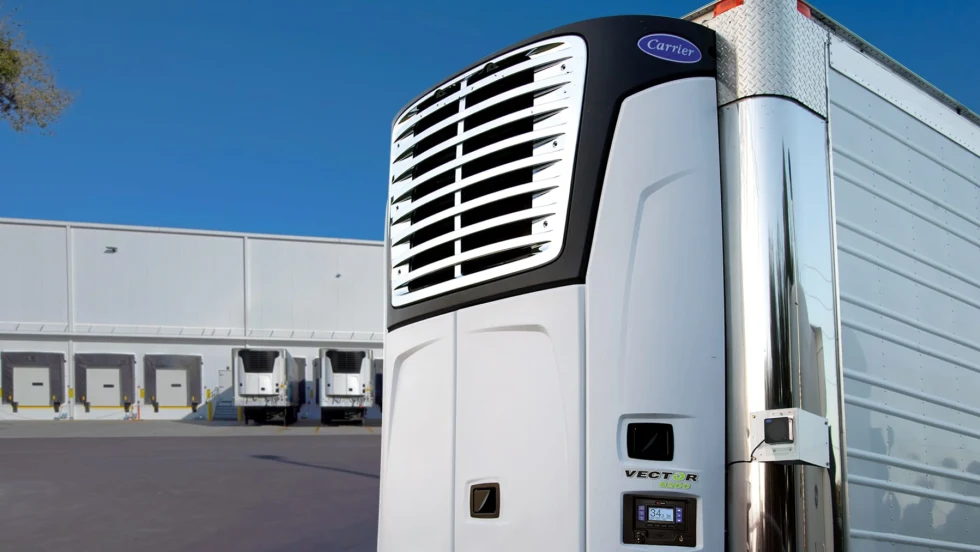
Carrier Transicold Adds All-Electric TRU for Stationary Cold Storage
Carrier Transicold’s new Vector 8200 all-electric transport refrigeration unit gives fleets a diesel-free option for temporary refrigerated and frozen trailer storage.
Read More →
A Closer Look at Kenworth’s Electric T880E Vocational Truck [Video]
Learn more about Kenworth's T880E battery-electric vocational truck at the Paccar Technical Center, including its range, applications, upfitting considerations, and PTO options, in this HDT Spotlight video.
Read More →