





Related: Class 8 Truck Orders Hit 3-Year High
Fleet Survey Shows Business is Great, Drivers are Scarce
How’s business? Better than ever, according to CK Commercial Vehicle Research’s first-quarter Fleet Sentiment Report survey of trucking fleets.
February 2, 2018
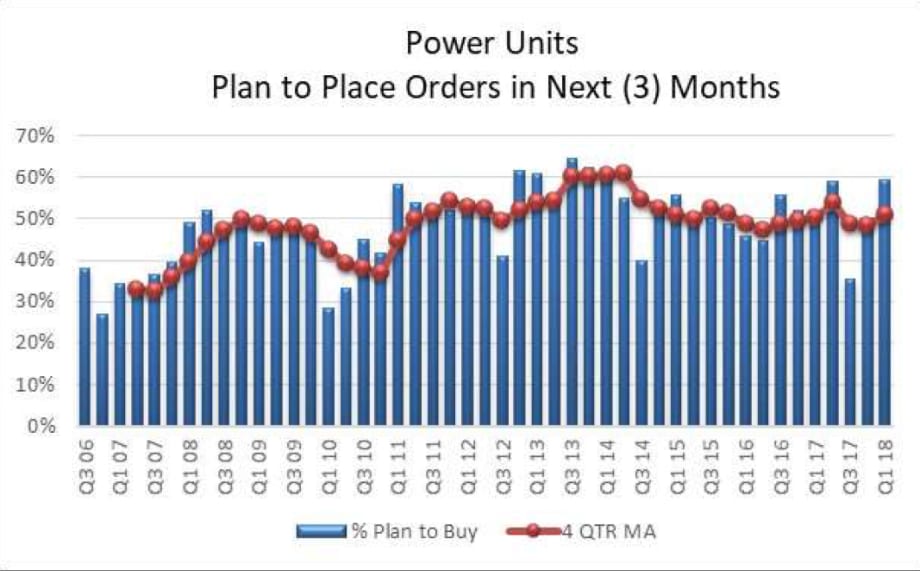
Business is good, so fleets are planning to buy equipment – but many would buy more if they had the truck drivers to put in them. Courtesy CKCVR
2 min to read
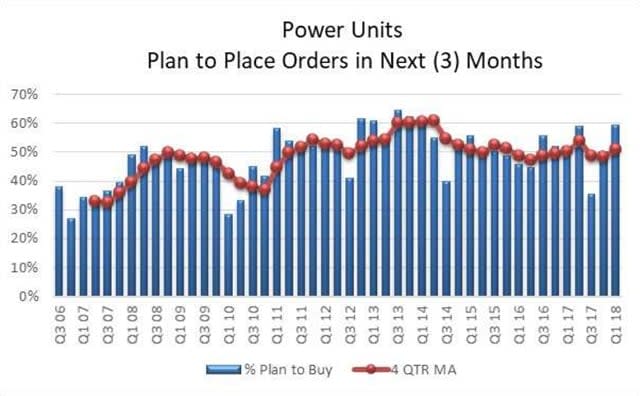
Business is good, so fleets are planning to buy equipment – but many would buy more if they had the truck drivers to put in them.Courtesy CKCVR
How’s business? Better than ever, according to CK Commercial Vehicle Research’s first-quarter Fleet Sentiment Report survey of trucking fleets.
Fleets were asked, “Considering all the factors that impact your company, on a scale of 1-5, in your opinion, what is the overall outlook for your fleet in the next three months?” The average keeps rising to new heights – in Q1 2018, a new record of 4.37.
Freight demand is strong at most companies in the survey.
Planned equipment purchases are keeping pace, with the CKCVR FSR Buying Index only showing a drop because it’s compared to exceptional numbers in last year’s fourth quarter and because fewer fleets were planning to place large trailer orders.
Nearly 60% (59.5%) of the Q1 respondents indicated they planned to place power unit orders during the first quarter, heavily weighted toward larger fleets.
“While I don’t expect Q1 orders to be higher than Q4, the number of fleets that plan to place orders shows continued strength in truck demand,” noted survey author Chris Kemmer of CK Commercial Vehicle Research in the report.
Some of the things fleets are planning to add to these new orders they didn’t spec previously include air disc brakes, automated transmissions, battery-powered auxiliary power units, and collision mitigation systems.
The driver shortage is still affecting two-thirds of respondents, with a number commenting that if they could find the qualified drivers, there’s plenty of business for them to add trucks to put them in.
Kemmer noted that the fleets that are planning to buy power units to add capacity are mostly those involved in building and construction, “not large for-hire fleets who are most heavily beset by the continuing driver shortage.”
However, she said, “Because of a continued driver shortage in an environment of strong freight, many fleets are using added trailer purchases to increase their capacity (doing more drop and hook, etc.)”
Interest in electric commercial trucks is spotty, but all respondents understand roadblocks and possible benefits. Top roadblocks mentioned include charging station infrastructure, range on a single charge, initial cost, and weight issues. Benefits expected include low or no fuel costs, environmental benefits, and possibly maintenance cost savings.
E-commerce and “last-mile” delivery demands are only expected to affect specific segments. Few expressed those as a reason to make wholesale changes any time soon, instead taking more of a mentality of being open to adapting to changes as they see them.
More Drivers

EEOC Sues Texas Trucking Company Over Driver Age Limits
The agency says Trancasa USA rejected applicants over 65 and applied tougher driving-record standards to those over 60.
Read More →
Nussbaum, Roehl Announce Second Driver Pay Increase This Year
This year has seen a swath of major truck driver pay increases as freight capacity has tightened.
Read More →
From One Generation to the Next: How Mentorship Builds Safer Truck Drivers
After three decades in trucking, Harold Perry shares what he's learned about driver safety, mentorship, and helping the next generation build confidence behind the wheel.
Read More →
Truck Drivers Need More Than Another Alert
Fleets have more visibility into truck health, safety events, and driver activity than ever. The next challenge is turning all that information into useful guidance for the person who has to decide what to do next.
Read More →
FMCSA Removes 110 Truck Driver Training Schools from Certified ELDT List
Federal regulators also are targeting more than 160 additional training providers and launching a nationwide audit of third-party CDL skills testers as part of a broader crackdown on trucking fraud.
Read More →
Hours of Service Pilot Programs: FMCSA Readies for 2027 Rollout
Two pilot programs could eventually reshape hours-of-service rules, giving truck drivers options to pause their 14-hour clock or use longer split sleeper rest periods.
Read More →
Medical Cards, English Proficiency Reshape Roadcheck Violations
Medical-card violations jumped to the top of the driver out-of-service list during CVSA’s 2026 International Roadcheck, while English-language proficiency violations appeared among the leading violations for the first time.
Read More →
Driver Trust Can Make or Break the Success of Fleet Safety Technology
New Teletrac Navman research suggests that onboarding, transparency about driver data, and positive feedback can play a significant role in how commercial drivers respond to safety and coaching technology.
Read More →
EEOC Sues KLLM Over Alleged Sex Discrimination in Driver Training
KLLM is facing a federal sex-discrimination lawsuit over policies the EEOC alleges put female truck driver trainees at a disadvantage.
Read More →
FMCSA Moves to Codify English Language Requirements for Commercial Drivers
By changing regulations on English-language proficiency requirements for commercial drivers, rather than relying on a guidance memo, the FMCSA said future administrations won't be able to walk back the Trump administration's stricter enforcement with just a memo.
Read More →