





Related: Embark Hauling Refrigerators to Prove Out Autonomous Truck Tech
Embark's New Road to Autonomous
Embark COO Mike Reid says his company's approach to autonomous trucks will help resolve driver shortage issues while delivering immediate value for fleets.
December 18, 2017
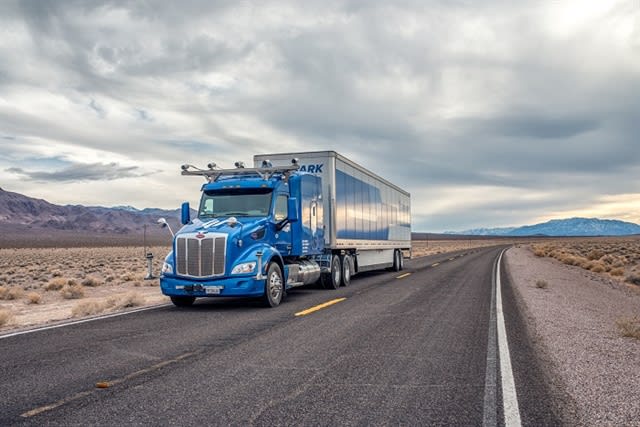
Embark says its initial autonomous vehicle control system will focus on weather-friendly routes with high freight volumes. Photo: Embark
3 min to read
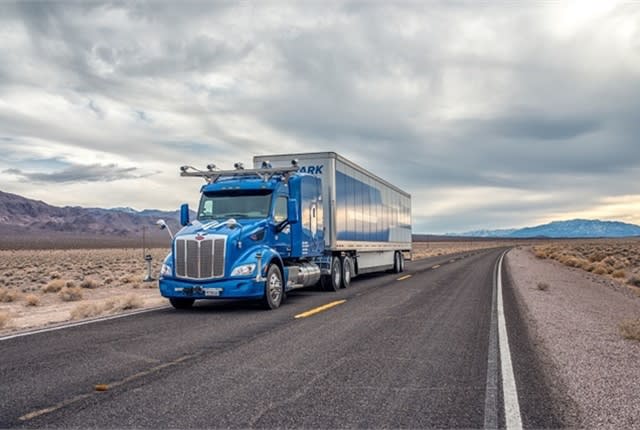
Embark says its initial autonomous vehicle control system will focus on weather-friendly routes with high freight volumes. Photo: Embark
The conversation in trucking has moved beyond debating if autonomous vehicle technology will be applied to commercial vehicles to pondering what the timeline for driverless trucks will be and how comprehensive those systems will be.
Embark is a Silicon Valley-based technology developer that is developing a truck-specific approach to autonomous driving. COO Mike Reid said Embark will address many of the immediate personnel issues in trucking today – and may even create jobs as in-home grocery and last-mile deliveries heat up in the coming months.
Reid, in an exclusive interview with HDT, said that there is “no question” the advent of autonomous vehicle technology will fundamentally change how fleets operate – and that Embark is focusing its initial autonomous vehicle systems to capitalize on those changes.
He said Embark is currently working on a deep-learning autonomous vehicle system that will focus exclusively on dedicated long-haul trucking corridors as a way to introduce the technology with immediate value for early adopters.
That’s why, according to Reid, Embark’s first autonomous vehicle system will be designed to take a semi-truck on long highway runs, with human drivers slipping behind the wheel at “transition points” off the highway to take the trucks into distribution centers, where freight can be offloaded and put on vehicles better suited for urban and last-mile delivery routes.
“A truck running on a long, boring 1,500-mile route is also operating in an environment where its exposure to the number of different and dynamic driving scenarios is seriously constrained,” Reid said. In other words, even at highway speeds, there’s simply a lot less going on that the vehicle’s autonomous control has to anticipate, track, and contend with than in a stretch of urban traffic with pedestrians, bicyclists, congestion, and all the other variables there that come into play.
And instead of developing an autonomous vehicle control system that is simply released onto American streets and expected to deal with the infinite number of variables that human drivers deal with on a daily basis, Reid said Embark will focus on both a retrofit and a new, OEM-spec system that is focused on very specific truck routes with favorable weather conditions and high freight volumes.
“The software ‘brain’ on these trucks will be capable of running these predetermined routes, providing value for fleets from the outset,” he said.
Reid said the result will be a truck that is capable of taking on jobs in a market segment that is proving difficult for fleets to recruit drivers for, while improving their bottom lines. “Our business case to the fleets for our autonomous technology is very simple,” he said. “What if every driver on that route drove their truck like your absolute best driver day in and day out in terms of speed limits, fuel economy, braking, turning, and overall safety? We think those are the sorts of things that will really appeal to fleets – superior vehicle performance with more efficient operations.”
And, Reid noted, dedicated long-haul autonomous technology would allow fleets to shift human drivers away from stressful, hard-to-full routes and instead employ them in urban and last-mile jobs that get them home every night. “There are a lot of issues in play, from legislation to the average age of the current driver pool that make us think we’ll see autonomous vehicles begin to play a role in the trucking industry sooner, rather than later,.
Embark recently announced that it has partnered with Peterbilt as well as Ryder System, and Reid said the company is in the process of proving out its autonomous vehicle concept with commercialization to follow “as soon as possible.”
More Drivers

Truck Drivers Need More Than Another Alert
Fleets have more visibility into truck health, safety events, and driver activity than ever. The next challenge is turning all that information into useful guidance for the person who has to decide what to do next.
Read More →
FMCSA Removes 110 Truck Driver Training Schools from Certified ELDT List
Federal regulators also are targeting more than 160 additional training providers and launching a nationwide audit of third-party CDL skills testers as part of a broader crackdown on trucking fraud.
Read More →
Hours of Service Pilot Programs: FMCSA Readies for 2027 Rollout
Two pilot programs could eventually reshape hours-of-service rules, giving truck drivers options to pause their 14-hour clock or use longer split sleeper rest periods.
Read More →
Medical Cards, English Proficiency Reshape Roadcheck Violations
Medical-card violations jumped to the top of the driver out-of-service list during CVSA’s 2026 International Roadcheck, while English-language proficiency violations appeared among the leading violations for the first time.
Read More →
Driver Trust Can Make or Break the Success of Fleet Safety Technology
New Teletrac Navman research suggests that onboarding, transparency about driver data, and positive feedback can play a significant role in how commercial drivers respond to safety and coaching technology.
Read More →
EEOC Sues KLLM Over Alleged Sex Discrimination in Driver Training
KLLM is facing a federal sex-discrimination lawsuit over policies the EEOC alleges put female truck driver trainees at a disadvantage.
Read More →
FMCSA Moves to Codify English Language Requirements for Commercial Drivers
By changing regulations on English-language proficiency requirements for commercial drivers, rather than relying on a guidance memo, the FMCSA said future administrations won't be able to walk back the Trump administration's stricter enforcement with just a memo.
Read More →
Drivers Put Western Star Trucks to the Test at Star Nation Experience
Watch to get an inside look at the Western Star trucks, technology, and community behind the Star Nation Experience 2026!
Read More →
Trump Administration Looks to Put More Veterans Behind the Wheel
The Freedom Haulers program pulls together existing and expanded programs at several federal agencies to recruit veterans to drive commercial heavy-duty trucks and cut the red tape for them to get a CDL, training, and employment.
Read More →
Putting Mack’s Command Steer to the Test
A test drive of Mack’s Command Steer active steering system evaluates how it can make truck driving easier and less tiring.
Read More →