




Related: Trucking Alliance Endorses Developing Autonomous Trucks
Trucking Alliance Adopts AAA Advanced Safety Tech Recommendations
The Alliance for Driver Safety & Security, commonly known as the Trucking Alliance, announced that its carrier members must use four truck-safety technologies that the AAA Foundation for Traffic Safety has concluded are critical to reducing large truck crashes and saving lives.
by Staff
November 1, 2017
Photo: Maverick Transportation
3 min to read
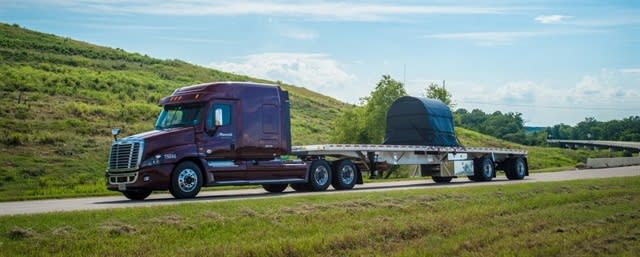
Photo: Maverick Transportation
The Alliance for Driver Safety & Security (aka the Trucking Alliance) announced on Nov. 1 that in order to qualify for membership, carriers must adopt four truck-safety technologies that the AAA Foundation for Traffic Safety has concluded are critical to reducing large truck crashes and saving lives.
The Trucking Alliance noted that a new AAA Foundation report, "Leveraging Large Truck Technology and Engineering to Realize Safety Gains," examined the costs and safety benefits of installing these four advanced safety technologies in large trucks:
Lane Departure Warning Systems, “which detect when the vehicle drifts out of its lane and warn the driver”
Video-based Onboard Safety Monitoring, “which utilizes in-vehicle video cameras and sensors”
Automatic Emergency Braking Systems, “which detect when the truck is in danger of striking the vehicle in front of it and brake automatically if needed”
Air Disc Brakes [on tractors], “which are superior to traditional drum brakes”
While the AAA Foundation’s report acknowledges that “many large commercial fleets have begun equipping trucks with these advanced safety technologies,” the Trucking Alliance said it is the first U.S. carrier-based organization to adopt these technologies as conditions for membership.
“These technologies can make the highways safer for our drivers and the public and [that's] why the Trucking Alliance carriers are installing them on new trucks,” said Steve Williams, president of the Trucking Alliance and Chairman/CEO of Little Rock-based Maverick USA. “The AAA Foundation report shows how these automated technologies can help commercial drivers and motorists avoid accidents and return home safely to their families.”
The AAA Foundation report found that by installing automatic braking systems and air disc brakes on all new trucks, 7,705 accidents, 92 deaths and 4,200 injuries could be avoided. The report also projected that if onboard cameras and lane departure warning systems were installed on all new and existing commercial trucks, another 69,372 large truck accidents could be avoided, saving 408 lives and 24,105 injuries.
“AAA applauds the Trucking Alliance for taking such an important step toward improving safety on U.S. roads,” said Marshall Doney, president and CEO of AAA. “Adding key safety technologies to fleets is critical if we are to reverse the growing rate of crash deaths on our roadways.”
Trucking Alliance carriers have adopted these standards for membership, which exceed federal requirements to operate as a motor carrier.
Electronic Logging Devices (ELDs) – Install certified ELDs or have Automatic On-Board Recording Devices (AOBRDs) in all interstate trucks, to verify hour-of-service compliance. (Effective Dec. 18, 2017, the federal government will require all carriers to have AOBRDs or install ELDs in interstate commercial trucks.)
Truck Speed Limiters – Utilize truck speed limiters, set at a maximum speed of no greater than 65 mph.
Hair Testing – Transition to hair testing to identify lifestyle drug users and opioid addicts, since hair tests are more reliable than the current federal pre-employment drug testing protocol for commercial drivers.
Public Liability Insurance – Maintain liability insurance coverage that is significantly higher than the minimum federal requirement, to sufficiently cover the costs associated with injuries, fatalities and loss of property in large truck accidents, as Congress directed 37 years ago.
Truck Safety Technologies – Install collision mitigation systems in all newly purchased Class 8 trucks, including 1) Lane Departure Warning Systems, 2) Onboard Video Monitoring, 3) Automatic Emergency Braking, and 4) Air Disc Brakes.
Driver Hiring and Training Programs – Utilize extensive pre-employment screening processes and conduct ongoing driver training, which is not required by current federal regulation.
“The trucking industry can’t be satisfied, until we dramatically reduce the number of injuries and loss of life from large truck crashes,” added Williams. “We must ensure that truck drivers are well trained, well rested, drug- and alcohol-free, and operating trucks with the latest technologies.”
More Drivers

Samsara Launches Custom AI Agent Builder
Agent Studio lets fleets create AI tools for hours-of-service monitoring, reporting and driver support, including agents that communicate by phone.
Read More →
Trucker Path Expands Reserved Parking Network
Trucker Path has added close to 6,000 more truck parking spaces to its Trucker Path Reserved Parking Network with the addition of Safe Truck Parking.
Read More →
EEOC Sues Texas Trucking Company Over Driver Age Limits
The agency says Trancasa USA rejected applicants over 65 and applied tougher driving-record standards to those over 60.
Read More →
Nussbaum, Roehl Announce Second Driver Pay Increase This Year
This year has seen a swath of major truck driver pay increases as freight capacity has tightened.
Read More →
From One Generation to the Next: How Mentorship Builds Safer Truck Drivers
After three decades in trucking, Harold Perry shares what he's learned about driver safety, mentorship, and helping the next generation build confidence behind the wheel.
Read More →
Truck Drivers Need More Than Another Alert
Fleets have more visibility into truck health, safety events, and driver activity than ever. The next challenge is turning all that information into useful guidance for the person who has to decide what to do next.
Read More →
FMCSA Removes 110 Truck Driver Training Schools from Certified ELDT List
Federal regulators also are targeting more than 160 additional training providers and launching a nationwide audit of third-party CDL skills testers as part of a broader crackdown on trucking fraud.
Read More →
Hours of Service Pilot Programs: FMCSA Readies for 2027 Rollout
Two pilot programs could eventually reshape hours-of-service rules, giving truck drivers options to pause their 14-hour clock or use longer split sleeper rest periods.
Read More →
Medical Cards, English Proficiency Reshape Roadcheck Violations
Medical-card violations jumped to the top of the driver out-of-service list during CVSA’s 2026 International Roadcheck, while English-language proficiency violations appeared among the leading violations for the first time.
Read More →
Driver Trust Can Make or Break the Success of Fleet Safety Technology
New Teletrac Navman research suggests that onboarding, transparency about driver data, and positive feedback can play a significant role in how commercial drivers respond to safety and coaching technology.
Read More →