




FMCSA Not Doing Enough to Keep Unsafe Operators Off Highways, NTSB Says
In the wake of its investigation of a crash caused by a fatigued motorcoach driver, the National Transportation Safety Board reiterated its call for the Federal Motor Carrier Safety Administration to change its motor carrier safety rating system.
by Staff
November 13, 2017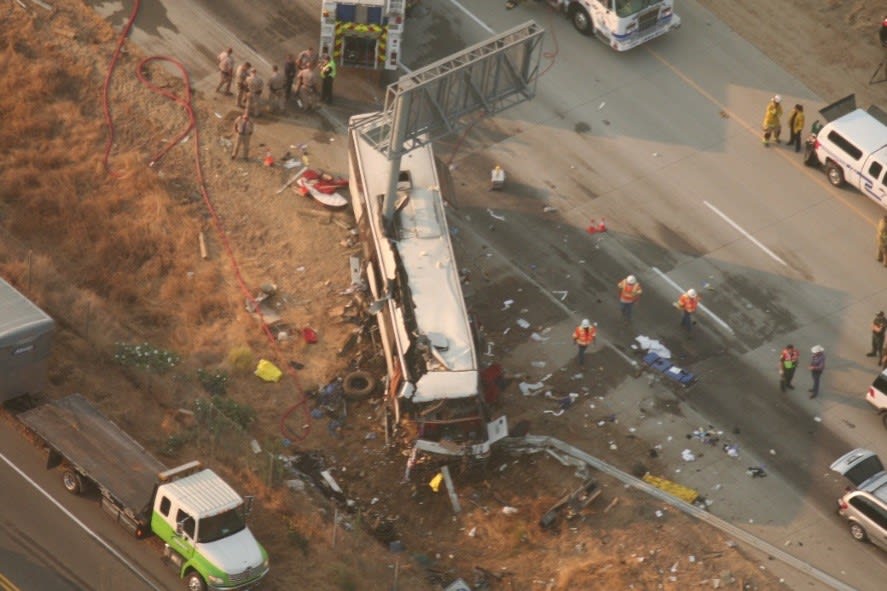
Aerial view shows motorcoach at final rest and impact damage caused by signpost penetrating two-thirds of vehicle. Photo: California Highway Patrol
3 min to read
Aerial view shows motorcoach at final rest and impact damage caused by signpost penetrating two-thirds of vehicle. Photo: California Highway Patrol
In the wake of its investigation of a crash caused by a fatigued motorcoach driver, the National Transportation Safety Board reiterated its call for the Federal Motor Carrier Safety Administration to change its motor carrier safety rating system to ensure carriers with serious safety issues either mitigate those risks or be placed out of service.
While the board’s recommendations primarily apply to passenger-carrying carriers, some of them would likely affect freight carriers as well.
A sleep-deprived driver operating a motorcoach during early morning hours on a California highway caused a crash that killed four of the 24 passengers, NTSB said in a report released Nov. 13.
A motorcoach operated by Fresno-based Autobuses Coordinados USA Inc., traveling from Los Angeles to Modesto on State Route 99, drifted out of its travel lanes, striking a barrier system and a highway signpost shortly after 3 a.m., Aug. 2, 2016, near Livingston, California. The crash forces resulted in the signpost entering the passenger compartment and tearing through almost the entire length of the vehicle. The surviving passengers received serious-to-minor injuries.
Investigators determined the driver, who was seriously injured, had only about five hours of opportunity for sleep in the 40 hours preceding the crash, leaving him in a state of “acute sleep loss” at the time of the crash. There were no tire marks or other indication the driver took any action to avoid the barrier after the motorcoach drifted out of its travel lane.
According to FMCSA records, Autobuses Coordinados vehicles failed eight of 29 federal inspections in just under two years, pushing its out-of-service rate to 38%, almost five times greater than the national average of 8%.
NTSB determined that inadequate safety practices of Autobuses Coordinados and the FMCSA’s lack of oversight contributed to the crash. As a result, the board reiterated two earlier recommendations it has made to the agency:
Change your safety fitness rating methodology so that adverse vehicle or driver performance-based data alone are sufficient to result in an overall unsatisfactory rating for the carrier.
Include safety measurement system rating scores in the methodology used to determine a carrier’s fitness to operate in the safety fitness rating rulemaking for the Compliance, Safety, Accountability initiative.
The FMCSA recently dropped its safety fitness rating rulemaking proposal. The now-withdrawn proposal on methodology would have determined when a motor carrier is not fit to operate trucks based on the carrier's on-road safety data; an investigation; or a combination of on-road safety data and investigation information.
NTSB does not have any regulatory-making authority. It investigates crashes and makes recommendations to various governmental agencies, industry associations and other groups to try to prevent similar crashes in the future.
The NTSB also determined that the guardrail, which did not prevent the motorcoach from colliding with the signpost, and was not designed to do so, contributed to the severity of the crash.
The NTSB also issued two new recommendations aimed at developing risk-based guidelines to determine where high-performance barrier systems should be installed to shield heavy vehicles from roadside obstacles and hazards.
The entire 62-page report, including the two new and five reiterated safety recommendations, is available at https://go.usa.gov/xnDSQ.
More Drivers

Truck Drivers Need More Than Another Alert
Fleets have more visibility into truck health, safety events, and driver activity than ever. The next challenge is turning all that information into useful guidance for the person who has to decide what to do next.
Read More →
FMCSA Removes 110 Truck Driver Training Schools from Certified ELDT List
Federal regulators also are targeting more than 160 additional training providers and launching a nationwide audit of third-party CDL skills testers as part of a broader crackdown on trucking fraud.
Read More →
Hours of Service Pilot Programs: FMCSA Readies for 2027 Rollout
Two pilot programs could eventually reshape hours-of-service rules, giving truck drivers options to pause their 14-hour clock or use longer split sleeper rest periods.
Read More →
Medical Cards, English Proficiency Reshape Roadcheck Violations
Medical-card violations jumped to the top of the driver out-of-service list during CVSA’s 2026 International Roadcheck, while English-language proficiency violations appeared among the leading violations for the first time.
Read More →
Driver Trust Can Make or Break the Success of Fleet Safety Technology
New Teletrac Navman research suggests that onboarding, transparency about driver data, and positive feedback can play a significant role in how commercial drivers respond to safety and coaching technology.
Read More →
EEOC Sues KLLM Over Alleged Sex Discrimination in Driver Training
KLLM is facing a federal sex-discrimination lawsuit over policies the EEOC alleges put female truck driver trainees at a disadvantage.
Read More →
FMCSA Moves to Codify English Language Requirements for Commercial Drivers
By changing regulations on English-language proficiency requirements for commercial drivers, rather than relying on a guidance memo, the FMCSA said future administrations won't be able to walk back the Trump administration's stricter enforcement with just a memo.
Read More →
Drivers Put Western Star Trucks to the Test at Star Nation Experience
Watch to get an inside look at the Western Star trucks, technology, and community behind the Star Nation Experience 2026!
Read More →
Trump Administration Looks to Put More Veterans Behind the Wheel
The Freedom Haulers program pulls together existing and expanded programs at several federal agencies to recruit veterans to drive commercial heavy-duty trucks and cut the red tape for them to get a CDL, training, and employment.
Read More →
Putting Mack’s Command Steer to the Test
A test drive of Mack’s Command Steer active steering system evaluates how it can make truck driving easier and less tiring.
Read More →