




Navistar Executives Look to the Future
After a tough run earlier this decade, Navistar told trucking reporters it is "back in business," touting its new and improved product line, a booming vocational market and a strong economy.
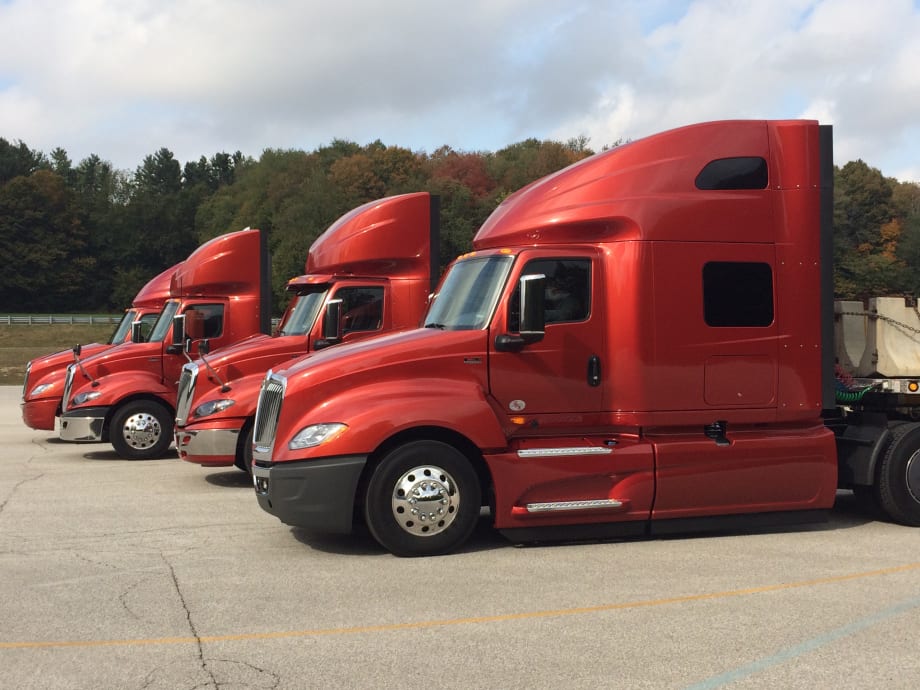
Navistar included all its latest models for test drives at an event at its proving grounds outside of New Carlisle, IN, earlier this week.
Photo: Jack Roberts
Navistar included all its latest models for test drives at an event at its proving grounds outside of New Carlisle, IN, earlier this week.
Photo: Jack Roberts
NEW CARLISLE, IN – Backed by a new family of products and a robust economy, Navistar executives are clearly feeling positive about the future.
“We have [introduced] a lot of new products in the last two years, and we got a lot of new products coming in the next two,” said Denny Mooney, senior vice president – product development, during a briefing to industry media this week.
Those new products include the LT linehaul tractor, its RH regional hauling counterpart introduced at the Expocam trade show in Montreal, the heavy vocational HX tractor launched last year to replace the PayStar, and the new HV that replaces the WorkStar. The HV was unveiled at the recent North American Commercial Vehicle Show in Atlanta, Georgia.
The HX itself represents a market segment that Navistar saw drop in half after it stopped producing 15L engines. “Our [13-liter model], because it was an EGR engine, we couldn’t cool it at some of the power and torque ratings we needed," Mooney said.
A little over five years later, though, Navistar says it’s back in the business. “We’re picking up share,” he said, noting that three HX models were entirely new entries in the marketplace. “In the vocational segment, if you don’t have the features, if you don’t have the power and torque, they’re not buying the truck,” he said.
Heavy vocational trucks represent a relatively small market compared to the sales volumes of linehaul tractors, but the segment is growing on news of booming construction and even improving sales in the oil and gas sector.
“It’s not a share play. It’s more of a profit play. These are high-margin trucks. The volumes are way higher in on-highway, but the margins are much thinner,” he said.
With just three weeks left in the company’s current fiscal year, Navistar is bullish on the economy in general, said Jeff Sass, Navistar’s senior vice president – North American truck sales and marketing. The company’s North American Class 8 market share inched up about 0.5%, with the share of medium-duty trucks up 3% in 2017. “I see the economy being very strong. I see the freight rates going up. I see the number of loads going up,” he said.
Still, there are challenges to come – specifically in the form of the electronic logging device mandate effective in December. Overall productivity is expected to drop 8-12% at first, and then level out at a drop of 3-5% once the rollout is complete, Sass said. “Those are the fleets that were running clean in the first place.”
It could influence the market for used trucks, too. Half of U.S. freight is hauled by a truck operated by its second or third owner, Sass said, predicting further consolidation in the truck market to come. “Most of those second or third owners have not implemented ELDs yet.”
In the battle for market share, Navistar executives say driver-centric features will play a significant role overall.
“We know there’s a driver shortage in the industry, but we have really, really tried to make these products [the type of] products drivers want to drive,” Mooney added. “If the drivers like our trucks, the fleets are going to buy our trucks.”
Driver-centric features include disc brakes that are less “grabby” than drum designs, he said. “We made disc brakes standard on the LT in June of this year, but we also saw the take rates come up.”
Other technologies have been making gains of their own. Take rates for collision mitigation systems are up 50%, while the sales of replacement bumpers and fenders has reportedly dropped.
Predictive cruise controls that adjust speeds and gears based on readings of topography have also seen take rates rise to 15%. The latter system, launched just over a year ago, is delivering “real world” fuel economy gains, Mooney said.
The biggest technological shift, though, has come in the form of automated manual transmissions, which have seen take rates rise above 70% compared to about 40% of trucks sold just two years ago. “It was one of those technologies we knew made it easier for drivers to drive trucks,” Mooney said.
The company’s proving grounds are playing a key role in enabling new technologies, he added, referring to the facilities purchased 2.5 years ago, close to the manufacturer’s Chicago-based engineering teams. Half the trucks that run the three-mile, three-lane oval, are even made by other manufacturers. That is keeping a team of 75 employees running seven days a week, three shifts a day.
This article from Today's Trucking is used with permission via an editorial partnership with the award-winning Canadian magazine.
Related: Volkswagen Lays Out Its Vision For The Future of Trucking
More Drivers

When Language Stops the Truck: The Return of ELP Out-of-Service Orders
English language proficiency rules for commercial drivers aren’t new, but renewed out-of-service enforcement has raised the stakes. Here’s what carriers need to know before a driver reaches a roadside inspection.
Read More →
Samsara Launches Custom AI Agent Builder
Agent Studio lets fleets create AI tools for hours-of-service monitoring, reporting and driver support, including agents that communicate by phone.
Read More →
Trucker Path Expands Reserved Parking Network
Trucker Path has added close to 6,000 more truck parking spaces to its Trucker Path Reserved Parking Network with the addition of Safe Truck Parking.
Read More →
EEOC Sues Texas Trucking Company Over Driver Age Limits
The agency says Trancasa USA rejected applicants over 65 and applied tougher driving-record standards to those over 60.
Read More →
Nussbaum, Roehl Announce Second Driver Pay Increase This Year
This year has seen a swath of major truck driver pay increases as freight capacity has tightened.
Read More →
From One Generation to the Next: How Mentorship Builds Safer Truck Drivers
After three decades in trucking, Harold Perry shares what he's learned about driver safety, mentorship, and helping the next generation build confidence behind the wheel.
Read More →
Truck Drivers Need More Than Another Alert
Fleets have more visibility into truck health, safety events, and driver activity than ever. The next challenge is turning all that information into useful guidance for the person who has to decide what to do next.
Read More →
FMCSA Removes 110 Truck Driver Training Schools from Certified ELDT List
Federal regulators also are targeting more than 160 additional training providers and launching a nationwide audit of third-party CDL skills testers as part of a broader crackdown on trucking fraud.
Read More →
Hours of Service Pilot Programs: FMCSA Readies for 2027 Rollout
Two pilot programs could eventually reshape hours-of-service rules, giving truck drivers options to pause their 14-hour clock or use longer split sleeper rest periods.
Read More →
Medical Cards, English Proficiency Reshape Roadcheck Violations
Medical-card violations jumped to the top of the driver out-of-service list during CVSA’s 2026 International Roadcheck, while English-language proficiency violations appeared among the leading violations for the first time.
Read More →