




3 Ways ELDs Should Help Prevent Driver Coercion
Drivers are at the heart of the electronic logging device mandate that kicks in just over four months from now. According to Pete Allen of MiX Telematics, it was concern about how drivers might be impacted that compelled FMCSA to put “provisions in place to prevent issues of harassment, one of which is driver coercion.”

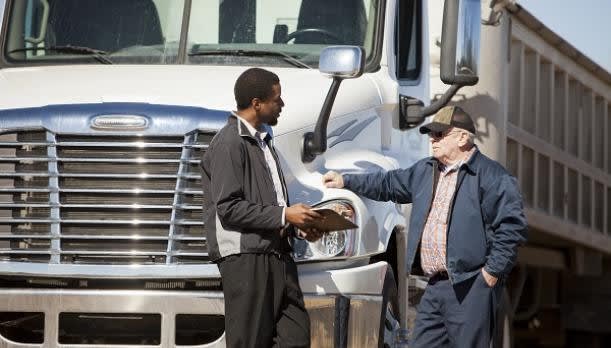
Photo: FMCSA

Photo: FMCSA
Drivers, of course, are at the heart of the electronic logging device mandate that kicks in just over four months from now, on December 18. According to Pete Allen, executive vice president of MiX Telematics, which provides ELD solutions, it was concern about how drivers might be impacted by rule change that compelled the Federal Motor Carrier Safety Administration to put “provisions in place to prevent issues of harassment, one of which is driver coercion.”
Allen told HDT that the rule includes these three technical requirements to help protect drivers from being coerced into violating federal hours-of-service regulations:
1. Unassigned Driving Time: The ELD device must track all miles associated with the vehicle. If any mileage is not assigned to a driver, it is labeled as Unassigned Driving Time.
When drivers log onto an ELD, they must be prompted if the vehicle they are in has any unassigned driving time. If a driver is responsible for any unassigned driving time, he or she must identify it as his or her own, and then the system will automatically update the driver’s Record of Duty Status. Managers should also monitor unassigned driving time from their vendor’s portal or reports. There may be unassigned driving time that is unaccounted for, and managers will need to remind the specific driver who drove the vehicle at that time to accept the unassigned driving time to remain compliant.
2. Edits to RODS/HOS: Under the rule, drivers are responsible for their RODS/HOS.
This requirement means the driver has the final say on any changes made to their RODS/HOS.The technical requirements require ELD devices to allow drivers to edit their own HOS logs, and to view and accept or reject any edits made by a manager. At driver log in, the ELD must prompt the driver if any edits to their RODS/HOS have been made. The driver will then accept or reject these changes.
3. Drivers must be prompted to verify: Prompting must be done to confirm their logs when they log in and out of their ELD, and drivers are responsible for confirming any subsequent changes to their logs within a 24-hour period.
If the driver has any logs that have not been confirmed, the ELD must prompt the driver to verify. The driver will then be responsible for confirming the information.
Not for Drivers Only
The rule ultimately is about driver safety, but “it’s not a driver-only transition,” according to Tom Cuthbertson, vice president of regulatory affairs for Omnitracs. “For example, dispatchers need to understand what ‘personal conveyance’ use and ‘yard time’ means and maintenance personnel have to understand the eight-day requirement.
"The training needed by all will vary based on the size and complexity of the trucking operation," he continued. "And policies will need to be set across the carrier to address such specifics as criteria for editing log entries.”
“Fleet size and device platform will determine how long it takes to get up to speed with the mandate,” David Heller, vice president of government affairs for the Truckload Carriers Association, told HDT. “Large fleets are already done with it; smaller fleets that aren’t are probably looking for user-friendly devices.”
As to enforcement, Heller said he’s experiencing “a little heartburn as the compliance data approaches. We’re a 50-state country and no two states are alike. That means some will be more ready than others for enforcement. But make no mistake — enforcement of the rule will begin on December 18.”
A full update on the ELD mandate will appear in the August edition ofHeavy Duty Trucking.
More Drivers

Truck Drivers Need More Than Another Alert
Fleets have more visibility into truck health, safety events, and driver activity than ever. The next challenge is turning all that information into useful guidance for the person who has to decide what to do next.
Read More →
FMCSA Removes 110 Truck Driver Training Schools from Certified ELDT List
Federal regulators also are targeting more than 160 additional training providers and launching a nationwide audit of third-party CDL skills testers as part of a broader crackdown on trucking fraud.
Read More →
Hours of Service Pilot Programs: FMCSA Readies for 2027 Rollout
Two pilot programs could eventually reshape hours-of-service rules, giving truck drivers options to pause their 14-hour clock or use longer split sleeper rest periods.
Read More →
Medical Cards, English Proficiency Reshape Roadcheck Violations
Medical-card violations jumped to the top of the driver out-of-service list during CVSA’s 2026 International Roadcheck, while English-language proficiency violations appeared among the leading violations for the first time.
Read More →
Driver Trust Can Make or Break the Success of Fleet Safety Technology
New Teletrac Navman research suggests that onboarding, transparency about driver data, and positive feedback can play a significant role in how commercial drivers respond to safety and coaching technology.
Read More →
EEOC Sues KLLM Over Alleged Sex Discrimination in Driver Training
KLLM is facing a federal sex-discrimination lawsuit over policies the EEOC alleges put female truck driver trainees at a disadvantage.
Read More →
FMCSA Moves to Codify English Language Requirements for Commercial Drivers
By changing regulations on English-language proficiency requirements for commercial drivers, rather than relying on a guidance memo, the FMCSA said future administrations won't be able to walk back the Trump administration's stricter enforcement with just a memo.
Read More →
Drivers Put Western Star Trucks to the Test at Star Nation Experience
Watch to get an inside look at the Western Star trucks, technology, and community behind the Star Nation Experience 2026!
Read More →
Trump Administration Looks to Put More Veterans Behind the Wheel
The Freedom Haulers program pulls together existing and expanded programs at several federal agencies to recruit veterans to drive commercial heavy-duty trucks and cut the red tape for them to get a CDL, training, and employment.
Read More →
Putting Mack’s Command Steer to the Test
A test drive of Mack’s Command Steer active steering system evaluates how it can make truck driving easier and less tiring.
Read More →