





Related: Truck-Bus Crash Kills 4, Driver Says He Was Distracted
NTSB: Trucker’s Use of Synthetic Marijuana Caused Fatal Crash
As a result of its investigation of a truck crash that killed four college athletes last year, the National Transportation Safety Board has issued recommendations to address “impairing substances” that are not tested for under federal regulations
November 18, 2015
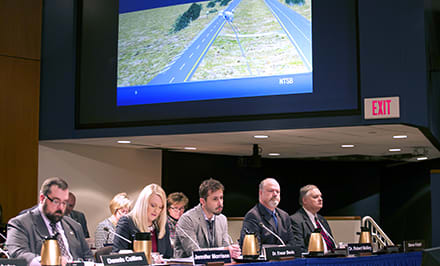
NTSB Investigator-in-Charge Jennifer Morrison shows the Board reenactment animation of collision between tractor-trailer truck and bus in Davis, Okla., on September 26, 2014. Photo: NTSB
4 min to read
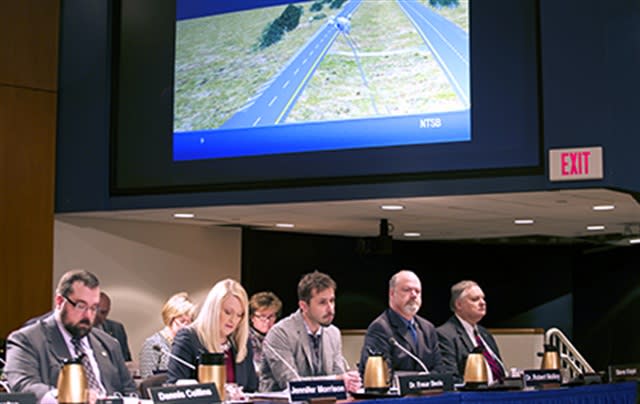
NTSB Investigator-in-Charge Jennifer Morrison shows the Board reenactment animation of collision between tractor-trailer truck and bus in Davis, Okla., on September 26, 2014. Photo: NTSB
As a result of its investigation of a truck crash that killed four college athletes last year, the National Transportation Safety Board issued recommendations on Nov. 17 aimed at helping motor carriers address “impairing substances” that are not tested for under federal regulations.
NTSB said it has determined that the truck driver charged with killing four members of the North Central Texas College softball team by crashing his tractor-trailer into the bus they were riding in caused the accident “due to incapacitation stemming from his likely use of a synthetic cannabinoid," commonly known as synthetic marijuana.
The board also stated that the driver at fault had a documented history of drug use.
According to NTSB, synthetic cannabinoids are chemical compounds “marketed as allegedly legal alternatives to marijuana; however, their effects can be considerably worse and they have been known to cause psychosis, seizures, and nonresponsiveness.”
The crash occurred on Sept. 26, 2014, along Interstate 35 North near Davis, Okla. The team was returning to Gainesville, Texas, from a scrimmage in Bethany, Okla., when the truck, after negotiating a slight rightward curve, departed the left lane, crossed the 100-foot-wide median and traveled more than 1,100 feet before colliding with the team’s medium-size bus in the southbound lane.
Four bus passengers died and five were seriously injured. Six additional bus passengers and both drivers sustained minor injuries.
After a nine-month investigation by the Oklahoma Highway Patrol, reports the Associated Press, Russell Wayne Staley, 53, of Saginaw, Texas, was charged on June 25 with four counts of first-degree manslaughter in the deaths of 19-year-old Meagan Richardson; 18-year-old Katelynn Woodlee; 20-year-old Jaiden Pelton; and 20-year-old Brooke Deckard.
NTSB pointed out that while federal law prohibits CDL drivers from operating a vehicle while impaired, federal regulations require testing for only a few impairing substances.
The board said this crash investigation highlights the challenges that disconnect presents to both employers and law enforcement. “Motor carriers need to know about this emerging class of drugs, and they need better tools to detect driver impairment,” said NTSB Chairman Christopher Hart.
As a result of the investigation, the NTSB issued two new recommendations to the Federal Motor Carrier Safety Administration:
Determine the prevalence of commercial motor vehicle driver use of impairing substances, particularly synthetic cannabinoids, and develop a plan to reduce the use of such substances.
Work with motor carrier industry stakeholders to develop a plan to aid motor carriers in addressing commercial motor vehicle driver use of impairing substances, particularly those not covered under current drug-testing regulations – such as promoting best practices by carriers, expanding impairment detection training and authority, and developing performance-based methods of evaluation.
In addition, NTSB issued this recommendation to the American Trucking Associations, American Bus Association, United Motorcoach Association, Owner-Operator Independent Drivers Association, and Commercial Vehicle Safety Alliance:
Inform your members about the dangers of driver use of synthetic drugs and encourage them to take steps to prevent drivers from using these substances.
NTSB also issued or reiterated recommendations regarding side impact protection standards for medium-size buses, updated criteria for median barrier installation, and on-board recorder system standards for large commercial vehicles.
Regarding on-board recorders, NTSB recommended that the National Highway Traffic Safety Administration:
Develop and implement minimum performance standards for event data recorders for trucks with gross vehicle weight ratings over 10,000 pounds that address, at a minimum, the following elements: data parameters to be recorded; data sampling rates; duration of recorded event; standardized or universal data imaging interface; data storage format; and device and data survivability for crush, impact, fluid exposure and immersion, and thermal exposure. The standards should also require that the event data recorder be capable of capturing and preserving data in the case of a power interruption or loss, and of accommodating future requirements and technological advances, such as flashable and/or reprogrammable operating system software and/or firmware updates.
After establishing performance standards for event data recorders for trucks with gross vehicle weight ratings over 10,000 pounds, require that all such vehicles be equipped with event data recorders meeting the standards.
NTSB also recommended that states require seat belt use for all vehicle seating positions that are equipped with belts.
The board found that none of the bus passenger were buckled in and it said that contributed to the severity of the crash. In addition, the bus driver failed to implement the college’s policy requiring passengers to wear seat belts.
“Had the seat belts been properly worn, they would probably have prevented ejections and reduced overall injuries,” the board stated.
More Drivers

Truck Drivers Need More Than Another Alert
Fleets have more visibility into truck health, safety events, and driver activity than ever. The next challenge is turning all that information into useful guidance for the person who has to decide what to do next.
Read More →
FMCSA Removes 110 Truck Driver Training Schools from Certified ELDT List
Federal regulators also are targeting more than 160 additional training providers and launching a nationwide audit of third-party CDL skills testers as part of a broader crackdown on trucking fraud.
Read More →
Hours of Service Pilot Programs: FMCSA Readies for 2027 Rollout
Two pilot programs could eventually reshape hours-of-service rules, giving truck drivers options to pause their 14-hour clock or use longer split sleeper rest periods.
Read More →
Medical Cards, English Proficiency Reshape Roadcheck Violations
Medical-card violations jumped to the top of the driver out-of-service list during CVSA’s 2026 International Roadcheck, while English-language proficiency violations appeared among the leading violations for the first time.
Read More →
Driver Trust Can Make or Break the Success of Fleet Safety Technology
New Teletrac Navman research suggests that onboarding, transparency about driver data, and positive feedback can play a significant role in how commercial drivers respond to safety and coaching technology.
Read More →
EEOC Sues KLLM Over Alleged Sex Discrimination in Driver Training
KLLM is facing a federal sex-discrimination lawsuit over policies the EEOC alleges put female truck driver trainees at a disadvantage.
Read More →
FMCSA Moves to Codify English Language Requirements for Commercial Drivers
By changing regulations on English-language proficiency requirements for commercial drivers, rather than relying on a guidance memo, the FMCSA said future administrations won't be able to walk back the Trump administration's stricter enforcement with just a memo.
Read More →
Drivers Put Western Star Trucks to the Test at Star Nation Experience
Watch to get an inside look at the Western Star trucks, technology, and community behind the Star Nation Experience 2026!
Read More →
Trump Administration Looks to Put More Veterans Behind the Wheel
The Freedom Haulers program pulls together existing and expanded programs at several federal agencies to recruit veterans to drive commercial heavy-duty trucks and cut the red tape for them to get a CDL, training, and employment.
Read More →
Putting Mack’s Command Steer to the Test
A test drive of Mack’s Command Steer active steering system evaluates how it can make truck driving easier and less tiring.
Read More →