




Brake Safety Week Inspection Results Show Lowest Brake System Out-of-Service Rate Yet
This year, participating agencies inspected 20,067 vehicles throughout Brake Safety Week and placed 2,714 commercial vehicles out-of-service for brake violations. The rate for brake violations ties with May 2013 and September 2010 for the lowest OOS rates recorded since similar events began in 1998.
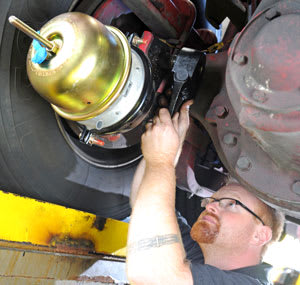
This year, participating agencies inspected 20,067 vehicles throughout Brake Safety Week and placed 2,714 commercial vehicles out-of-service for brake violations. Of the vehicles inspected, the Out-of-Service rate for all brake-related violations conducted in North America was 13.5%, compared with 15.3% for the same week in 2012.
This rate for brake violations ties with May 2013 and September 2010 for the lowest OOS rates recorded since similar events began in 1998. The OOS rate for brake adjustment rose slightly to 9.0%, still near a record low, and the OOS rate for brake components was 7.1%, the lowest it has been since 2000.
The OOS rates for inspections in Canada were lower than in the U.S., which is historically consistent. The OOS rate for brake adjustment was 9.2% in the U.S. and 6.2% in Canada. The OOS rate for brake components was 7.2% in the U.S. and 5.4% in Canada. The OOS rate for brakes was 13.6% in the U.S. and 11.6% in Canada.

Commercial vehicle safety inspectors from across the continent conducted their annual Brake Safety Week outreach and enforcement campaign Sept. 8-14.
Brake Safety Week is part of the Operation Airbrake program sponsored by CVSA in partnership with the U.S. Department of Transportation’s Federal Motor Carrier Safety Administration. During that week, inspectors selected vehicles for inspection and conducted either North American Standard Level I or Level IV inspections just on brake systems to verify regulatory compliance. They also helped to inform operators about the importance of proper maintenance.
The Commercial Vehicle Safety Alliance conducts this weeklong campaign every year with support from federal, state, provincial and local safety inspectors across North America.
Brake Safety Week Results at a Glance:
20,067 vehicles were inspected. In 2012, 21,255 were inspected.
1,811 or 9% of vehicles were placed OOS for brake adjustment (9.4% in 2012, 8.4% in 2011, 8.9% in 2010).
1,434 or 7.1% of vehicles were placed OOS for brake components (7.8% in 2012, 7.9% in 2011, 8% in 2010).
2,714 or 13.5% of vehicles were placed OOS for brakes overall (15.3% in 2012, 14.2% in 2011, 13.5% in 2010).
More than 3.4 million brakes have been inspected since the program’s inception.
More Drivers

FMCSA Removes 110 Truck Driver Training Schools from Certified ELDT List
Federal regulators also are targeting more than 160 additional training providers and launching a nationwide audit of third-party CDL skills testers as part of a broader crackdown on trucking fraud.
Read More →
Hours of Service Pilot Programs: FMCSA Readies for 2027 Rollout
Two pilot programs could eventually reshape hours-of-service rules, giving truck drivers options to pause their 14-hour clock or use longer split sleeper rest periods.
Read More →
Medical Cards, English Proficiency Reshape Roadcheck Violations
Medical-card violations jumped to the top of the driver out-of-service list during CVSA’s 2026 International Roadcheck, while English-language proficiency violations appeared among the leading violations for the first time.
Read More →
Driver Trust Can Make or Break the Success of Fleet Safety Technology
New Teletrac Navman research suggests that onboarding, transparency about driver data, and positive feedback can play a significant role in how commercial drivers respond to safety and coaching technology.
Read More →
EEOC Sues KLLM Over Alleged Sex Discrimination in Driver Training
KLLM is facing a federal sex-discrimination lawsuit over policies the EEOC alleges put female truck driver trainees at a disadvantage.
Read More →
FMCSA Moves to Codify English Language Requirements for Commercial Drivers
By changing regulations on English-language proficiency requirements for commercial drivers, rather than relying on a guidance memo, the FMCSA said future administrations won't be able to walk back the Trump administration's stricter enforcement with just a memo.
Read More →
Drivers Put Western Star Trucks to the Test at Star Nation Experience
Watch to get an inside look at the Western Star trucks, technology, and community behind the Star Nation Experience 2026!
Read More →
Trump Administration Looks to Put More Veterans Behind the Wheel
The Freedom Haulers program pulls together existing and expanded programs at several federal agencies to recruit veterans to drive commercial heavy-duty trucks and cut the red tape for them to get a CDL, training, and employment.
Read More →
Putting Mack’s Command Steer to the Test
A test drive of Mack’s Command Steer active steering system evaluates how it can make truck driving easier and less tiring.
Read More →
Competition Heating Up for Truck Drivers
New report reveals rising driver hiring costs, the return of sign-on bonuses, growing AI advantages, and the operational factors shaping driver retention.
Read More →