




Trucking Company Sues Caterpillar Over ACERT Engine Technology
Caterpillar is again facing legal action as a result of the ACERT engine technology it used to meet EPA's 2007 emissions regulations. A proposed class action suit filed last week in New Jersey federal court alleges Caterpillar sold defective engine systems that constantly failed and did not last as long as Caterpillar said they would.
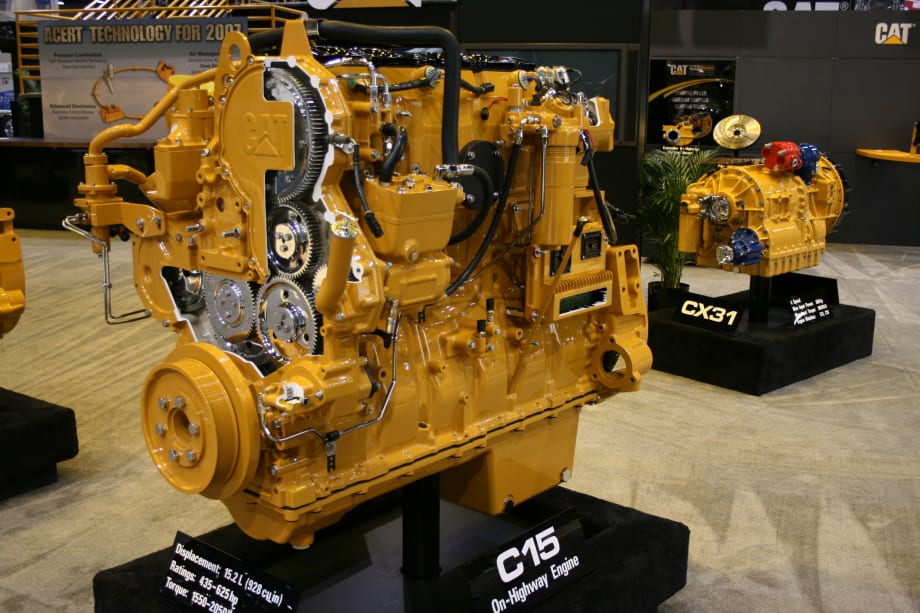
Caterpillar advertised its C15 engine with ACERT technology for 2007 at an industry trade show.
Caterpillar advertised its C15 engine with ACERT technology for 2007 at an industry trade show.
Caterpillar is again facing legal action as a result of the ACERT engine technology it used to meet EPA's 2007 emissions regulations.
According to a website for business lawyers, law360.com, a proposed class action suit filed last week in New Jersey federal court alleges Caterpillar sold defective engine systems that constantly failed and did not last as long as Caterpillar said they would.
BK Trucking Co. alleges that Caterpillar has known for years that its Caterpillar C13 and C15 Advanced Combustion Emission Reduction Technology diesel engines were defective, yet concealed the problems while still touting the engines’ high quality and reliability.
“This action arises from defendant’s failure, despite longstanding knowledge, to disclose to plaintiff and other consumers that the emissions and regeneration systems of the engines are defective and predisposed to constant failure,” the complaint says. “Caterpillar actively concealed the defect and that the existence of the defect would diminish the intrinsic and resale value of the vehicles.”
BK Trucking said it bought 10 new trucks with the C13 or C15 engines between 2007 and 2010 and that they break down every seven or eight weeks. Emissions and regeneration systems were cited as the main culprits. The problems include repeated instances of check-engine lights, engine de-rating, and diesel particulate filters clogging due to faulty regens, with soot buildup that causes requent engine shutdowns, the suit alleges.
The suit alleges Caterpillar provides only temporary repairs or replaces it with another equally defective and failure-prone system.
A spokesman for Caterpillar told Law360.com that the company does not discuss pending litigation.
It's not the first legal challenge Caterpillar has faced over its ACERT technology. In 2010, we reported on a similar lawsuit in Texas, which chronicles problems with Caterpillar C15 Acert engines produced with exhaust emissions equipment designed to meet federal limits imposed in January 2007. That suit involved 90 Cat-powered trucks run by three fleets.
BK Trucking Co. is represented by James C. Shah, Natalie Finkelman Bennett and Scott R. Shepherd of Shepherd Finkelman Miller & Shah LLP and by John W. Trimble of Trimble & Armano. The case is BK Trucking Co. v. Caterpillar Inc., case number 1:13-cv-02076, in the U.S. District Court for New Jersey.
More Drivers

From One Generation to the Next: How Mentorship Builds Safer Truck Drivers
After three decades in trucking, Harold Perry shares what he's learned about driver safety, mentorship, and helping the next generation build confidence behind the wheel.
Read More →
Truck Drivers Need More Than Another Alert
Fleets have more visibility into truck health, safety events, and driver activity than ever. The next challenge is turning all that information into useful guidance for the person who has to decide what to do next.
Read More →
FMCSA Removes 110 Truck Driver Training Schools from Certified ELDT List
Federal regulators also are targeting more than 160 additional training providers and launching a nationwide audit of third-party CDL skills testers as part of a broader crackdown on trucking fraud.
Read More →
Hours of Service Pilot Programs: FMCSA Readies for 2027 Rollout
Two pilot programs could eventually reshape hours-of-service rules, giving truck drivers options to pause their 14-hour clock or use longer split sleeper rest periods.
Read More →
Medical Cards, English Proficiency Reshape Roadcheck Violations
Medical-card violations jumped to the top of the driver out-of-service list during CVSA’s 2026 International Roadcheck, while English-language proficiency violations appeared among the leading violations for the first time.
Read More →
Driver Trust Can Make or Break the Success of Fleet Safety Technology
New Teletrac Navman research suggests that onboarding, transparency about driver data, and positive feedback can play a significant role in how commercial drivers respond to safety and coaching technology.
Read More →
EEOC Sues KLLM Over Alleged Sex Discrimination in Driver Training
KLLM is facing a federal sex-discrimination lawsuit over policies the EEOC alleges put female truck driver trainees at a disadvantage.
Read More →
FMCSA Moves to Codify English Language Requirements for Commercial Drivers
By changing regulations on English-language proficiency requirements for commercial drivers, rather than relying on a guidance memo, the FMCSA said future administrations won't be able to walk back the Trump administration's stricter enforcement with just a memo.
Read More →
Drivers Put Western Star Trucks to the Test at Star Nation Experience
Watch to get an inside look at the Western Star trucks, technology, and community behind the Star Nation Experience 2026!
Read More →
Trump Administration Looks to Put More Veterans Behind the Wheel
The Freedom Haulers program pulls together existing and expanded programs at several federal agencies to recruit veterans to drive commercial heavy-duty trucks and cut the red tape for them to get a CDL, training, and employment.
Read More →