




5 Things You Need to Know About ELDs
Electronic logging devices to track driver hours of service become mandatory in December 2017. Everything you need to know about compliance is spelled out in the final rule, but here's a quick look at some of the more common sources of confusion – and a few things you'll need to consider that are not spelled out in the text of the rule.

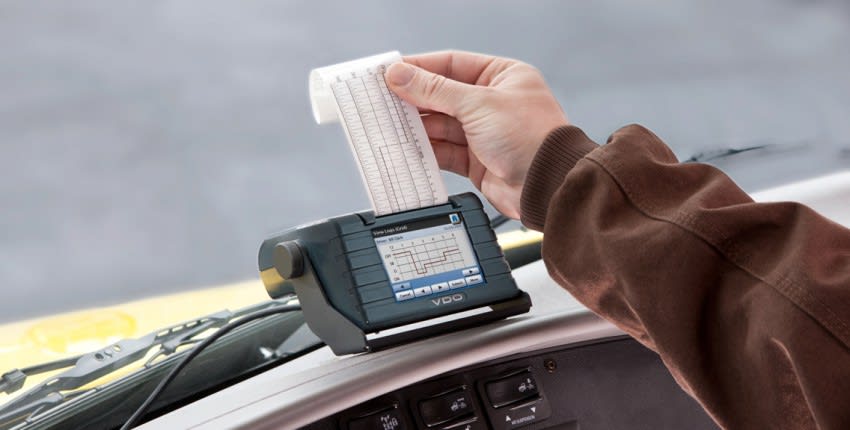
Printing is one of several ways e-logs can be presented to enforcement officials at roadside. (Photo courtesy Continental VDO.)
Printing is one of several ways e-logs can be presented to enforcement officials at roadside. (Photo courtesy Continental VDO.)
Electronic logging devices to track driver hours of service become mandatory in December 2017. Everything you need to know about compliance is spelled out in the final rule, but here's a quick look at some of the more common sources of confusion – and a few things you'll need to consider that are not spelled out in the text of the rule. A couple of these points will be of particular interest to really small carriers and independents.
1. Self-certified doesn't mean compliant.
FMCSA has left it up to suppliers to certify that devices they offer meet all the requirements of the rule. The agency offers a rather lengthy checklist to help suppliers but does no verification of its own. The onus is on the vendor to self-certify their product, says Joel Beal of JBA Telematics. “It's the honor system,” Beal explained in a recent webinar, “because FMCSA says they don't have the budget to check all of the product that's coming to market.”
It's still early days, but Beal says there are already what appear to be some non-compliant devices on FMCSA's list of self-verified devices. He recommends asking the vendor to supply all the documentation they used in the self-certification process as well as all the driver documentation.
“For example, if you operate under the California agricultural exemption or the oil field exemption or into Canada [a Canadian ELD rule is forthcoming], make sure the device you choose fits with and can comply with the rules you operate under,” Beal advises.
2. The required supporting documents.
This requirement could prove to be a burden to some carriers because it takes us back to the retention of paper, or it will require the manual conversion of a paper receipt to some form of digital image. Drivers are required to retain all related documentation for a period of eight days, but receipts must be submitted to the carrier no later than 13 days after the document comes into the driver's possession. The final rule states this requirement is to verify on-duty not driving time.
The rule says carriers must retain each supporting document generated or received in the normal course of business, and goes on to say that carriers need not retain more than eight supporting documents. Among them must be the earliest and the latest time indications of all the documentation.
Supporting documentation can include dispatch records, trip records, expense receipts related to on-duty not driving time, payroll records, settlement sheets, etc. They must include appropriate data to link the record to a driver and a date and trip as well as the time, location, etc. Such documents must be retained for six months.
3. There are (a few) exemptions.
The list of operations exempt from using electronic logs under the new federal mandate is short – three to be precise.
Drivers who are on time cards, typically those that operate within a 100-air-mile radius of the terminal. Some casual drivers are exempt as well, provided they work no more than eight days out of 30.
Drive-away and tow-away operations, typically those that deliver or ferry new or used trucks from factories to dealers or customers.
Trucks manufactured for model-year 1999 or earlier, which may not have the electronic infrastructure to support ELDs.
4. What happens during Inspections.
At roadside, inspectors will be looking for a certification sticker supplied by the manufacturer and the handbook explaining how the ELD is used. When asked to produce the log, the driver may electronically transfer the information to the officer via email using an identifier unique to that inspection request, or via bluetooth or USB file transfer. The driver may also hand the officer printed copies of the logs if a printer is available. A fourth option is handing the device to the inspector if it is not tethered to the vehicle or if the cable is long enough to reach outside the truck.
In a facility audit, inspectors can demand six months of logs, in which case the carrier can display the logs on screen or in printed form. Inspectors can also ask to see any edits performed on the logs, meaning they will need the originals of all electronic records of duty status. They will also ask to see supporting documents (see number 2).
5. Interoperability of different devices.
Managing owner-operators’ use of ELDs could be among the biggest challenges here, but it's certainly not the only one. Allowing each owner-operator to use the ELD of his or her choice could require a lot of back-end infrastructure on the carrier’s part. On the other hand, requiring owner-operators to acquire and use your choice of ELD could pose some hiring and retention strife. Depending on how you manage it, management's decision could impose significant cost on one party or the other.
Your approach also runs the risk of compromising the arm's-length carrier/owner-operator relationship. In the replies to various comments contained in the full document, FMCSA says, “the independent contractor relationship is outside the scope of this rulemaking,” so you're on your own on this front.
In a broader context, there may be reasons one brand or type of ELD might suit one division of the company better than another, or in the event of a merger or acquisition, there could be significant cost associated with “retooling.”
Learn more about living with ELDs in the April issue of Heavy Duty Trucking.
More Drivers

Truck Drivers Need More Than Another Alert
Fleets have more visibility into truck health, safety events, and driver activity than ever. The next challenge is turning all that information into useful guidance for the person who has to decide what to do next.
Read More →
FMCSA Removes 110 Truck Driver Training Schools from Certified ELDT List
Federal regulators also are targeting more than 160 additional training providers and launching a nationwide audit of third-party CDL skills testers as part of a broader crackdown on trucking fraud.
Read More →
Hours of Service Pilot Programs: FMCSA Readies for 2027 Rollout
Two pilot programs could eventually reshape hours-of-service rules, giving truck drivers options to pause their 14-hour clock or use longer split sleeper rest periods.
Read More →
Medical Cards, English Proficiency Reshape Roadcheck Violations
Medical-card violations jumped to the top of the driver out-of-service list during CVSA’s 2026 International Roadcheck, while English-language proficiency violations appeared among the leading violations for the first time.
Read More →
Driver Trust Can Make or Break the Success of Fleet Safety Technology
New Teletrac Navman research suggests that onboarding, transparency about driver data, and positive feedback can play a significant role in how commercial drivers respond to safety and coaching technology.
Read More →
EEOC Sues KLLM Over Alleged Sex Discrimination in Driver Training
KLLM is facing a federal sex-discrimination lawsuit over policies the EEOC alleges put female truck driver trainees at a disadvantage.
Read More →
FMCSA Moves to Codify English Language Requirements for Commercial Drivers
By changing regulations on English-language proficiency requirements for commercial drivers, rather than relying on a guidance memo, the FMCSA said future administrations won't be able to walk back the Trump administration's stricter enforcement with just a memo.
Read More →
Drivers Put Western Star Trucks to the Test at Star Nation Experience
Watch to get an inside look at the Western Star trucks, technology, and community behind the Star Nation Experience 2026!
Read More →
Trump Administration Looks to Put More Veterans Behind the Wheel
The Freedom Haulers program pulls together existing and expanded programs at several federal agencies to recruit veterans to drive commercial heavy-duty trucks and cut the red tape for them to get a CDL, training, and employment.
Read More →
Putting Mack’s Command Steer to the Test
A test drive of Mack’s Command Steer active steering system evaluates how it can make truck driving easier and less tiring.
Read More →