




Legal Pot in Colorado: How it's Affected Trucking
It’s been almost two years since Colorado officially legalized marijuana. With other states considering similar measures, Colorado Motor Carrier Association President Greg Fulton reflects on the law and its impact on the trucking industry.
by Greg Fulton, CMCA
November 17, 2015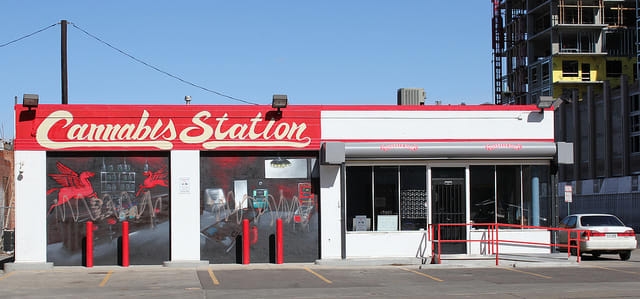
Cannabis station, a medical marijuana dispensary, is located at the site of a former gas station in Denver. Photo by Jeffrey Beall via Flickr through Creative Commons license.
4 min to read
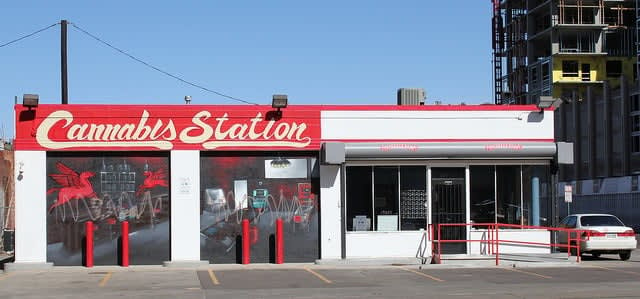
Cannabis station, a medical marijuana dispensary, is located at the site of a former gas station in Denver.Photo by Jeffrey Beall via Flickr through Creative Commons license.
It’s been almost two years since Colorado officially legalized marijuana. With other states considering similar measures, it's a good time to reflect on the Colorado experience and the impact of the law on the trucking industry.
Colorado voters passed a voter referendum in 2012 that authorized the legal sale of marijuana for recreational use, treating it in a manner similar to alcohol. The law took effect on January 1, 2014. Many proponents of the measure viewed enforcement of marijuana laws as a poor use of law enforcement and court resources. They also felt that passage would also eliminate the black market in this drug. Further, many saw that the taxation of this product could significantly increase the state's revenue, which could be used for primary education as well as drug prevention and rehabilitation programs.
Colorado’s experience has been a mixed one of both anticipated and unforeseen developments.
First, the legalization has been a boon for the state’s tax revenues, generating over $70 million in additional revenue annually. While much needed by the state and local governments, this amount falls short of original expectations. This may be somewhat explained by the fact that it is a cash-based industry because of legal limitations associated with the use of credit or debit cards. A pure cash business does not lend itself well to tracking or an audit trail, and some estimate that revenues for this industry may be significantly underreported.
Second, a key area of concern was the impact of legalization on crime and highway safety. Opponents of the measure had predicted that crime would increase based on the financial needs of users. Proponents felt that crime would drop, as the decriminalization would reduce drug trafficking and the crimes associated with it. The facts fail to support either premise. Crime levels are similar to what they were prior to the passage, without a significant increase or decrease in key categories.
In regard to traffic safety and accidents, the impact has been difficult to determine because of the lack of a good, quick, roadside test for marijuana as there is for alcohol. Recent reports do indicate that traffic fatalities involving a party who has marijuana in their system have risen, but overall Colorado’s accidents and fatalities are not significantly greater than prior to legalization.
Third, usage levels for marijuana appeared to increase across all age groups since the legalization. This has created a particular problem for the trucking industry and other employers in Colorado that either by law or choice require a drug-free workplace.
Legalization has made an already critical shortage of drivers worse. While motor carriers continue to tell their truck drivers that they are in violation of the law if there is even a trace of marijuana in their system, our companies continue to see high failure rates on drug tests.
In addition, other positions or jobs in the trucking industry where employees are tested have also seen a spike in failed tests. As an example, one company hiring dock workers specifically told all applicants before they applied that they would be drug tested prior to consideration. Even with this prior warning, 70% of the applicants still tested positive.
Unexpected consequences
While our industry anticipated the challenge associated with a higher failure rate for drug tests, we did not foresee some of the other challenges associated with legalization.
One major surprise was the space/storage requirements for the marijuana industry. The marijuana industry is much more than the local shop that sells the product. It requires an infrastructure of "grow houses" and warehouses to support the business. The magnitude of this demand and its impact on industries like trucking was clearly underestimated. The price of warehouse space as well as terminals (that have been converted) has risen dramatically, and there is now a shortage of space.
A recent article noted that between 2009 (the year when medical marijuana was approved) and 2014, marijuana businesses accounted for more than a third of all industrial space leased in the Denver metro area. As a result, prices have soared and industrial space is at a premium. This led to several trucking companies being forced out of properties that they had leased for many years due to higher rents or the repurposing of these sites by the marijuana industry.
The most recent example of “collateral damage” from the shortage of space due to legalization was the Marine Corps Toys for Tots program. That group lost their previous space and was desperately looking to find warehouse space for storage and distribution for this Christmas season. In the past, companies donated space for this worthy cause, but the shortage of space brought on by legalization of marijuana changed things. Toys for Tots found itself for the first time ever making a plea to the public for space. Fortunately, a trucking executive member of CMCA helped to arrange for space after a significant search on our part.

Greg Fulton
We anticipate that the shortage of terminal/warehouse space may be alleviated as new industrial sites are built, as well as the possibility that legalization of marijuana in other states may reduce sales within Colorado.
We do not see an end in sight, however, on the greater challenge that legalization has created in finding drivers, technicians, and others for our industry who must be drug free to work in it.
Subscribe to Our Newsletter
More Drivers
Trucker Path Expands Reserved Parking Network
Trucker Path has added close to 6,000 more truck parking spaces to its Trucker Path Reserved Parking Network with the addition of Safe Truck Parking.
Read More →
EEOC Sues Texas Trucking Company Over Driver Age Limits
The agency says Trancasa USA rejected applicants over 65 and applied tougher driving-record standards to those over 60.
Read More →
Nussbaum, Roehl Announce Second Driver Pay Increase This Year
This year has seen a swath of major truck driver pay increases as freight capacity has tightened.
Read More →
From One Generation to the Next: How Mentorship Builds Safer Truck Drivers
After three decades in trucking, Harold Perry shares what he's learned about driver safety, mentorship, and helping the next generation build confidence behind the wheel.
Read More →
Truck Drivers Need More Than Another Alert
Fleets have more visibility into truck health, safety events, and driver activity than ever. The next challenge is turning all that information into useful guidance for the person who has to decide what to do next.
Read More →
FMCSA Removes 110 Truck Driver Training Schools from Certified ELDT List
Federal regulators also are targeting more than 160 additional training providers and launching a nationwide audit of third-party CDL skills testers as part of a broader crackdown on trucking fraud.
Read More →
Hours of Service Pilot Programs: FMCSA Readies for 2027 Rollout
Two pilot programs could eventually reshape hours-of-service rules, giving truck drivers options to pause their 14-hour clock or use longer split sleeper rest periods.
Read More →
Medical Cards, English Proficiency Reshape Roadcheck Violations
Medical-card violations jumped to the top of the driver out-of-service list during CVSA’s 2026 International Roadcheck, while English-language proficiency violations appeared among the leading violations for the first time.
Read More →
Driver Trust Can Make or Break the Success of Fleet Safety Technology
New Teletrac Navman research suggests that onboarding, transparency about driver data, and positive feedback can play a significant role in how commercial drivers respond to safety and coaching technology.
Read More →
EEOC Sues KLLM Over Alleged Sex Discrimination in Driver Training
KLLM is facing a federal sex-discrimination lawsuit over policies the EEOC alleges put female truck driver trainees at a disadvantage.
Read More →