




4 Ways Technology Can Improve Fleet Operations
Information technology permeates all parts of a successful trucking fleet's operations today, and sessions at ALK's Transportation Technology Summit last week showcased technology used in trailer detention management, in-cab navigation, in-cab video and driver hiring.


Henry Popplewell of SkyBitz and Chris Smallwood of U.S. Xpress shared details on the fleet's experience since implementing SkyBitz’s trailer tracking system. Photo: Jim Beach
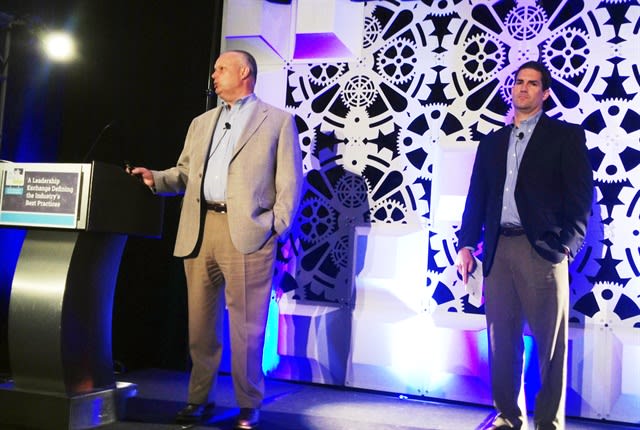
Henry Popplewell of SkyBitz and Chris Smallwood of U.S. Xpress shared details on the fleet's experience since implementing SkyBitz’s trailer tracking system.Photo: Jim Beach
Information technology permeates all parts of a successful trucking fleet's operations today, and sessions at ALK's Transportation Technology Summit last week showcased technology used in trailer detention management, in-cab navigation, in-cab video and driver hiring.
The event in Princeton, N.J., April 4-7, brought together representatives of trucking fleets and technology providers to share their thoughts on the future of the industry and how technologies can improve carrier operations.
The summit featured a number of sessions on the economy, technology and case studies on how specific fleets have implemented various technologies to improve various parts of their operations.
Trailer Tracking and Detention
In a session on how carriers can use trailer tracking to improve trailer detention management, Henry Popplewell, senior vice president and general manager of SkyBitz, and Chris Smallwood, director of finance, U.S. Xpress, shared details on U.S. Xpress’s experience since implementing SkyBitz’s trailer tracking system.
Smallwood said the Chattanooga, Tenn.-based carrier uses technology to “innovate and drive efficiency” and noted the company uses tools it developed in-house to integrate data the collect from various systems. Getting more accurate data in terms of their trailer locations delivered a “big ROI payback,” he said. Plus, improved detention management allowed the company to drive trailer retention down.
According to Popplewell, the goal was not to have the information needed to charge detention fees, but to get equipment back on the road as quickly as possible.
Integrating the SkyBitz system allowed U.S. Xpress to eliminate some of the manual work they had to do to validate their data – they get better data now in a way they can make use of it, Smallwood said.
The next step is to “leverage the investment,” Smallwood added – “how can we do things better now that we have this data and get all of the ROI out of it?” They are looking at using the system to integrate tire pressure monitoring on their trailers and to get better utilization out of their equipment.
“When you can send a driver and he knows the trailer is going to be where you tell him it’s going to be and it is going to be empty,” that in itself increased efficiencies, he said. And since they are getting better utilization out of their trailer fleet, the company is not anticipating adding trailers.
Also, on the maintenance side, the data the system provides has allowed them to look into checking their trailer tires based on miles instead of on a time schedule.
In-Cab Navigation
Jeff Champa, senior director of product management, Omnitracs, addressed the importance of navigation technologies to fleets. “The platform in the vehicle is not complete until we can add a navigation product,” he said. That is why the company partners with ALK to integrate their products into their telematics products.
He noted that case studies on in-cab navigation show that fleets have increased on-time delivery by 15%, reduced out-of-route miles by 6% (within the first 90 days) and reduced truck route violations by 7% to less than 1% of total miles.
Adding navigation gives the driver “a lot of capability in the cab of the truck," he said.
The next step, he said, is for Omnitracs to integrate with back office systems, which will give the driver “one-button” access to navigation, eliminating the need for the driver to key in addresses, since that information would be included in the driver’s dispatch instructions the TMS has provided.
Navigation, he concluded, is to the 21st Century what messaging was to the 20th.
In-Cab Video
Adam Kahn, senior director, marketing of SmartDrive and John Billingsley, director of safety and training with G&P Trucking, presented a case study of G&P’s experience with using SmartDrive’s video system as a coaching and training tool.
Since 2011 G&P has deployed collision avoidance systems in all its new vehicles and has added lane assist systems and adaptive cruise control. Any of these systems can trigger the in-cab video system, which provides video evidence of what was happening in front of the truck and in the cab when these systems were triggered.
Billingsley said G&& “take pains to make sure drivers are appropriately prepared." The SmartDrive system helps them show drivers in one-on-one sessions when they are successful. He noted that driver acceptance has been very high.
Since adopting the video system, he said the company’s overall risk score (an in-house measure) had dropped more than 42%. Speeding is down 56%, driver distractions down 23%, short following distance down 21% and not wearing a seatbelt is down by 10%.
One driver reduced his risk score from 900 to the mid-140s after coaching using the videos.
Billingsley's recommendations for fleets: Find the right coach, implement good policies and procedures for reviewing video, have constant interaction with drivers and give recognition when it’s warranted.
Improving Driver Hiring

Curt Valkovic, director of driver training, Maverick Transportation, discusses his company's experience with using driver training technology from EBE Technologies.(Photo courtesy of Able Communications)
Cindy Nelson, vice president, marketing and business development, EBE Technologies, and Curt Valkovic, director of driver training, Maverick Transportation, presented a case study on the Arkansas-based fleet’s use of EBE’s hiring/retention technologies.
Nelson noted that technology can reduce a number of barriers to getting driver applicant information back to HR departments. And the analytic capabilities of hiring/retention technologies can also help identify those applicants who won’t stick around.
Valkovic said at his company, the keys to driver retention are training, company culture, driver recognition and pay.
The company uses EBE’s computerized driver training application, LMS 2.0 and that it “has transformed the entire organization.”
“You have to have the technology, you have to manage the data,” and that prompted a change in management behavior.
The training platform is a self-paced, web-based system in which they use their own training videos. Noting the change in driver demographics, he said that “you have a demographic now that is used to being told what to,” unlike 10 or 15 years ago. “We found out we needed to put together an agenda for their training program because they want to know what happens next.”
Some keys to getting and retaining the right drivers include real-time needs assessment – where the is individual lacking. If they find a driver who is struggling, Maverick puts together an action plan to help that driver be successful. He noted that since 2014 when they implemented the system, they’ve had 100 driver action plans. Before, that would have been 100 people the company didn’t hire. “Drilling down to the individual has really helped us.”
Their training program is the same for all applicants regardless of experience, he said. “Whether you have 30 years of experience or three days, you go through the same process.” The experienced applicants may not take as long to complete the training, since it is self-paced.
Another key is that the content of the training program should be flexible to fit each specific company.
The software has saved them enough time that they have been able to reallocate on of their instructors to tutoring. An automated system also helps mitigate risk by ensuring DOT and company compliance, with all training activities recorded for auditing purposes.
But the bottom line is that the software has helped improve graduation rates and it has helped attract drivers who have heard about the program. The company’s current turnover is 61.7%, down from the mid-70s range.
More Drivers

Why Hiring Truck Drivers Is Getting Harder
Higher recruiting costs, a shrinking driver pool, and renewed pay competition are raising the stakes for fleets heading into 2027.
Read More →
Roehl Offers Truck Drivers $10,000 Retention Incentive
Payments begin after the first load and continue in mileage-based installments for eligible experienced drivers joining the fleet.
Read More →
Platform Science Adds Dispatch and Safety Tools
Four additions to PS Fleet help fleets monitor loads, manage driver coaching, share truck locations and adjust video system settings.
Read More →
When Language Stops the Truck: The Return of ELP Out-of-Service Orders
English language proficiency rules for commercial drivers aren’t new, but renewed out-of-service enforcement has raised the stakes. Here’s what carriers need to know before a driver reaches a roadside inspection.
Read More →
Samsara Launches Custom AI Agent Builder
Agent Studio lets fleets create AI tools for hours-of-service monitoring, reporting and driver support, including agents that communicate by phone.
Read More →
Trucker Path Expands Reserved Parking Network
Trucker Path has added close to 6,000 more truck parking spaces to its Trucker Path Reserved Parking Network with the addition of Safe Truck Parking.
Read More →
EEOC Sues Texas Trucking Company Over Driver Age Limits
The agency says Trancasa USA rejected applicants over 65 and applied tougher driving-record standards to those over 60.
Read More →
Nussbaum, Roehl Announce Second Driver Pay Increase This Year
This year has seen a swath of major truck driver pay increases as freight capacity has tightened.
Read More →
From One Generation to the Next: How Mentorship Builds Safer Truck Drivers
After three decades in trucking, Harold Perry shares what he's learned about driver safety, mentorship, and helping the next generation build confidence behind the wheel.
Read More →
Truck Drivers Need More Than Another Alert
Fleets have more visibility into truck health, safety events, and driver activity than ever. The next challenge is turning all that information into useful guidance for the person who has to decide what to do next.
Read More →