




Five Ways Private Fleets Keep Drivers Longer
In 2012, driver turnover at large truckload carriers averaged 98%, according to figures from the American Trucking Associations. At smaller truckload fleets turnover averaged 82%.
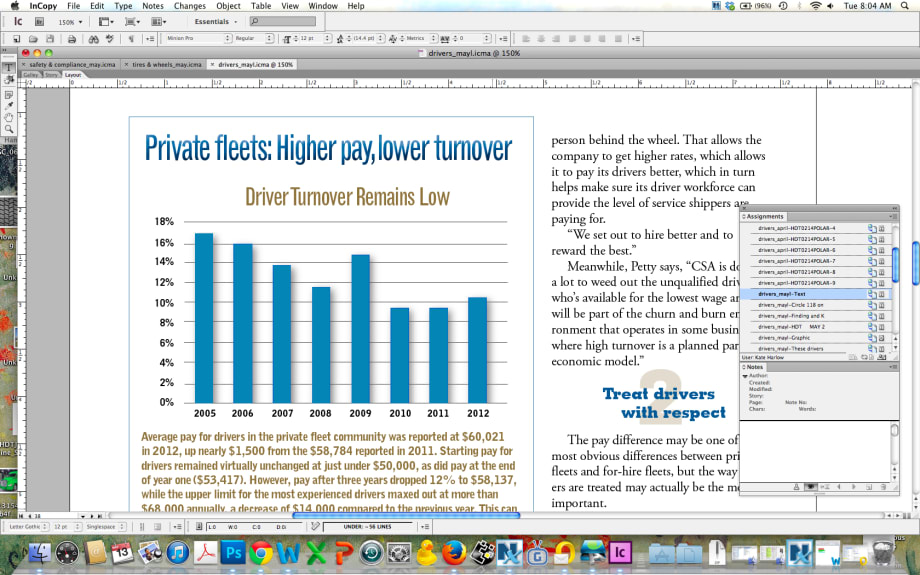
Average pay for drivers in the private fleet community was reported at $60,021 in 2012, up nearly $1,500 from the $58,784 reported in 2011. Starting pay for drivers remained virtually unchanged at just under $50,000, as did pay at the end of year one ($53,417). However, pay after three years dropped 12% to $58,137, while the upper limit for the most experienced drivers maxed out at more than $68,000 annually, a decrease of $14,000 compared to the previous year.
In 2012, driver turnover at large truckload carriers averaged 98%, according to figures from the American Trucking Associations. At smaller truckload fleets turnover averaged 82%.
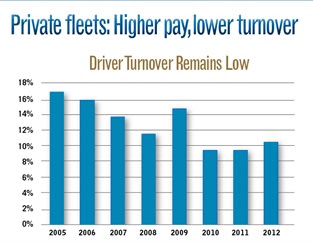
At private fleets, according to the National Private Truck Council, the average turnover rate in 2012 was 11%.
“They really are in two different worlds,” explains Gary Petty, NPTC president and CEO. Not only are private fleet drivers typically paid more, with better benefits and more home time, but also, the very nature of the work is different.
“The average private fleet driver spends about a third of his or her time not driving – in the store or [distribution center] interacting with the customer. So being able to keep customers happy, being the front line and face of the customer service dimension of the corporation, makes it really a very different job.”
However, there are some things private fleets do that for-hire fleets may be able to emulate and adapt.
1. Set a higher standard – and pay for it
The driver standards for private fleets are higher, Petty explains. Many require two to three years of full-time experience as drivers, and the average hiring age is close to 40. These more mature drivers, he says, are less likely to give up on a job quickly.
Most private fleets have strict safety and customers service standards, and drivers who don’t measure up will not be tolerated.
Michael Gower, who drives for TDI Golf in Ontario, in a LinkedIn discussion said he knows from experience that “private fleets do look after drivers better.” But they also expect more.
“We represent the company 24/7. We never know when we may interact with a customer or potential customer,” Gower says. “It’s all about image, and we all know that there are no retakes on the first image you make. It is imperative that that first impression be positive. For-hire fleets don’t care/seem to worry about that. It’s all about the next load and little more.”
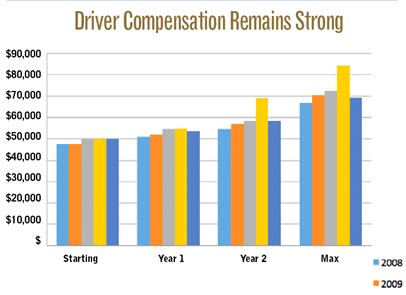
Average pay for drivers in the private fleet community was reported at $60,021 in 2012, up nearly $1,500 from the $58,784 reported in 2011. Starting pay for drivers remained virtually unchanged at just under $50,000, as did pay at the end of year one ($53,417). However, pay after three years dropped 12% to $58,137, while the upper limit for the most experienced drivers maxed out at more than $68,000 annually, a decrease of $14,000 compared to the previous year.
Those higher standards are rewarded monetarily. Average pay (as reflected by the annual W-2 earnings statement) for drivers in the private fleet community was reported at $60,021 for 2012, according the NPTC. In comparison, the National Survey of Driver Wages reported that in 2013, the median driver pay for dry van drivers was $47,544.
How do you adapt this strategy in a for-hire fleet? Jim Mickey, a 2010 HDT Truck Fleet Innovator and president/co-owner of Canada’s Coastal Pacific Xpress, says his company actively goes after freight that requires a better person behind the wheel. That allows the company to get higher rates, which allows it to pay its drivers better, which in turn helps make sure its driver workforce can provide the level of service shippers are paying for.
“We set out to hire better and to reward the best.”
Meanwhile, Petty says, “CSA is doing a lot to weed out the unqualified driver who’s available for the lowest wage and will be part of the churn and burn environment that operates in some businesses where high turnover is a planned part of economic model.”
2. Treat drivers with respect
The pay difference may be one of the most obvious differences between private fleets and for-hire fleets, but the way drivers are treated may actually be the most important.
“Pay is never one of the top things that keep employees,” says Jane Clark, who works with many private fleets as vice president of member services for NationaLease. “It might be in the top 10. Feeling like they make a difference, like they are part of a team, is always in the top reasons why people stay with a company.”
It’s not just your company that needs to treat drivers with respect – it’s also how they are treated by the customer.
“One area that for-hire fleets have to deal with that private fleets don’t is the way our employees are treated when delivering or picking up freight for our customers,” says Ken Johnson, CEO at Leonard’s Express in Farmington, N.Y. “Some shippers and receivers are very good to our drivers, but some are just terrible.”
These drivers work an average of 58 hours per week, which is down from 2011 by 3.5 hours but in line with the 55.3 hours reported in 2010. Of these work hours, 37.5 are spent behind the wheel each week, while the remainder is spent performing other non-driving tasks such as loading (7.9 hours a week) and unloading (13 hours a week).
Driver turnover at these private fleets was 11% in 2012, up slightly from 2010’s 10%, but lower than 2009’s 15%. Source:
You can’t control how shippers and receivers treat drivers on the spot. However, you can be like Jim Mickey and stand up for your drivers when you hear repeated complaints about mistreatment at certain customers.
“We help duke it out on behalf of our drivers,” Mickey says, when it comes to things like excessive detention times and making sure drivers are treated with respect.
Even if you don’t succeed in every case, drivers will likely give you points for trying.
3. Change the operations
Many fleets have been moving to more regional operations and dedicated runs that get drivers home more often. This is partly emulating private fleets.
Not only do such operations get drivers home more often, but when a driver has interactions with the same customers over time, Petty explains, “there is this culture of goodwill and trust and confidence that develops over time between the driver and the customer. That tends to attract a different type of person, not just a ‘truck driver’ with the usual skills and good safety record. These types of drivers tend to stay a long time.”
It also builds a relationship with the customer that results in the driver being treated better by the customers.
“These are different jobs operating in different worlds under different business models,” Petty says. “But this is probably going to change over the next 25 years. We all know that overall trucking routes are getting shorter, not longer.”
4. Be up front with recruits about the job
Private fleets, Petty says, do a good job of putting out a lot of advance information to candidates about what the job really entails, so there are no unpleasant surprises for a recruit in those crucial first few weeks and months on the job.
“A number of companies actually put out videos that show the first hour of the day for a typical shift, for instance. The candidate can look at it and ask, ‘Can I see myself in that role?’ If they don’t, they’re not going to waste anyone’s time applying.”
Clark agrees. “Companies need to be committed to complete honesty and openness when recruiting drivers. You don’t want a new recruit to leave because the job wasn’t what you had implied. Not only are you going to lose that driver, it is going to give you a bad reputation and will discourage future drivers from joining your company.”
5. Be committed to safety
Private fleets are generally very serious about safety. Ryder Dedicated, which hires its own drivers that are then leased to many private fleets, has only a 15% voluntary turnover ratio, according to Jorge Salas, VP of operations for Ryder Dedicated.
“I hear a lot from our drivers about our commitment to safety,” he says. For instance, with Ryder’s Captain of the Ship policy, employees are empowered to take responsibility for their own safety. For example, if drivers believe road conditions are too dangerous to complete runs, they can say so without penalty.
“When they see that our drivers can actually have the freedom to say they can’t or shouldn’t drive anymore and receive our support behind their decision,” it means a lot, Salas says.
Ryder also invests in safety technologies such as lane departure warning and back-up collision alerts. And most private fleets adopted electronic logs years ahead of them gaining traction in the for-hire world.
“What you have with private fleets is a culture of long-term investment inequality transportation department for the long haul,” Petty says. “It begins with top equipment, putting into place the best technology, spec’ing the trucks with the latest and most sophisticated safety tech, finding the best possible people, paying them the best, having the best benefits.
“We know that translates into better service, much higher safety performance, and …. It’s naturally going to translate into a safer, more conscious, happy and productive driver.”
The changing world of transportation could force more of the for-hire industry to follow that model.
“I think overall everybody knows that the availability of qualified and successful drivers continues to shrink,” Petty says. “The market is going to force the pay and benefits up to compete with alternative types of careers these people have available to them. It stands to reason that the cost of transportation is going to continue to rise, and the old model of extremely high turnover of 100% a year is probably not sustainable in the future.”
More Drivers
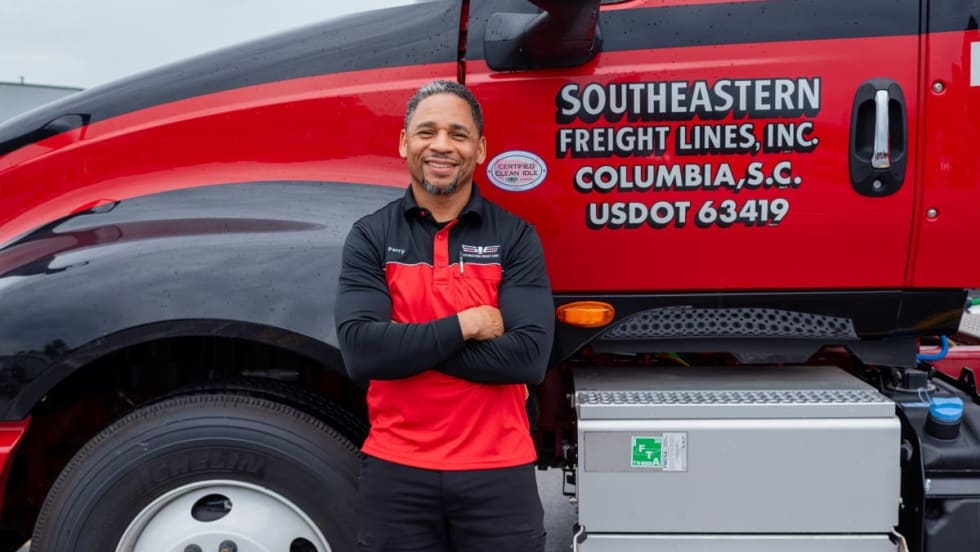
From One Generation of Drivers to the Next: How Mentorship Builds Safer Drivers
After three decades in trucking, Harold Perry shares what he's learned about driver safety, mentorship, and helping the next generation build confidence behind the wheel.
Read More →
Truck Drivers Need More Than Another Alert
Fleets have more visibility into truck health, safety events, and driver activity than ever. The next challenge is turning all that information into useful guidance for the person who has to decide what to do next.
Read More →
FMCSA Removes 110 Truck Driver Training Schools from Certified ELDT List
Federal regulators also are targeting more than 160 additional training providers and launching a nationwide audit of third-party CDL skills testers as part of a broader crackdown on trucking fraud.
Read More →
Hours of Service Pilot Programs: FMCSA Readies for 2027 Rollout
Two pilot programs could eventually reshape hours-of-service rules, giving truck drivers options to pause their 14-hour clock or use longer split sleeper rest periods.
Read More →
Medical Cards, English Proficiency Reshape Roadcheck Violations
Medical-card violations jumped to the top of the driver out-of-service list during CVSA’s 2026 International Roadcheck, while English-language proficiency violations appeared among the leading violations for the first time.
Read More →
Driver Trust Can Make or Break the Success of Fleet Safety Technology
New Teletrac Navman research suggests that onboarding, transparency about driver data, and positive feedback can play a significant role in how commercial drivers respond to safety and coaching technology.
Read More →
EEOC Sues KLLM Over Alleged Sex Discrimination in Driver Training
KLLM is facing a federal sex-discrimination lawsuit over policies the EEOC alleges put female truck driver trainees at a disadvantage.
Read More →
FMCSA Moves to Codify English Language Requirements for Commercial Drivers
By changing regulations on English-language proficiency requirements for commercial drivers, rather than relying on a guidance memo, the FMCSA said future administrations won't be able to walk back the Trump administration's stricter enforcement with just a memo.
Read More →
Drivers Put Western Star Trucks to the Test at Star Nation Experience
Watch to get an inside look at the Western Star trucks, technology, and community behind the Star Nation Experience 2026!
Read More →
Trump Administration Looks to Put More Veterans Behind the Wheel
The Freedom Haulers program pulls together existing and expanded programs at several federal agencies to recruit veterans to drive commercial heavy-duty trucks and cut the red tape for them to get a CDL, training, and employment.
Read More →