




Why Do Wheels Come Off Trucks?
We don't hear many reports of wheel separations anymore, but that doesn't mean we have solved the problem. Reliable estimates suggest unplanned separations still occur at a rate of probably several per day. Exact numbers are hard to determine because many incidents go unreported.

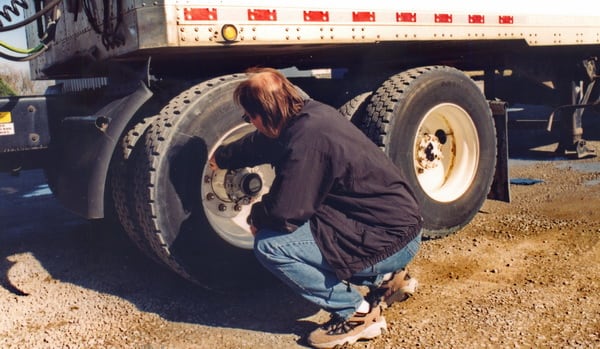
Drivers should be trained to inspect their wheels. Early detection can prevent a loose wheel from becoming a separation statistic.
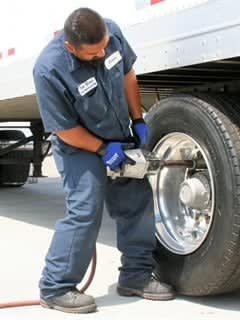
It's fine to run the nuts on using an impact wrench, but final fastener torque must be measured with a calibrated torque wrench.
We don't hear many reports of wheel separations anymore, but that doesn't mean we have solved the problem. Reliable estimates suggest unplanned separations still occur at a rate of probably several per day. Exact numbers are hard to determine because many incidents go unreported.
"We do not have much information about wheel off incidents," says William Schaefer, director of Vehicle Programs at the Commercial Vehicle Safety Alliance. "A lost wheel may not be discovered immediately by the vehicle operator and then when it is, it is fixed, providing no record for enforcement or research efforts. Also, even when a wheel is involved in a crash - whether with another vehicle or with pedestrians or property - the driver may not know it has happened and tracking the vehicle down could be a challenging forensic exercise."
The October issue of Heavy Duty Trucking features a in-depth look at solutions to wheel separations, including tips on bearing installation and wheel fastener tightening and installation procedures. Because of the limited space in our printed publication, there was not a lot of room for a broader discussion of the problem. In this edition of our monthly Tire & Wheel newsletter, we take a deep-dive into the issue of wheel separations, including some very good background on the problem and some innovative research into its causes.
The last time wheel separations came under serious scrutiny in this country was 1992. Following a rash of wheel separations in the fall of 1991 that left seven people dead, an extensive National Transportation Safety Board investigation concluded that "…the leading causes of wheel separations from medium and heavy trucks are improper tightening of wheel fasteners and bearing failure; both are the result of inadequate maintenance."
A series of recommendations issued by the NTSB was followed up by industry, including the Truck Trailer Manufacturers Association, the Society of Automotive Engineers, the Technology and Maintenance Council of the American Trucking Associations and others. Suppliers came to the table with innovative products and guidelines aimed at improving wheel installation and reducing wheel-separation incidents.
The NTSB report, available here, dealt more with solutions than the causes. In fairness, since 1992, policies and procedures have been developed to mitigate the problem, and information on wheel-end maintenance is easy to find. The recurring problems seem to rest with industry's reluctance in put in place rigorous maintenance procedures.
A few years after the series of incidents that prompted the NTSB investigation, the Province of Ontario experienced a series of fatal wheel separation events. The tragedies that occurred in 1995 prompted an investigation into the causes of wheel separation, and do date, some of the best research on the problem has come from Ontario.
A coroner's inquest, convened in October of that year, put forward 31 recommendations concerning wheel maintenance and inspection, chains of responsibility and legal accountability. Among the results of the inquest was a contentious absolute liability offence with fines of up to $50,000 to the carrier and driver, regardless of why a wheel might have separated.
The recommendations also mandated official investigation of each reported incident. From that, Ontario learned a great deal about the causes and was able to reduce the number of wheel separations quite dramatically.
The number of reported incidents dropped from 215 in 1997 to just 99 in 1998, with an average of 75 incidents per year between 1999 and 2003 (the most recent year for which figures are readily available). This decrease has been sustained up to the present time, but countless more wheel separations went - and continue to go - unreported.
Trends in wheel separation
In its investigation, officials in the Province of Ontario came up with some interesting statistics on wheel separation incidents. Research revealed that separation incidents were about even between tractor and trailer, with trailers representing about 6% more incidents than trucks.[PAGEBREAK]
Seasonality also appears to have been a factor, although hard conclusions about why remain elusive. Separation incidents reported in Ontario spiked to around 35 per month in January and February 1997 when the monthly average over the year was about 5 or 6. Fastener-related separation accounted for 25 of the recorded incidents while bearing related failures accounted for about 8 to 10. The following year, the seasonal increase was present, but with the heightened awareness of the problem, and after the training programs were in place, the numbers dropped to about half the previous year's numbers.
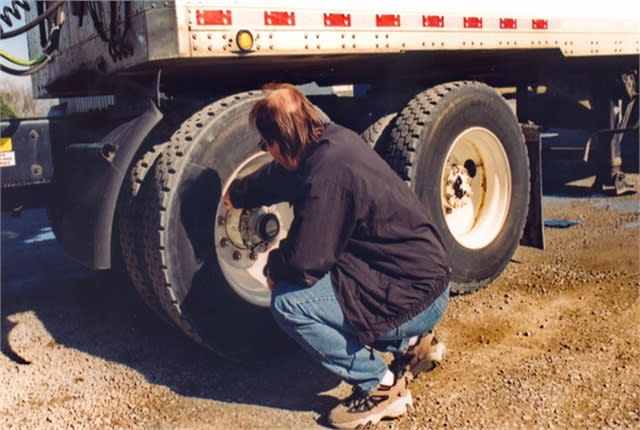
Drivers should be trained to inspect their wheels. Early detection can prevent a loose wheel from becoming a separation statistic.
In 643 incidents where the mode of failure was reported, failure of the wheel fasteners occurred in 65% of the incidents, while wheel bearings were the mode of failure in 26%.
Failure of the wheel itself or the axle spindle resulting in separations accounted for only 9% of the 643 incidents. Those types of failures are considered exceptions to the norm.
Of a group of 80 separation reports generated between 2000 and 2003 involving wheel fasteners, 66 or 83%, noted that the suspect wheel had recently been repaired. This turns out to be a critical observation.
One of Ontario's coroner's jury recommendations was a training and certification program for workers who remove or replace wheels on trucks, trailers and motor coaches. It's an offense in that province for a non-certified technician to install a wheel, and there is a sign-off procedure to document who did the work.
The training program covers, among many other things, proper wheel-nut torqueing procedures, which investigators had discovered was lacking in the province. Proper procedures include removing all rust and debris from mating surfaces, proper inspection of the fastening hardware and proper fastening, which means at the very least using a calibrated torque wrench rather than an impact wrench to tighten the lug nuts.
Investigations of many wheel-separations revealed that wheel nuts had worked lose due to lost clamping force attributed to material lodged between the wheel discs breaking free and/or fasteners damaged by over-torqueing. As we have noted, the number of reported separations has dropped since the training, certification and sign-off programs went into place. No longer, in Ontario, can just anyone grab an impact wrench go to town on a truck wheel.
The Ontario regulations also require a recently installed wheel to be retorqued after 50 to 100 miles. While many carriers and owner-operators say the requirement is burdensome, it appears to have contributed to a reduction in wheel separations.
Check out the October edition of Heavy Duty Trucking for more on the procedures and techniques for proper wheel-end maintenance.
You can read a very good synopsis of the events in Ontario in a report written by the Ontario Ministry of Transportation's Rob Monster. It's well worth 10 minutes of your time. You can down load it here.
Additional Wheel Separation Reports
More Drivers

Truck Drivers Need More Than Another Alert
Fleets have more visibility into truck health, safety events, and driver activity than ever. The next challenge is turning all that information into useful guidance for the person who has to decide what to do next.
Read More →
FMCSA Removes 110 Truck Driver Training Schools from Certified ELDT List
Federal regulators also are targeting more than 160 additional training providers and launching a nationwide audit of third-party CDL skills testers as part of a broader crackdown on trucking fraud.
Read More →
Hours of Service Pilot Programs: FMCSA Readies for 2027 Rollout
Two pilot programs could eventually reshape hours-of-service rules, giving truck drivers options to pause their 14-hour clock or use longer split sleeper rest periods.
Read More →
Medical Cards, English Proficiency Reshape Roadcheck Violations
Medical-card violations jumped to the top of the driver out-of-service list during CVSA’s 2026 International Roadcheck, while English-language proficiency violations appeared among the leading violations for the first time.
Read More →
Driver Trust Can Make or Break the Success of Fleet Safety Technology
New Teletrac Navman research suggests that onboarding, transparency about driver data, and positive feedback can play a significant role in how commercial drivers respond to safety and coaching technology.
Read More →
EEOC Sues KLLM Over Alleged Sex Discrimination in Driver Training
KLLM is facing a federal sex-discrimination lawsuit over policies the EEOC alleges put female truck driver trainees at a disadvantage.
Read More →
FMCSA Moves to Codify English Language Requirements for Commercial Drivers
By changing regulations on English-language proficiency requirements for commercial drivers, rather than relying on a guidance memo, the FMCSA said future administrations won't be able to walk back the Trump administration's stricter enforcement with just a memo.
Read More →
Drivers Put Western Star Trucks to the Test at Star Nation Experience
Watch to get an inside look at the Western Star trucks, technology, and community behind the Star Nation Experience 2026!
Read More →
Trump Administration Looks to Put More Veterans Behind the Wheel
The Freedom Haulers program pulls together existing and expanded programs at several federal agencies to recruit veterans to drive commercial heavy-duty trucks and cut the red tape for them to get a CDL, training, and employment.
Read More →
Putting Mack’s Command Steer to the Test
A test drive of Mack’s Command Steer active steering system evaluates how it can make truck driving easier and less tiring.
Read More →