




Navistar Details Product Changes, Thinking Behind Emissions Strategy Change
Navistar will be taking orders within a month for International ProStar+ tractors with a Cummins 15-liter ISX engine and Cummins selective catalytic reduction aftertreatment to meet EPA 2010 emissions regulations. By next May it plans to have available a 13-liter MaxxForce engine with Cummins SCR. The company will roll out both engines in other models in staggered launches throughout next year
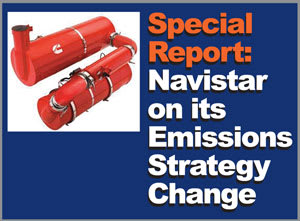
Navistar chose Cummins Aftertreatment Solutions for a fast-to-market solution.
Navistar will be taking orders within a month for International ProStar+ tractors with a Cummins 15-liter ISX engine and Cummins selective catalytic reduction aftertreatment to meet EPA 2010 emissions regulations. By next May it plans to have available a 13-liter MaxxForce engine with Cummins SCR. The company will roll out both engines in other models in staggered launches throughout next year.
Company officials discussed their change in emissions strategy one-on-one in meetings with trucking journalists at their Lisle, Ill., headquarters.
The company for several years has been working to get its MaxxForce 13-liter engine to meet the Environmental Protection Agency's 2010 emissions limits of 0.2 grams per brake horsepower-hour of NOx, using only its In-Cylinder Technology without aftertreatment. Unsuccessful and facing a situation where it's running out of emissions credits and paying out massive amounts in fines to the EPA, Navistar recently announced it will add urea-based aftertreatment to its 13-liter engine, using proven Cummins Emissions Solutions products, as well as offering the Cummins ISX 15-liter.
Navistar says the combination of its MaxxForce engines with Cummins SCR aftertreatment, which it's calling In-Cylinder Technology Plus (ICT+), will not only meet 2010 EPA emissions regulations, but also will position the company to meet new federal greenhouse gas rules in advance of 2014 and 2017 deadlines.
The company will gradually roll out the ICT+ and the Cummins ISX 15 in other models throughout next year. Here's the planned timing:
- January 2013: ProStar+ with ISX 15 (limited production will start in November/December)
- May 2013: ProStar+ with MaxxForce 13 with ICT+ (limited production in March/April)
- April 2013: International 9900 with ISX 15
- June 2013: PayStar 5900 SBA with ISX 15
Other vehicles will get the MaxxForce 11/13 with ICT+ (WorkStar, TranStar, LoneStar, etc.) in staggered launches starting in May 2013.
Navistar said its current products will continue for the rest of the year using a combination of previously earned emissions credits and non-conformance penalties for trucks sold in some states.
Although company officials said they see no problems in continuing to get engines to customers in the interim, they're also aware that they need to move pretty quickly.
"One of the things that might concern people is, that's a big development program," said David Majors, vice president of product development. "We aren't going to wake up tomorrow and flip the switch. So we've been very thoughtful about the way we're going to plan this and purposeful in execution."
However, he said, the transition isn't as difficult as you might think.
Navistar officials emphasized that the MaxxForce engine itself will not change. The Cummins SCR system will be added, including DEF tanks. This does require rearranging some components under the hood and on the chassis. The aftertreatment system will be located under the passenger side step on most models, while the diesel tanks will be pushed backward on the chassis. Moving the tanks back actually will help a little with front axle loading.
"What this really is, is taking the engine we have today, not changing one single part, not even a bolt," explained Tim Shick, vice president, North American engine sales, noting that the company has built 40,000 of the 13-liter MaxxForce engines.
Well, actually, said Majors, there is one part that's changing - a single sensor.
Beyond that, other than the addition of the aftertreatment system and some wiring and air line routing changes, the primary change will be in the software.
Navistar engineers are adjusting the combustion chemistry, the way the engine burns fuel, to be compatible with the Cummins aftertreatment system. Fuel pressure, turbo boost, amount of cooled-exhaust-gas recirculation, engine operating temperature, etc., will be calibrated to work with the SCR technology. The company has spent the last several years working to calibrate those items to help cut NOx emissions, so it has plenty of experience, Shick said.
"We are cutting back on EGR flow a little bit. As the EGR flow goes down, the use of urea will offset that to bring about full emissions compliance."
Before we see the MaxxForce ICT+, however, the company chose to move first on getting the Cummins ISX working in the ProStar+. The Cummins ISX engine was the only one available in the ProStar when it first launched, so adapting the ProStar+ to add the ISX and SCR is relatively simple. Engineers already have retrofitted a couple of ProStars with the ISX 15 and the SCR aftertreatment as validation trucks, or "mules," and have been running them successfully.
Navistar officials pointed out that contrary to what some people seem to believe, the company did not cut ties with Cummins when it decided to go with an in-cylinder solution to 2010 emissions. Navistar built 11,000 trucks with Cummins engines in them last year for export markets including Mexico and Latin America.
Officials are still confident that its recent focus on a market shift to 13-liter engines for many on-highway applications is the right one.
"Our prime path will still be the 13-liter," said Jack Allen, president of North America Truck and Parts for Navistar, showing a chart illustrating how the 15-liter market has come down and leveled out at about half 15-liter and half 11- to 13-liter. Paccar's earnings report shows a similar trend, he said.
"It's our own engine, and we're confident on where the market is going to go on 13 liters."
Navistar hasn't yet decided whether it will continue to develop its own 15-liter MaxxForce engine, or rely only on the Cummins ISX15 to satisfy customers who require more power.
Why did Navistar choose the tougher road to begin with, instead of just using SCR that built on what had already been proven in Europe?
Allen explained that the company was trying to help its customers meet emissions regulations less expensively and at the same time give Navistar a competitive advantage.
Noting that customers today are spending $20,000 more for a heavy truck than they did just a few years ago, thanks to emissions and safety regulations and other factors, Allen explained, "What we tried to set out to do was, how can we position ourselves as a company geared toward making our customers more successful?"
Navistar planners saw a possible opportunity to gain a competitive advantage in designing an engine that did not use selective catalytic reduction aftertreatment, with its additional weight, complexity and need for drivers to add a second liquid.
"The only thing we ran out of here was time," Allen said. "We ran out of credits before we could get to 0.2."
Even though Navistar has had to change its strategy, Allen believes the company still can see a competitive advantage, and customers can see a benefit, because of the knowledge the company has gained along its in-cylinder-technology detour. Because Navistar already had been able to design a lower-NOx-producing engine without SCR that was competitive with SCR-equipped engines in terms of fuel economy, Allen said, adding SCR should allow it to get a leg up in fuel economy.
"We think our system, ICT+, is going to provide the best of both worlds," Allen said.
In order to meet 2014 and 2017 emissions standards, officials said, all engine makers will be looking to further fine-tune what's going on inside the combustion chamber to improve fuel economy and cut greenhouse gas emissions.
"We're one of the leaders in fuel economy," Shick said. "We intend to retain that leadership going forward and it will frankly give us a leg up on 2014 and 2017, because we believe that capability of mixing EGR with SCR is something we've got a lot more experience in going forward than the other folks."
As we move toward on-board diagnostics requirements that are needed starting in 2013 as well as 2014 and 2017 GHG standards, Majors said, the engine "control strategy has to be a lot faster and a lot more accurate. We've already done that hard work."
Meanwhile, Navistar officials noted, the EPA is close to releasing a revised proposal on whether or not Navistar may pay penalties on engines that don't meet clean air standards. The proposal is currently under review at the White House Office of Management and Budget.
Navistar officials acknowledged that after several years of sermonizing on the evils of SCR and diesel exhaust fluid, its change of strategy will mean rebuilding trust and a lot of education with dealers and customers.
Majors admitted it is a challenge. He said the "truths are still relevant," referring to drawbacks of using diesel exhaust fluid such as the need to keep it from freezing or overheating and potential problems with DEF quality as have been seen in Europe. However, he said, "the industry has proven itself, the [DEF] infrastructure is there."
"Yeah, we've got fences to mend and we've got to shore some things up," Allen said, "but we don't have to go create an aftertreatment solution. We can use something proven in the marketplace. We need to get to market fast and we need to turn around our market position. So we said, let's use the ISX to do that. We wouldn't have done it a few years ago, but ... that's a fast way to get to market."
Officials also suggested that SCR itself has matured in the years since the company made the decision to avoid it.
"We've gone much deeper into EGR than anybody has, arguably," Shick said. "We know the touchpoints, we know the critical things we have to control, and we have much more flexibility to mesh those two. And while we were doing that, SCR technology was maturing and developing as well."
Some in the industry have reacted with attitudes of "it's about time" or "told you so." However, Navistar officials said, they have many customers who were disappointed by the news - especially vocational customers, for whom packaging the additional aftertreatment equipment on the chassis can be a challenge. But it's one Navistar engineers are already working on.
With its struggles to meet EPA emissions standards and change in emissions strategy, a $172 million loss in the second quarter, a probe from the Securities and Exchange Commission and drops in its stock price, rumors and speculation have abounded about the fate of Navistar, including talk of a possible takeover by Volkswagen or investor Carl Icahn. Navistar even put a "poison pill" takeover defense in place in June.
A recent Forbes article, titled "Death by Hubris?" asked if the go-it-alone strategy the company adopted to meet 2010 emissions regulations would lead to the demise of the company, saying "Navistar had done worse than pick the diesel version of Betamax when the rest of the world was going to VHS."
When asked about the rumors, Jack Allen noted with a chuckle, "If you'd listened to the rumors in the 30-some-odd years I've been here, we'd have been bought and sold eight times."
On a more serious note, he said, the biggest thing Navistar has done to address the uncertainty about the future of the company was go to the debt market and gain access to borrow a billion dollars.
"The point is, we don't need a billion dollars," Allen said. "The rumors of our demise are exaggerated. But we did it to make sure we had the liquidity to manage through this transition. Because we don't know what's out there. The industry order intake the last couple of months has been nothing short of dismal. We did it to ensure financial stability for our investors, for our employees, for our customers. We're only going to take it if we need it."
Related Stories:
8/3/2012 - Navistar's Engine Plans Include Cummins, but Its Financial Losses Continue
8/1/2012 - Don't Count Navistar Out
6/8/2012 - Navistar Reports Worse-Than-Expected Results, Makes Management Changes
3/23/2009 - Navistar, Competitors Continue Sparring Over SCR
More Equipment
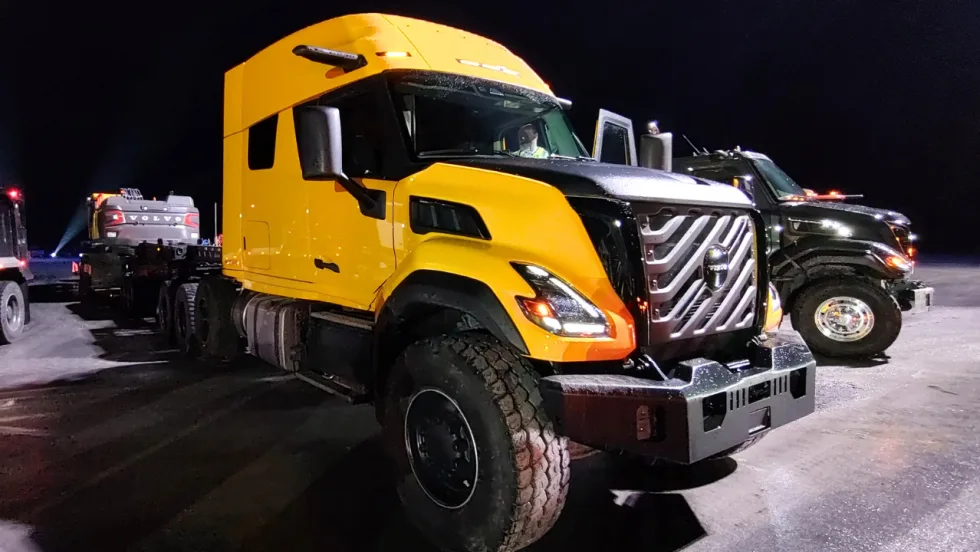
Volvo Unveils New VNX Heavy-Haul and Vocational Truck
Volvo Trucks has launched the VNX, a new vocational truck also available as a tractor in day cab and two sleeper configurations, with one heavy-haul model. The Volvo VNX is powered by Volvo's D13 platform, which delivers up to 540 horsepower and 1,950 pound-feet of torque and is EPA 2027-compliant.
Read More →
How GP Transco Cuts Trucking Fuel Costs, a Tenth of a Gallon at a Time
What’s another tenth of a mile per gallon worth? GP Transco shares how equipment upgrades and driver coaching turn small gains into meaningful fuel savings.
Read More →
Electric Yard Tractors Move Beyond Pilots
Operating-cost savings have overtaken sustainability goals as the leading reason surveyed fleets are adopting battery-electric terminal tractors, according to new NACFE research.
Read More →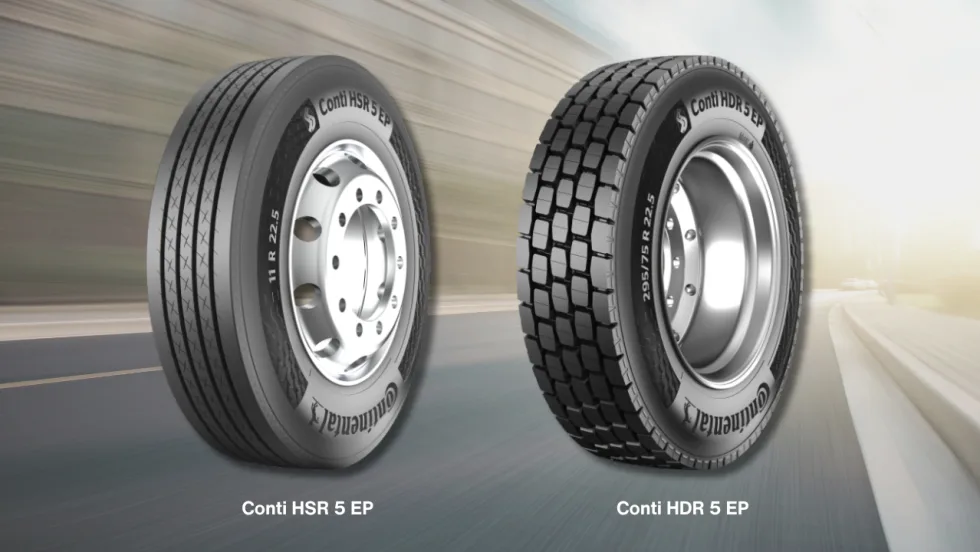
Continental Introduces New Regional Truck Tires
Continental says its new Generation 5 steer and drive tires for regional operations offer longer tread life, with estimated mileage gains of 22% and 19%, respectively.
Read More →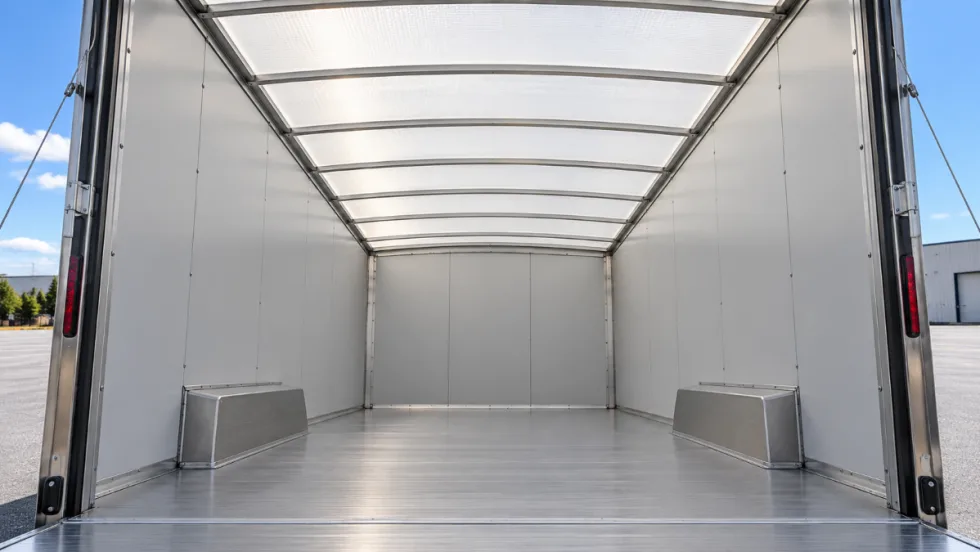
Tekmodo Introduces CargoBright Brand for Translucent Trailer Roofs
CargoBright is designed to diffuse daylight across the cargo area while performing as a working vehicle roof.
Read More →
Fleet Economics Shape Electric Truck Outlook
ACT Research expects costs, charging infrastructure, and technology improvements to drive zero-emission commercial vehicle adoption as federal regulations and incentives retreat.
Read More →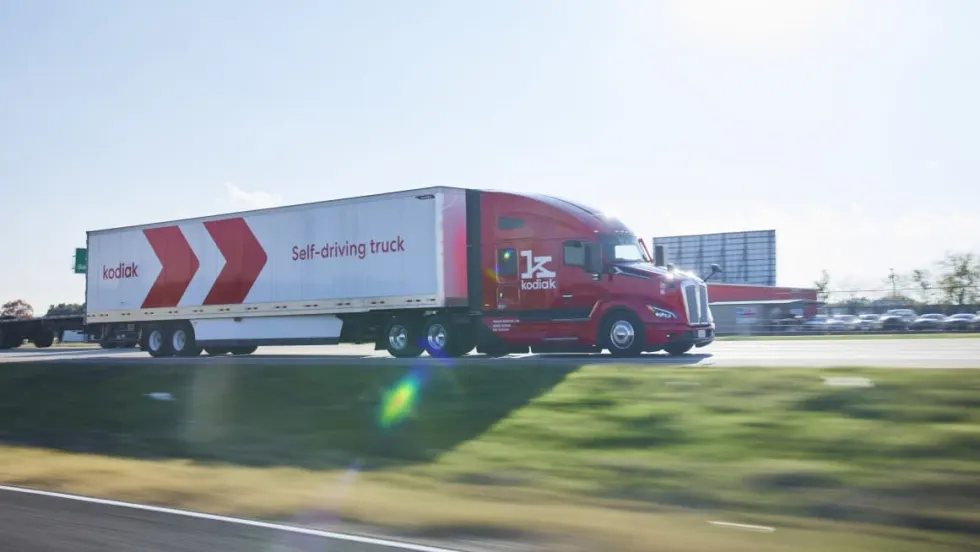
Kodiak Targets Dallas–Houston for Driverless Trucks
The company says its autonomous trucks are completing the I-45 run without a safety observer taking control. It plans to remove the observer by the end of 2026.
Read More →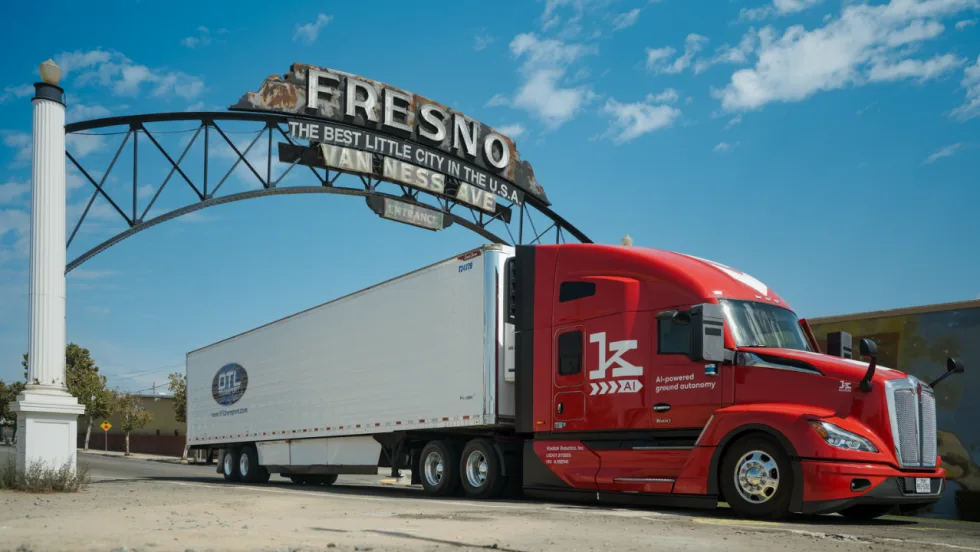
Kodiak Hauls Produce in California Autonomous Truck Pilot
Kodiak AI and DTL Transport have begun hauling produce between Fresno and Los Angeles under California’s new rules for testing heavy-duty autonomous trucks. A safety driver remains behind the wheel.
Read More →
Used-Truck Remarketing Math Is Changing
Used-truck value is no longer just a concern at trade-in. Decisions made throughout a truck’s first life can influence what it’s worth years later.
Read More →
How Volvo Updated Its D13 for EPA 2027 [Watch]
Volvo’s updated D13 promises lower emissions without sacrificing performance or fuel economy. Take a closer look at what changed inside the engine in this HDT Spotlight video.
Read More →